Steady-State Conduction with Internal Heat Generation
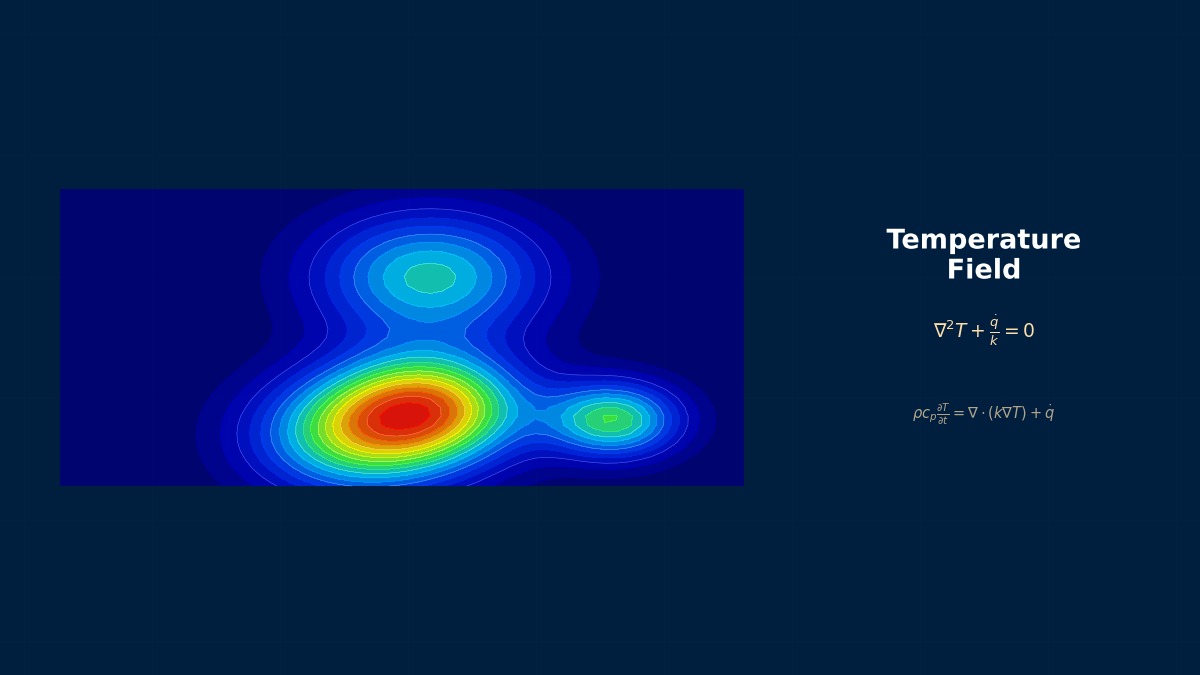
Steady-State Conduction with Internal Heat Generation: Theoretical Foundations
Physics of Internal Heat Generation
Professor, in what situations does internal heat generation occur?
It appears in various forms such as Joule heating from electrical resistance, decay heat from nuclear fuel, and chemical reaction heat. All are expressed as the volumetric heat generation rate $\dot{q}_v$ [W/m$^3$].
Governing Equation for a Flat Plate
The governing equation for a flat plate (thickness $2L$, both surfaces at the same temperature $T_s$) with uniform internal heat generation $\dot{q}_v$ is
The solution is a parabolic distribution.
The center temperature is $T_{\max} = T_s + \dot{q}_v L^2 / (2k)$.
It makes intuitive sense that it becomes a parabola. The center is the hottest.
The important point is that $T_{\max} \propto L^2$. Doubling the plate thickness quadruples the center temperature rise. Making it thinner is the most effective cooling measure.
Case of a Cylinder
For a cylinder of radius $R$ (outer surface temperature $T_s$)
Center temperature $T_{\max} = T_s + \dot{q}_v R^2 / (4k)$. Compared to $2k$ for the plate, it's $4k$ for the cylinder, meaning the cylinder cools more efficiently.
Case of a Sphere
For a sphere (radius $R$)
The denominator is even larger at $6k$. The larger the surface area/volume ratio, the higher the cooling efficiency.
| Shape | $T_{\max} - T_s$ | Surface Area/Volume |
|---|---|---|
| Flat Plate | $\dot{q}_v L^2/(2k)$ | $1/L$ |
| Cylinder | $\dot{q}_v R^2/(4k)$ | $2/R$ |
| Sphere | $\dot{q}_v R^2/(6k)$ | $3/R$ |
So the sphere has the best cooling efficiency.
That's because a sphere has the maximum surface area for the same volume. However, the story becomes a bit more complex when convection conditions are included.
Governing Equation for Internal Heat Generation
The steady-state heat conduction equation with internal heat generation is ∇²T + q̇/k = 0. The heat generation density spans over three orders of magnitude, from nuclear fuel pellets (q̇≈10⁸ W/m³) to Li-ion battery cells (q̇≈10⁵ W/m³). The importance of this equation surged in the 1940s with nuclear reactor design.
Computational Methods for Steady-State Conduction with Internal Heat Generation
Implementation in FEM
How do you set up internal heat generation in FEM?
Set the volumetric heat generation rate for the elements. In FEM formulation, the following is added to the element heat load vector:
where $N_i$ is the shape function. For uniform generation, $\dot{q}_v \cdot V_e / n_{\text{node}}$ is equally distributed to each node.
How do you set it in Ansys?
Set it using the BFE (Body Force on Element) command.
```
BFE,ALL,HGEN,,1e6 ! Apply 1e6 W/m3 to all elements
```
In the Workbench GUI, apply the Internal Heat Generation condition to the Body. In Abaqus, set it with *DFLUX, BF$(\dot{q}_v)$.
Handling Non-Uniform Heat Generation
In real problems, the heat generation rate is often spatially non-uniform.
| Example | Heat Generation Distribution | Modeling |
|---|---|---|
| Electrical Resistor | Uniform ($I^2R/V$) | Constant |
| Nuclear Fuel Rod | Cosine distribution (axial) | Table/Function input |
| Electronic Circuit Board | Local (IC parts only) | Define Body per component |
| Induction Heating | Concentrated at skin depth | Coupled with electromagnetic analysis |
Induction heating requires coupling with electromagnetic analysis, I see.
Calculate the eddy current density using Ansys Maxwell or COMSOL AC/DC module, then input $\dot{q}_v = J^2/\sigma$ (Joule heating density) into the thermal analysis. In Ansys, data transfer is automated via Workbench's coupling function.
Mesh Considerations
In internal heat generation problems, if the mesh is too coarse, temperature peaks get averaged out.
So sufficient mesh is needed to accurately capture the center temperature.
Correct. Concentrate mesh in areas with the maximum temperature gradient (near boundaries). For a cylinder, the gradient is zero near the center so it can be coarse, but the area near the outer surface should be fine.
Analytical Solution for Heat Generation in a Flat Plate
For a flat plate of thickness 2L with uniform generation q̇, the center temperature is Tmax = Ts + q̇L²/(2k). For a 10mm thick silicon wafer (k=150 W/m·K) with q̇=10⁶ W/m³, the center temperature rise is only 0.08K—a calculation example showing its high uniformity.
Steady-State Conduction with Internal Heat Generation in Practice
Application Example: Joule Heating in an Electrical Wire
I'd like to see a concrete calculation example.
Let's consider an AWG18 copper wire (diameter 1.02mm, $\rho_e = 1.7 \times 10^{-8}$ Ωm) with a 10A current.
| Parameter | Value |
|---|---|
| Cross-sectional area $A$ | $8.17 \times 10^{-7}$ m$^2$ |
| Resistance $R/L$ | 0.0208 Ω/m |
| Heat generation $I^2R/L$ | 2.08 W/m |
| $\dot{q}_v$ | $2.55 \times 10^6$ W/m$^3$ |
| $T_{\max} - T_s$ | $\dot{q}_v R^2/(4k) = 0.0016$℃ |
It only rises by 0.0016℃?
That's because copper's $k = 398$ W/(m K) is very large. The temperature difference is dominated not by the wire interior but by the insulation and external convection. In other words, the important factor in wire thermal design is the outer surface temperature of the insulation; the temperature distribution inside the copper can be considered almost uniform.
Application Example: Nuclear Fuel Rod
For a nuclear reactor fuel rod (UO$_2$ pellet, $k = 3$ W/(m K), $\dot{q}_v = 4 \times 10^8$ W/m$^3$, radius 5mm)
A 833℃ temperature difference? That's on a completely different scale.
That's because UO$_2$ has low $k$ and $\dot{q}_v$ is orders of magnitude larger. Ensuring the fuel center temperature does not exceed the melting point (about 2800℃) is the core of safety design.
Verification Points
Verify internal heat generation problems by checking the following.
- Shape of temperature distribution: Parabolic distribution for uniform generation
- Location of maximum temperature: Is it at the symmetry center?
- Energy balance: Total heat generation $\dot{q}_v \times V$ = Heat dissipation from surfaces
- Comparison with theoretical solution: Check calculations for simple shape parts
Checking the energy balance seems the most reliable.
In Ansys, check the Reaction Summary in the t
Related Topics
Experience the theory firsthand with the interactive simulator for this field
All Simulators