Spectral Radiometric Analysis
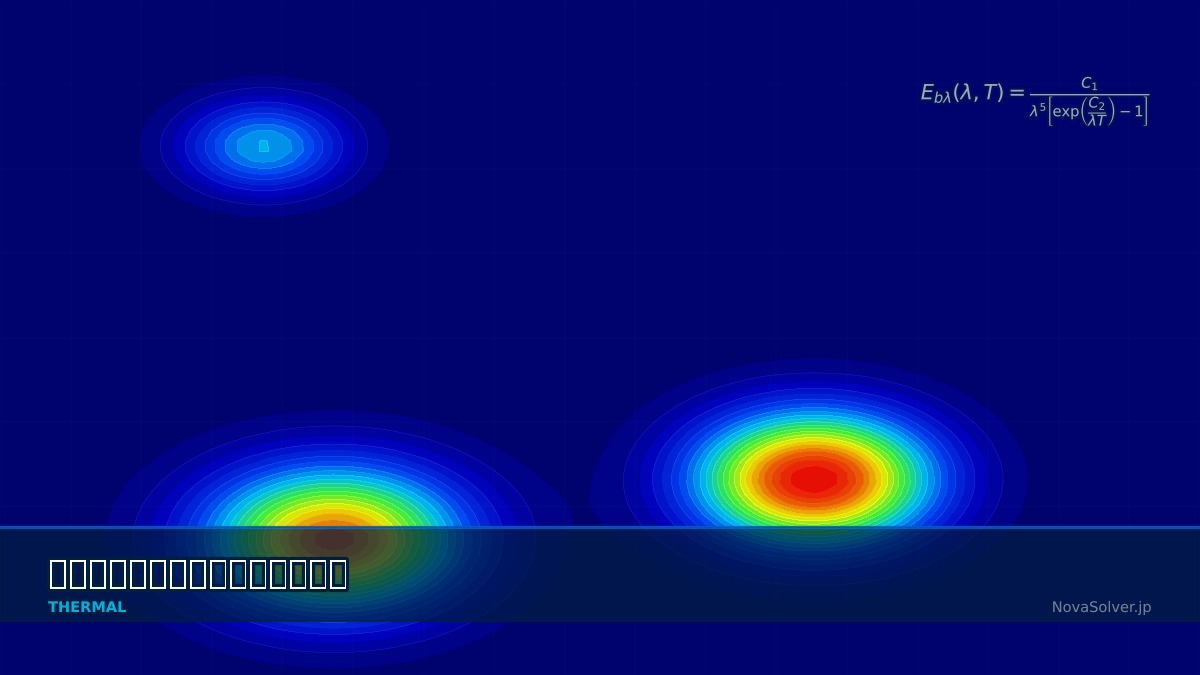
Spectral Radiometric: Theoretical Foundations
Why Consider Each Wavelength?
Why is it necessary to consider spectral radiation wavelength by wavelength? Wouldn't it be enough to just look at the total radiant energy using the Stefan-Boltzmann law?
Good question. Roughly speaking, it's because in many engineering applications, "how much light of which wavelength is emitted/absorbed" is fundamental. There are many cases where the gray body approximation, which treats all wavelengths together, lacks sufficient accuracy.
What are some specific cases?
Let me give three typical examples.
- Solar Cell Design: Silicon solar cells have a bandgap of 1.1eV, which corresponds to a wavelength of about 1.1μm. Light with a longer wavelength than this cannot eject electrons, so its energy cannot be converted. To calculate what percentage of the solar spectrum is contained below this wavelength, knowledge of spectral radiation is essential.
- Infrared Sensors / Thermography: The atmospheric transmission windows differ in the mid-infrared (3–5μm) and far-infrared (8–14μm) bands. To select the sensor's sensitivity wavelength range according to the target temperature range, you must first know the spectral radiation characteristics of the object.
- Selective Emitter/Collector Surface Design: Solar thermal collectors use "selective absorber surfaces" that absorb sunlight (short wavelength) well and suppress their own thermal radiation (long wavelength). This involves intentionally creating a wavelength-dependent emissivity of ε≈0.95 at short wavelengths and ε≈0.05 at long wavelengths, which cannot be designed with the gray body approximation.
I see... So for solar cells, light with a wavelength above 1.1μm is wasted. So what percentage of sunlight can silicon actually use?
Using the band emissivity $F(0 \to \lambda T)$ to calculate, the fraction of the Sun's (surface temperature 5778K) total radiant energy contained at wavelengths below 1.1μm is about 75%. The remaining 25% is at wavelengths too long for silicon to convert. Furthermore, there are quantum efficiency and recombination losses even on the short-wavelength side, so the theoretical maximum efficiency becomes about 33% (Shockley-Queisser limit). This is where spectral radiation analysis comes into play.
Planck's Radiation Law
What is the fundamental equation for spectral radiation?
The most fundamental is Planck's radiation law. The spectral emissive power (radiant power per unit area, per unit wavelength) of a blackbody at temperature $T$ at wavelength $\lambda$ is:
Where:
- $C_1 = 2\pi hc^2 = 3.742 \times 10^{8} \ \text{W} \cdot \mu\text{m}^4/\text{m}^2$ (First radiation constant)
- $C_2 = hc/k_B = 1.439 \times 10^{4} \ \mu\text{m} \cdot \text{K}$ (Second radiation constant)
- $h$: Planck constant, $c$: speed of light, $k_B$: Boltzmann constant
Since $\lambda^5$ is in the denominator, it rises sharply on the short-wavelength side and decays gently on the long-wavelength side. So the graph looks like a bell-shaped curve?
That's right. When temperature increases, two things happen: (1) The entire curve shifts upward (total radiant energy increases), (2) The peak position shifts to shorter wavelengths. The visible example of this peak shift is heating iron: it glows dark red → orange → white.
Wien's Displacement Law
You said the peak shifts to shorter wavelengths as temperature increases, but what does that look like quantitatively?
Differentiating Planck's law with respect to $\lambda$ and setting it to zero yields Wien's displacement law:
Wow, that's a very simple formula! I'd like to try calculating it for specific temperatures.
Let's calculate a few examples.
| Object | Temperature T [K] | λmax [μm] | Wavelength Region |
|---|---|---|---|
| Solar surface | 5778 | 0.50 | Visible light (green) |
| Incandescent bulb filament | 2800 | 1.04 | Near-infrared |
| Molten iron | 1800 | 1.61 | Near-infrared |
| Human body | 310 | 9.35 | Far-infrared |
| Room temperature wall | 300 | 9.66 | Far-infrared |
| Liquid nitrogen | 77 | 37.6 | Extreme far-infrared |
The filament of an incandescent bulb (2800K) has its peak near 1μm in the near-infrared. The energy contained in the visible range (0.4–0.7μm) is only about 10% of the total. That's why 90% of the electrical energy in an incandescent bulb is wasted as "heat"—this is precisely the reason they've been replaced by LEDs.
What, 90% of an incandescent bulb is infrared! That's immediately clear when you think about Wien's displacement law. The fact that the human body emits infrared at about 10μm is also directly connected to why thermography uses sensors in the 8–14μm band.
Exactly. In engineering design, you use Wien's law to quickly estimate: "What is the object's temperature? → What is its peak wavelength? → What wavelength band of sensors or materials are needed?" This is the first step in spectral radiation.
Band Emissivity F(0→λT)
How do you find the energy for just a specific wavelength range? For example, "radiant energy only in the visible light band of 0.4–0.7μm".
That's where band emissivity (blackbody radiation function) $F(0 \to \lambda T)$ comes in. It is defined as:
$F$ takes a value between 0 and 1 and is uniquely determined as a function of $\lambda T$. The fraction of radiant energy contained in the band from wavelength $\lambda_1$ to $\lambda_2$ is:
Can this $F$ value be obtained analytically?
It doesn't have a closed analytical form, but by substituting $\xi = C_2/(\lambda T)$, it can be expressed as an infinite series:
In practice, sufficient accuracy is obtained with just the first few terms of the series (n=1~3). Let's put some representative values in a table:
| $\lambda T$ [μm·K] | $F(0 \to \lambda T)$ | Application Example |
|---|---|---|
| 1000 | 0.000321 | UV region evaluation at high temperatures |
| 2000 | 0.0667 | Visible light lower limit (equivalent to 0.35μm for Sun T=5778K) |
| 2898 | 0.250 | Up to peak wavelength (25% of total) |
| 4000 | 0.481 | Visible light upper limit (equivalent to 0.69μm for Sun T) |
| 6000 | 0.738 | Near-infrared region evaluation |
| 10000 | 0.914 | Up to mid-infrared region |
| 50000 | 0.9995 | Almost all wavelengths |
For example, the energy ratio of the visible light band (0.4–0.7μm) in sunlight (5778K) is $F(0 \to 0.7 \times 5778) - F(0 \to 0.4 \times 5778) = F(0 \to 4045) - F(0 \to 2311)$ ≈ 0.491 − 0.124 = 0.367 (about 37%).
So visible light is less than 40% of solar energy. The remaining 60% is distributed in UV and infrared... With this table, you can even get a rough estimate by hand calculation!
Spectral Emissivity and Real Surfaces
So far we've talked about blackbodies, but what about actual materials?
Real surfaces are represented using spectral emissivity $\varepsilon_\lambda(\lambda, T)$:
The total emissivity $\varepsilon(T)$ across all wavelengths is a weighted average using the spectral emissivity:
The important point is that the total emissivity becomes temperature-dependent. Even if the spectral emissivity $\varepsilon_\lambda$ itself doesn't change much with temperature, because the Planck distribution's peak shifts with temperature, the total emissivity changes with temperature.
Let's give a concrete example. Glass has $\varepsilon_\lambda \approx 0.05$ (almost transparent) in the visible band (0.4–0.7μm), but it jumps to $\varepsilon_\lambda \approx 0.95$ in the infrared band (above 5μm). This is the physical cause of the greenhouse effect—sunlight (short wavelength) passes through glass, but the infrared (long wavelength) radiated by indoor objects is absorbed by the glass and re-radiated indoors.
Does Kirchhoff's law $\varepsilon_\lambda = \alpha_\lambda$ (spectral emissivity = spectral absorptivity) hold here as well?
Under thermal equilibrium, $\varepsilon_\lambda = \alpha_\lambda$ holds strictly for each wavelength and direction. However, note: the equality of total emissivity and total absorptivity across all wavelengths ($\varepsilon = \alpha$) is limited to cases where the irradiation spectrum and the self-emission spectrum have the same shape. For a surface receiving sunlight, the incident spectrum is at 6000K and the self-emission spectrum is at 300K, so generally $\varepsilon \neq \alpha_{\text{solar}}$. Selective absorber surface design precisely utilizes this inequality.
Shockley and Queisser, Who Determined the Solar Cell Limit
In 1961, Shockley and Queisser used spectral radiation theory to derive the theoretical maximum efficiency of a single-junction solar cell as 33.7%. Photons below the bandgap $E_g$ are unusable due to insufficient energy, and photons significantly above $E_g$ have excess energy that becomes heat. This "double loss" cannot be derived without understanding spectral radiation. The design of multi-junction tandem cells where each layer handles a different bandgap (e.g., GaInP/GaAs/Ge triple-junction achieving over 46% efficiency) is essentially an optimal partitioning problem of the band emissivity $F(0 \to \lambda T)$.
Computational Methods for Spectral Radiometric
Wavelength Band Model
When actually solving spectral radiation in CAE, do you treat wavelength continuously?
Treating a continuous spectrum exactly would be computationally prohibitive, so in practice, the Wavelength Band Model is used. The spectrum is divided into $N$ bands, and within each band, the radiative properties are assumed constant.
How many bands $N$ should be used? I understand more bands give better accuracy, but...
If the object's spectral emissivity $\varepsilon_\lambda(\lambda)$ is smooth, N=5~10 is often sufficient. If there are boundaries where emissivity changes sharply (e.g., near the cutoff wavelength of a selective absorber), align band boundaries there and use about 20 bands. Ansys Fluent's DO method supports up to 20 bands.
Tips for band division:
- Finely divide wavelength regions where emissivity changes significantly.
- Finely divide wavelength regions where radiant energy is concentrated (near the Planck distribution peak).
- Make bands coarse, or omit, wavelength regions with almost no radiant energy.
Weighted Sum of Gray Gases Model (WSGGM)
Gas radiation (like CO$_2$ and H$_2$O) also needs to be considered wavelength by wavelength, right? Gas spectra seem complex with line spectra...
Exactly. Gas spectra consist of tens of thousands of absorption lines, so solving them line-by-line (Line-by-Line method) is astronomically expensive computationally. Therefore, in practice, the Weighted Sum of Gray Gases Model (WSGG) is used.
The idea is to approximate the real gas as a hypothetical "mixture of gray gases". Each gray gas $j$ has an absorption coefficient $\kappa_j$ and a weight $a_j(T)$:
Where $p$ is the gas partial pressure, $s$ is the path length. $j=0$ corresponds to the transparent window ($\kappa_0=0$).
How are the weights $a_j(T)$ determined?
They are determined by performing Line-by-Line calculations from high-precision spectral databases like HITRAN or HITEMP and fitting the results with polynomials. Smith's WSGGM (1982) and Johansson & Lallemant's improved version are widely used. Coefficient tables for different temperature ranges and $\text{CO}_2/\text{H}_2\text{O}$ mixing ratios are publicly available and are built into Fluent and STAR-CCM+.
Combination with Monte Carlo Method
Do you use Monte Carlo ray tracing for spectral radiation, the same as for regular radiative heat transfer?
Yes. The Monte Carlo method naturally extends to spectral radiation. For each ray particle, you:
- Sample a wavelength band probabilistically from the Planck distribution at the surface temperature;
- Sample a direction from the surface.
- Trace the ray and track absorption/emission at each band wavelength;
- Repeat for many rays (typically millions) to converge.
The main advantage is geometric flexibility—you can handle complex geometries, diffuse and specular reflections, and participating gases simultaneously. The main disadvantage is long compute time. For small problems (< 1 million cells), Monte Carlo is becoming popular. For large simulations, the band model is still more practical.