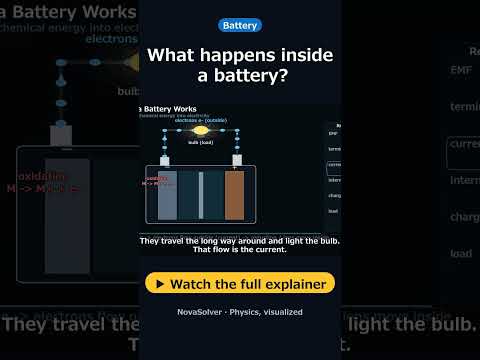
Enter load power, daily usage hours, backup days, and DOD to instantly calculate required battery capacity (Ah/kWh). Supports Li-ion, Lead-Acid, and LiFePO4 with temperature correction.
Parameters
Load Power P500 W
Daily Usage Hours8 h
Autonomy (Backup Days)3 days
DOD (Depth of Discharge)0.80
System Voltage48 V
System Efficiency η0.95
Temperature25 °C
Battery Type
Battery Bank Sizing — Live Simulation
Live Readings
—
Required Capacity [Ah]
—
State of Charge SOC [%]
—
Remaining Autonomy [days]
—
Usable Energy [kWh]
Design Results
—
Total Capacity [kWh]
—
Standard Cell Count
—
Estimated Cost [10,000 JPY]
—
Cycle Life
—
Temperature Correction Factor
—
Reference Capacity C [Wh]
—
Theory & Key Formulas
Required capacity (energy): C = E_daily × days ÷ (DoD × η); required Ah = C ÷ V
E_daily = P × h (daily energy consumption). Runtime = usable Wh ÷ load power. Apply the temperature correction factor k_temp to estimate effective capacity.
Verification example: E_daily=500W×8h=4000Wh, days=3, DoD=0.8, η=0.95 → C≈15,789 Wh, or about 329Ah at 48V.
What is Battery Sizing?
🙋
What exactly is "battery sizing" and why can't I just buy the biggest battery I can afford?
🎓
Basically, battery sizing is calculating the minimum capacity needed to power your devices for a required time. An oversized battery is a waste of money and space, while an undersized one fails when you need it most. In practice, you balance load, backup time, and battery health. Try moving the "Backup Days" slider above from 1 to 3 days—you'll see the required capacity triple!
🙋
Wait, really? So if my load is 100W for 5 hours a day, I don't just need 500Wh? What are all these other parameters like DOD and efficiency?
🎓
Great question! The raw energy (500Wh) is just the start. A real battery system has losses. For instance, the Depth of Discharge (DOD) tells you how much of the battery's total capacity you can safely use. If you set DOD to 0.8 for a Li-ion battery in the simulator, you're telling it to only use 80% of the battery's nameplate capacity to preserve its lifespan. The system efficiency (η) accounts for energy lost in inverters and wiring.
🙋
Okay, that makes sense. But why does the simulator ask for temperature and battery type? Does a Lead-Acid battery really need different math than a Li-ion one?
🎓
Absolutely! This is a key CAE and real-world design principle. Battery chemistry drastically changes performance. A common case is a solar system in a cold garage. Lead-acid batteries lose a huge amount of capacity in the cold, while Li-ion is less affected. The "Temperature Correction Factor" (k_temp) automatically adjusts for this. Try switching the battery type from Li-ion to Lead-Acid while keeping other settings the same—you'll see the required Ah jump because we must assume a much lower, safer DOD.
Physical Model & Key Equations
The core calculation determines the required battery capacity in Amp-hours (Ah) based on the total energy demand, adjusted for system losses and battery usage limits.
Where: P = Load Power (Watts) t_daily = Daily Usage (hours/day) N_days = Backup Days DOD = Depth of Discharge (0 to 1) V_sys = System Voltage (Volts) η = System Efficiency (0 to 1, typically ~0.85 for inverter losses) k_temp = Temperature Correction Factor (<1 for cold, =1 at 25°C)
The energy capacity can also be expressed in Watt-hours (kWh), which is often more intuitive for system sizing.
This equation removes voltage, showing the pure energy need. The battery's Ah rating is then found by dividing this energy by the system voltage: $Ah = \frac{E_{required} (Wh)}{V_{sys}}$. The DOD, η, and k_temp are derating factors that ensure the design works reliably in real-world, non-ideal conditions.
Frequently Asked Questions
DOD (Depth of Discharge) represents the depth of discharge, indicating the percentage of the battery's total capacity that has been used. For example, a DOD of 0.8 means up to 80% of the capacity can be used. Typical recommended values are 0.5 to 0.6 for lead-acid batteries, 0.8 to 0.9 for Li-ion, and 0.8 to 1.0 for LiFePO4. Be careful not to set it too high, as it can shorten battery life.
The temperature correction coefficient compensates for the effect of operating temperature on battery capacity. Generally, 25°C is used as the reference. At low temperatures (0°C or below), input a value of 0.7 to 0.9, and at high temperatures (40°C or above), input around 1.05 to 1.1. Lead-acid batteries experience a significant drop at low temperatures, while Li-ion batteries are relatively stable. Refer to each battery's datasheet for details.
Ah (ampere-hours) is used for battery selection when the system voltage is fixed, while kWh (kilowatt-hours) is suitable for understanding the total energy capacity. For example, a 12V system with 100Ah equals 1.2kWh. kWh is convenient for comparing systems with different voltages. This tool displays both, so please use them according to your purpose.
Longer backup days proportionally increase the required capacity. Effective countermeasures include: ① Reviewing the load power and reducing unnecessary devices, ② Shortening the usage time, ③ Choosing a battery type (such as LiFePO4) that allows setting the DOD as high as possible, and ④ Improving system efficiency η (e.g., by using a high-efficiency inverter). Additionally, it is recommended to calculate by dividing the number of days into segments to check if the capacity is realistic.
Real-World Applications
Residential Solar + Storage Systems: Homeowners use this exact calculation to size their battery bank. They input critical loads (like refrigeration and lighting), desired backup days during a grid outage, and their local climate's temperature range to get a correctly sized, cost-effective system.
Uninterruptible Power Supply (UPS) Design: For server racks or medical equipment, engineers specify the load (in Watts), the required "runtime" in hours (not days), and a DOD suitable for frequent cycling. The system voltage is often fixed (e.g., 48V DC), making the Ah calculation straightforward.
Off-Grid Cabins & Telecommunications: These systems have no grid backup, so "Backup Days" is often determined by "days of autonomy"—the number of cloudy days with no solar recharge. Sizing must be robust, often using conservative DOD values for Lead-Acid to ensure 10+ years of life in remote locations.
Electric Vehicle Auxiliary Power: Designers size the 12V battery that powers lights, computers, and accessories when the main traction battery is off. The load profile, usage time, and temperature (under the hood) are critical inputs, with Li-ion becoming the preferred type for its higher DOD and temperature tolerance.
Common Misconceptions and Points to Note
First, it's crucial not to select a battery based solely on its Ah (Ampere-hour) capacity. Even with the same 100Ah rating, the storable energy is completely different: 1.2kWh for a 12V system versus 4.8kWh for a 48V system. Always check the final "kWh" in the tool. Next, beware of the pitfall of overly optimistic assumptions about system efficiency η. Losses from inverters and charge controllers can be surprisingly significant, especially with inexpensive equipment where efficiency can drop below 85%. For example, if your calculation shows you need 10kWh, assuming η=0.85 means you actually need to draw about 11.8kWh (10 ÷ 0.85) from the battery. Finally, pay attention to misinterpreting cycle life. A catalog stating "Cycle life: 3000 cycles" is typically for a specific Depth of Discharge (DOD), e.g., 80%. If you consistently discharge to 90% DOD in actual use, the lifespan could be less than half of that. The tool's lifespan estimate is just a guideline; aim for a design with a safety margin.