Set capacity, internal resistance, and C-rate to visualize discharge curves (voltage vs. SOC) via equivalent circuit models in real time. Supports Li-ion, LFP, and NiMH chemistries with degradation cycle and high-rate discharge effects.
Battery type
Parameters
Ah
mΩ
C
%
×
Phase: Charging
Presets
Live results
—
SOC (%)
—
Terminal voltage Vt (V)
—
Current I (A)
—
Time remaining (h)
—
Accumulated energy (Wh)
—
Voltage drop I·R (V)
Real-time charge/discharge animation
Left: battery charge level (SOC) and current direction (red arrows flow in during charging; blue arrows flow out during discharging). Right: OCV(SOC) curve and current operating point (● = terminal voltage Vt; dashed line = OCV). Coulomb counting, SOC(t) = SOC₀ − ∫I dt/Q, is integrated in real time.
SOC(t) and terminal voltage history
Live SOC (%) and terminal voltage Vt (V) over time. The charging phase (rising SOC) is followed continuously by the discharging phase (falling SOC).
Theory & Key Formulas
Terminal voltage in the equivalent-circuit (R_int) model:
\(V_t = \text{OCV}(\text{SOC}) - I \cdot R_{int}\) (discharging), \(\;V_t = \text{OCV}(\text{SOC}) + I \cdot R_{int}\) (charging)
Here \(\eta\) is coulombic efficiency, \(Q_0\) is cell capacity [Ah], and \(I\) = C-rate × effective capacity. Time remaining: \(t_{rem}=\text{SOC}\cdot Q_0/I\). Heat generation: \(P_{heat}=I^2 R_{int}\).
Battery SOC and Charge/Discharge — Understanding Through Conversation
🙋
SOC refers to 'State of Charge,' right? Like the battery level on a smartphone. But how is it actually calculated?
🎓
Yes, that's State of Charge. The simplest method is 'Coulomb counting,' where SOC(t) = SOC₀ - ∫I dt / Q₀, just integrating the amount of charge that has flowed. However, since the actual capacity Q₀ changes due to internal resistance losses and aging, practical applications also use the 'Kalman filter method,' which references the OCV (open circuit voltage) from the voltage to correct the SOC.
🙋
The voltage drops during discharge, right? Is that due to internal resistance?
🎓
That's the main cause. It can be expressed with an equivalent circuit model: terminal voltage Vt = OCV(SOC) − I × R_int. OCV is the 'ideal voltage' that varies with SOC, and when current I flows, the voltage drop I×R_int across the internal resistance R_int is subtracted, giving the terminal voltage. During charging, the sign reverses, becoming OCV + I×R_int.
🙋
What is 'C-rate'? What does '3C discharge' mean?
🎓
1C is 'the current that discharges a fully charged battery in 1 hour.' For a 50Ah battery, 1C = 50A. A 3C discharge would be 150A, theoretically emptying it in about 20 minutes. However, at high rates, the voltage drop becomes large, reaching the cutoff voltage (e.g., 2.5V) earlier, so the actual extractable capacity is less than the rated value. This is called the Peukert effect.
🙋
The discharge curves of Li-ion and LFP look completely different. Why is LFP so flat?
🎓
It's due to differences in electrochemical phase transitions. LFP (Lithium Iron Phosphate) has a wide two-phase coexistence region between LiFePO₄ and FePO₄, during which the potential is nearly fixed. Li-ion (NMC) has a continuous change in lithium concentration, so the voltage changes gradually. The flat characteristic of LFP also makes SOC estimation from OCV more difficult.
🙋
What kind of calculations are done in EV or factory battery management systems (BMS)?
🎓
Mainly: ① SOC estimation (Coulomb counting + voltage correction), ② SOH (State of Health: current capacity / initial capacity), ③ cell balancing control, ④ temperature management (heat generation = I²×R_int), and ⑤ protection against overcharge, overdischarge, and overcurrent. EV BMS calculates these every 100 ms, and the goal is to maintain SOC accuracy within ±1–2% using Kalman filters or machine learning.
🙋
How is battery life determined? How many charges until it's done?
🎓
Generally, the end of life (EOL) is defined as when the capacity drops below 80% of the initial value. Li-ion (NMC) typically lasts 500–1000 cycles, while LFP lasts 2000–4000 cycles. Degradation is often approximated by a model formula like Q(N) = Q₀ × exp(-k×N). Actual degradation strongly depends on temperature, DOD (depth of discharge), and charge rate, with high temperature, deep discharge, and fast charging accelerating the process.
Frequently Asked Questions
SOC (State of Charge) is the current remaining charge (0–100%), while SOH (State of Health) is the ratio of current maximum capacity to initial capacity (100% when new, below 80% at end of life). SOC changes with each charge/discharge cycle, but SOH degrades slowly over the long term. BMS design requires both SOC accuracy (within ±2%) and SOH estimation (within ±5%).
Main methods: ① DCIR (DC internal resistance): Apply a current pulse and calculate R = ΔV/ΔI from the voltage drop. ② EIS (Electrochemical Impedance Spectroscopy): Apply an AC signal and measure frequency-dependent impedance (Nyquist plot). DCIR is simple and suitable for real-time measurement, while EIS can separate interfacial resistance and diffusion resistance in detail.
Charging at high currents risks lithium ions not being uniformly inserted into the negative electrode (graphite), leading to lithium metal deposition on the surface (lithium plating). This lithium dendrite can cause internal short circuits and capacity degradation (SEI growth). Additionally, heat generation from internal resistance (I²R) increases, raising temperature and accelerating electrolyte decomposition.
Driving range = effective energy (Wh) / energy consumption (Wh/km). Effective energy is the usable energy from SOC 100% to 20% (with buffer remaining). Energy consumption depends on vehicle speed, air resistance (proportional to v³), rolling resistance, auxiliary power, and temperature (low temperature increases internal resistance). Generally, highway driving worsens energy consumption (higher air resistance) compared to city driving.
This replaces liquid electrolyte with solid electrolyte (oxide-based Li₂La₃Zr₂O₁₂ etc., sulfide-based Li₆PS₅Cl etc.). Advantages: non-flammable, high voltage compatibility, thinner design. Challenges: high resistance at solid interfaces, inferior performance under high current discharge compared to liquid systems, and high manufacturing cost. Currently, automakers aim for mass production around 2027–2030 for automotive use. From an internal resistance model perspective, R_int is expected to be about 5–10 times that of liquid systems.
In battery pack thermal management design, heat generation Q_gen = I²R + others is calculated from an electrochemical model (P2D model or equivalent circuit model), and temperature distribution is analyzed using thermal conduction CFD (Fluent/OpenFOAM, etc.). This electro-thermal coupled analysis optimizes cooling plate placement, reduces hot spots, and predicts winter performance. Thermal-structural analysis is also possible with Abaqus/Ansys Mechanical.
Set battery capacity (Ah) using sl_q slider—typical values: 50 Ah for automotive, 2.6 Ah for smartphones
Adjust internal resistance (mOhm) with sl_r—lithium-ion cells typically 10–50 mOhm; higher values increase voltage sag
Define discharge C-rate via sl_c—1C means full discharge in 1 hour; 2C discharges in 30 minutes with steeper voltage drop
Optionally increase degradation (%) using sl_deg to simulate aged cells with higher resistance and reduced usable capacity
Observe the voltage-versus-SOC curve updating in real time, showing voltage collapse near 0% SOC
Worked Example
A 48 V automotive battery pack: 100 Ah capacity, 15 mOhm per-cell equivalent resistance, discharged at 2C (200 A). At 50% SOC with 200 A load current, voltage sag = I × R = 200 × 0.015 = 3 V, reducing nominal 48 V to 45 V instantaneously. After 5% degradation, internal resistance rises to ~15.75 mOhm, sag becomes 3.15 V, and usable capacity drops to 95 Ah, compressing the practical discharge window.
Practical Notes
High C-rates (≥3C) in power tools reveal voltage collapse; Li-ion cutoff typically 2.5 V/cell to prevent copper-dendrite plating
Thermal runaway risk increases with degradation—cells above 5% calendar age often show 20–30% resistance rise in field
Battery management systems (BMS) must derate available current when SOC drops below 10% to prevent voltage regulation failure
Temperature couples with resistance: every 10°C rise adds ~3–5% resistance for lithium-ion chemistry
🎬 Watch it in motion
Chemistry Becomes Power | How a Battery Works
Why 3.7 V reads as 3.4 V | How a Battery works #Shorts
Why voltage sags under heavy load | How a Battery works #Shorts
Why two metals make electricity | How a Battery works #Shorts
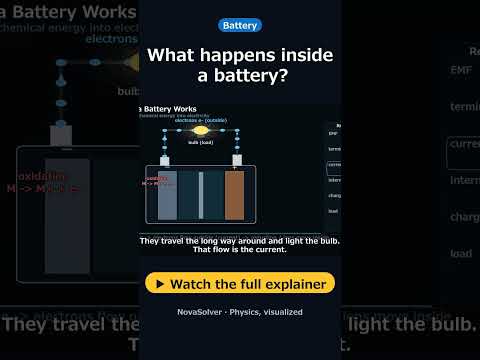
What happens inside a battery? | How a Battery works #Shorts