Design the buckling-restrained brace (BRB), a brace that cannot buckle. Adjust the core area, yield stress, effective length and design drift to see the yield strength, axial stiffness, ductility demand and hysteretic energy per cycle update in real time, and study a brace that stably absorbs seismic energy.
Parameters
Core area A_core
mm²
Cross-section of the steel core that carries the axial force and yields
Core yield stress F_y
MPa
Yield stress of the core steel grade (lower for low-yield-point steel)
Effective core length L
mm
Length of the yielding portion of the core
Young's modulus E
GPa
Elastic modulus of the core steel (about 205 GPa for steel)
Design story drift
mm
Axial deformation of the brace under the design earthquake
Results
—
Yield strength P_y (kN)
—
Axial stiffness k (kN/mm)
—
Yield displacement δ_y (mm)
—
Ductility demand μ
—
Energy per cycle (kJ)
—
Core strain rating
—
BRB section & hysteresis — axial cycle animation
A BRB made of a steel core, a de-bonding layer and a restraining casing cycles between tension (stretched) and compression (shortened). Because it cannot buckle, the core yields symmetrically in compression and traces a stable hysteresis loop alongside.
Axial stiffness k and the energy E_cyc dissipated in one cycle of the idealised elastoplastic hysteresis loop. Because the casing prevents buckling, the core yields symmetrically in tension and compression, so E_cyc equals the area enclosed by the loop.
What is a Buckling-Restrained Brace?
🙋
A "buckling-restrained brace" is a type of the diagonal brace you see in a building wall, right? What makes it different from an ordinary brace?
🎓
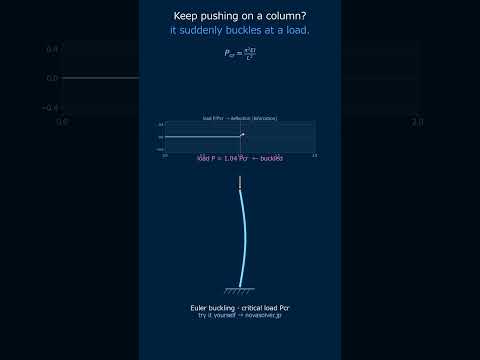
Good question. An ordinary steel brace is strong when you pull on it, but it is a slender bar, so when you push on it, it buckles easily and bends out of line. Once it has buckled, its compression resistance collapses. An earthquake shakes a building back and forth, so the brace sees tension and compression in turns. With an ordinary brace, the compression side is weak — it becomes a deeply unfair member.
🙋
I see... so how does a buckling-restrained brace stop that buckling?
🎓
The idea is elegant. It splits the two jobs of a brace into two separate parts. A slender steel core in the centre is given the job of carrying the axial force and yielding. That core is wrapped by a casing — usually a steel tube filled with mortar — which physically restrains it from bulging sideways. And the casing is deliberately de-bonded from the core, so it carries no axial load itself. Its only job is lateral support.
🙋
What is the benefit once the core no longer buckles?
🎓
With the threat of buckling gone, the core can now yield in compression exactly as well as it yields in tension. The force-displacement graph — the hysteresis loop — becomes a fat, left-right symmetric shape, almost like an ideal elastoplastic damper. In the animation top right you can see it draw a loop of the same width in tension and compression. An ordinary brace gives a one-sided pinched loop instead.
🙋
Why is a large fat loop a good thing? Does it make the building stronger against earthquakes?
🎓
Exactly. The area the loop encloses is the very amount of seismic energy the brace has turned into heat and thrown away. While the BRB busily absorbs seismic energy, less energy reaches the main frame — the columns and beams — so their damage is reduced. Increase the design story drift on the left slider and you will see the energy per cycle rise sharply. The BRB acts as a dedicated seismic-energy absorber for the building.
🙋
When designing one, which number should I watch most carefully?
🎓
The core strain. It is how much the core stretches and shortens under the design earthquake, as a ratio. Making the core short or pushing it through a large deformation increases the strain. Within a few percent the toughness of steel handles it easily, but a large strain over 3 percent raises the worry of low-cycle fatigue, where the core fractures after only a few cycles. In practice, you give the core enough effective length to keep the strain within a practical range.
Frequently Asked Questions
An ordinary steel brace is strong in tension but, being slender, buckles in compression at a much lower load. Once it has buckled, its compressive resistance collapses and its hysteresis loop becomes badly pinched and asymmetric, dissipating very little energy. A buckling-restrained brace (BRB) solves this by restraining the slender inner steel core laterally with a casing — typically a steel tube filled with mortar — so the core physically cannot buckle. Freed from buckling, the core yields in compression exactly as well as in tension, producing a full, fat, symmetric and stable hysteresis loop that absorbs seismic energy cycle after cycle.
The yield strength P_y is the product of the core cross-sectional area A_core and the core yield stress F_y: P_y = A_core x F_y. For A_core = 2500 mm² and F_y = 235 MPa, P_y = 587,500 N which is about 587.5 kN. Because a BRB does not buckle, this yield strength is essentially the same in tension and in compression, which makes the design simple and transparent. The casing is deliberately de-bonded from the core and carries no axial load itself.
The most important quantity for BRB performance is the core strain demand under the design earthquake. Core strain is the design drift divided by the effective core length, shown here as a percentage. Within a few percent it sits comfortably inside steel's ductility, but an excessive strain risks low-cycle fatigue, where the core fractures after only a few cycles. In general a design with a core strain above about 3 percent should be revisited from the fatigue point of view for a member subjected to repeated deformation.
The energy per cycle is the area enclosed by the hysteresis loop (force versus axial displacement) when the brace makes one full cycle to plus and minus the design drift. It represents the seismic energy the brace has dissipated as heat. For an idealised elastoplastic loop, the energy per cycle is approximately 4 x yield strength x (design drift minus yield displacement), reported here in kJ. The larger this area, the more efficiently the brace absorbs the energy fed into the building, protecting the main frame from damage.
Real-World Applications
Seismic frames of new buildings: Buckling-restrained braces are widely built into the steel or reinforced-concrete frames of new buildings as energy-dissipating members that concentrate the absorption of seismic energy. By keeping the columns and beams of the main frame close to elastic while the BRBs take the damage, the building is more likely to keep functioning after a major earthquake. They are common in schools, government offices and hospitals — buildings that must stay usable after a quake.
Seismic retrofit of existing buildings: Buckling-restrained braces are often added to buildings constructed under older codes to raise their seismic performance. With ordinary steel braces the retrofit effect is lopsided because the compression side buckles, but a BRB works symmetrically in tension and compression, so the amount of strengthening can be decided rationally. Detailing into framed openings that keep windows clear, balancing structure with architecture, has also been put into practice.
Energy-dissipating braces for bridges and industrial facilities: They are also used as braces for structures subjected to repeated loading, such as elevated bridges, towers and plant frames. Because the core shows stable elastoplastic behaviour, it is easy to model in seismic response analysis and the response reduction can be quantitatively evaluated — a practical advantage.
Damping design and time-history analysis study: Before running a detailed non-linear time-history response analysis, a simplified model like this tool gives a first estimate of the yield strength, stiffness and hysteretic absorbed energy. Having a rough grasp of the energy carried by the braces helps to check the validity of the analysis model and to set rational initial values for the number of braces and the core dimensions.
Common Misconceptions and Pitfalls
The most common misconception is assuming the casing carries the axial load. The casing of a buckling-restrained brace (a steel tube filled with mortar and so on) is dedicated to restraining the core from bulging sideways and buckling; it is de-bonded from the core and carries no axial load itself. The yield strength P_y is set purely by the core area and yield stress. Making the casing thicker does not raise the yield strength — to raise it you must revisit the core. Do not confuse the two.
Next, getting by with a short core without minding the core strain. Shortening the core makes the core strain larger for the same design drift, and the core may fracture early due to low-cycle fatigue. A design where this tool's core strain rating shows "core strain too high" should be revisited from the standpoint of fatigue life under repeated deformation. A BRB is a member expected to survive tens of cycles, so plan the strain with a comfortable margin.
Finally, the misconception that installing a BRB lets you raise the stiffness freely. The axial stiffness k is proportional to the core area and Young's modulus and inversely proportional to the effective length. Increasing the core area to raise the yield strength also raises the stiffness, which changes the building's natural period and seismic input. Strength, stiffness and hysteretic energy cannot be decided independently — they are interlinked. BRB design means deciding the core dimensions and effective length while watching the balance of these three and the interface with the main frame.
How to Use
Enter core cross-sectional area (50–500 mm²) using the slider or numeric input; typical steel BRBs use 100–250 mm².
Set yield stress (250–400 MPa) for the steel core material; structural steel typically ranges 350 MPa.
Input core length (400–2000 mm) representing the unbounded portion between connection gussets.
Adjust Young's modulus (190–210 GPa for steel) if using non-standard alloys; default 200 GPa.
Run calculation to obtain yield strength P_y, axial stiffness k, yield displacement δ_y, ductility demand μ, energy dissipation per cycle, and core strain rating.
Worked Example
Design a BRB for a mid-rise office building lateral system. Core area = 150 mm², yield stress = 350 MPa, core length = 1200 mm, E = 200 GPa. Simulation yields: P_y = 52.5 kN (0.150 × 350), k = 25 kN/mm (200×0.150/1.2), δ_y = 2.1 mm (52.5/25), energy per cycle ≈ 47 kJ at 15% core strain. This BRB configuration suits a 5-story frame with estimated 10 kN storey drift demand.
Practical Notes
Increase core area and yield stress together to raise lateral strength; a 200 mm² core with 360 MPa steel yields ~72 kN versus ~48 kN for 150 mm² at 320 MPa.
Longer core lengths (≥1500 mm) reduce axial stiffness and allow greater yield displacements; use for flexible connections where 3–4 mm drift is acceptable.
Core strain rating >8% indicates excellent hysteretic performance but requires high-quality steel and gusset plate welding to prevent local buckling initiation.
Verify restraining system bearing plates and mortar can resist 1.5× computed yield load to prevent encasing shell failure.
🎬 Watch it in motion
Euler Buckling | a slender column snaps sideways at once #Shorts
Why does a column suddenly snap? Euler buckling #Shorts