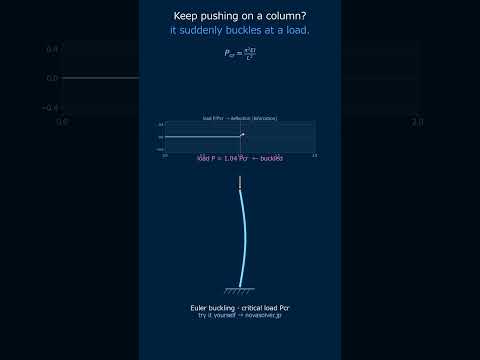
Set cross-section, end conditions, and load eccentricity to compute Euler critical load, slenderness ratio, and the P-δ curve in real time. The deformed shape and initial imperfection effects are visualized side by side.
Parameters
mm
mm
mm
GPa
MPa
Analysis Results
Failure Mode
—
Critical Stress σcr
—
Critical Load Pcr
—
Slenderness λ
—
Transition Slenderness λc
—
Current Load P
—
Column Failure
σcr-λ Curve (Johnson + Euler)
Theory & Key Equations
$$\lambda_c = \pi\sqrt{\dfrac{2E}{\sigma_y}}$$
Transition slenderness: the boundary between the Johnson and Euler formulas. \(E\): elastic modulus, \(\sigma_y\): yield stress.
Inelastic buckling of intermediate columns (Johnson parabola). The stress is \(\sigma_y\) at \(\lambda=0\) and \(\sigma_y/2\) at \(\lambda_c\), where the curve joins the Euler curve with a continuous tangent. The critical load is \(P_{cr}=\sigma_{cr}\,A\).
What is Column Buckling?
🙋
What exactly is "buckling"? I thought a column just squashes down when overloaded.
🎓
Basically, buckling is a sudden sideways bending failure, not a crushing one. It happens when a slender column under compression becomes unstable. In practice, think of pushing down on a plastic ruler—it suddenly snaps sideways. Try selecting the "Fixed-Free" end condition in the simulator and watch the dramatic sideways deflection.
🙋
Wait, really? So the strength depends on how it bends, not just the material? What's this "effective length" I see in the controls?
🎓
Exactly! The critical load depends heavily on stiffness and geometry. The "effective length" (KL) is a brilliant simplification—it's the length of an equivalent pin-ended column that buckles the same way. For instance, a fixed-fixed column is so much stiffer it acts like a much shorter pin-ended one. Slide the "End Condition" parameter and watch the K-factor and buckling shape change.
🙋
So the cross-section shape must matter too. Does a wide-flange "I-beam" column buckle differently than a solid square?
🎓
Great question! It matters immensely because it changes the "I" value—the moment of inertia. An I-beam packs most of its material away from the center, giving it a huge I for its weight, making it much more resistant to buckling. In the simulator, switch between the "I-beam" and "Solid Square" cross-sections and see how the critical load changes, even with the same end conditions.
Physical Model & Key Equations
The fundamental governing equation is the Euler-Bernoulli beam equation for a column under axial load P. The critical buckling load is found by solving the eigenvalue problem for this differential equation, which leads to the classic Euler formula.
$$P_{cr}= \frac{\pi^2 E I}{(K L)^2}$$
Where: $P_{cr}$ = Critical Euler buckling load (N). $E$ = Young's modulus of the material (Pa). $I$ = Second moment of area (moment of inertia) of the cross-section (m⁴). This depends on shape and orientation. $L$ = Actual physical length of the column (m). $K$ = Effective length factor (dimensionless). It accounts for rotational and translational restraints at the ends.
The slenderness ratio $\lambda$ is a key dimensionless parameter that determines whether a column will fail by buckling (slender) or by material crushing (stocky).
$$\lambda = \frac{K L}{r}$$
Where: $r$ = Radius of gyration of the cross-section, $r = \sqrt{I/A}$ (m). $A$ = Cross-sectional area (m²).
A high slenderness ratio ($\lambda \gt \lambda_{lim}$) means buckling is the dominant failure mode. The simulator calculates this ratio for you based on your chosen parameters.
Frequently Asked Questions
K is a coefficient representing the support method of the column. Set K=1.0 for both ends pinned, K=0.5 for both ends fixed, K=2.0 for one end fixed and the other free, and K=0.7 for one end fixed and the other pinned. Selecting the appropriate value based on the actual structure allows for correct calculation of the buckling load.
Generally, an initial imperfection of about 1/500 to 1/1000 of the column length L (e.g., 2 to 4 mm for L=2 m) is realistic. Considering manufacturing precision and construction errors, set a larger value if you want to evaluate on the safe side. Setting it too large will underestimate the buckling load.
This curve plots the load P on the vertical axis against the deflection δ on the horizontal axis. The peak indicates the buckling load, and beyond that, the post-buckling behavior where the load decreases can be observed. If there is an initial imperfection, the peak becomes unclear, and you can visually grasp how the maximum load decreases below the Euler buckling load.
If the cross-sectional shape is determined, it can be calculated using formulas. For example, for a rectangular cross-section (width b × height h), I = bh³/12, and for a circular cross-section (diameter d), I = πd⁴/64. Depending on the CAE tool, you may be able to select the cross-sectional shape and have it calculated automatically. If you are unsure, please refer to a mechanics of materials handbook.
Real-World Applications
Structural Steel Framing: In skyscrapers, steel columns are designed to prevent buckling under the immense weight of floors above. Engineers use K-factors (like the ones in this simulator) to account for how beams and girders provide partial fixity at the column ends, optimizing material use and safety.
Aircraft Struts and Spars: Lightweight aluminum struts in aircraft landing gear and wing spars are highly slender to save weight. Buckling analysis is critical here; a small miscalculation in effective length or cross-section inertia can lead to catastrophic failure during landing or high-G maneuvers.
Scaffolding and Construction Shoring: Temporary tubular steel columns used to support concrete slabs during construction are often pin-ended and very long. Their buckling load, calculated precisely with the Euler formula, dictates the safe spacing and maximum height of the shoring system to prevent collapse.
Silicon Micro-Electro-Mechanical Systems (MEMS): At the microscale, tiny silicon columns can act as sensors or actuators. Their buckling behavior, governed by the same physics but at a different scale, is used in devices like pressure sensors and optical switches, where a controlled buckling event triggers a signal.
Common Misconceptions and Points to Note
When you start using this tool, there are a few common pitfalls. First is the mindset that "finding the buckling load is the end goal". While the Euler buckling load $P_{cr}$ is a crucial metric, in practice, simply applying a safety factor isn't enough. If you look at the P-δ curve considering initial imperfections, deflection often starts increasing rapidly around $0.8P_{cr}$. Therefore, where you set the allowable deflection becomes the key to determining the actual design load. For instance, with bridge piers, where visual deflection limits are strict, the upper limit might be set around $0.6P_{cr}$.
Next is the interpretation of "fixed" end conditions. Selecting "one end fixed" in the tool significantly increases the strength, but achieving a perfectly fixed condition on-site is extremely difficult. Even when embedded in a concrete foundation, some rotation occurs. Comparing the results for "both ends pinned" and "one end fixed" in this tool and learning to imagine the intermediate behavior is the first step towards mastery.
Finally, the pitfall of the moment of inertia $I$ . The $I$ of an H-beam differs greatly depending on the direction. Even when you change the cross-section in the tool, always be mindful that buckling occurs in the weak-axis direction (the direction with the smaller moment of inertia). Square pipes are easier to handle as they are nearly isotropic, but if the plate thickness is thin, local buckling occurs first. So, even if the tool shows a global buckling result, you must not let your guard down.
Enter column length in lenL (meters), e.g., 3.5m for a structural steel column
Define rectangular cross-section: width bParam (mm) and height hParam (mm); for example, 150mm × 250mm for an I-beam flange assembly
Set load eccentricity in ecc (mm) to model off-center loading; use 0 for concentric, 25 for bending-critical cases
Select end conditions via the input field: pinned-pinned (1), fixed-free (2), or fixed-fixed (3)
Click Calculate to generate Euler buckling load, slenderness ratio λ, and P-δ deflection curve
Review deformation visualization showing column bowing under progressive axial load
Worked Example
Steel column: L=4.0m, section 100×200mm, E=200GPa, fixed-pinned ends, ecc=15mm. Computed results: critical buckling load Pcr≈185kN at λ=92.4, deflection at midspan δ≈8.3mm when axial load reaches 150kN. The P-δ curve exhibits nonlinear growth beyond 120kN due to second-order (P-δ) moment amplification from eccentricity, confirming transition from elastic to buckling-dominated response per AISC 360.
Practical Notes
Eccentricity amplifies deflection: a 20mm offset in a 3m pinned column increases midpoint sag by ~40% versus concentric loading
Slenderness limit λ<200 for structural steel; λ<300 acceptable for temporary bracing only
Fixed-free (cantilever) columns buckle at ~1/4 the Euler load of pinned columns with identical geometry; verify boundary conditions in CAD before analysis
Use for preliminary sizing before FEA; validate flange-web interaction in actual I-sections with the tool's rectangular simplification
🎬 Watch it in motion
Euler Buckling | a slender column snaps sideways at once #Shorts
Why does a column suddenly snap? Euler buckling #Shorts