NovaSolver›Fluid Statics: Hydrostatic Pressure & Buoyancy Back
Fluid Mechanics Simulator
Fluid Statics: Hydrostatic Pressure & Buoyancy
Choose fluid type, object shape, and density to compute hydrostatic pressure, buoyancy force, and net force in real time. Watch the object float or sink with an animated pressure gradient visualization.
Fluid Selection
Water Depth h (m)
m
Object Settings
Characteristic Length L (m)
m
Object Density ρ_obj (kg/m³)
kg/m³
Results
Results
—
Hydrostatic Pressure at h (kPa)
—
Object Volume V (m³)
—
Object Mass m (kg)
—
Buoyancy Fb (kN)
—
Gravity Fg (kN)
—
Net Force (+float / −sink) kN
—
Neutral Buoyancy Density (kg/m³)
Pressure Gradient & Buoyancy Animation
Pressure vs Depth Profile
Theory & Key Formulas
$P(h) = P_0 + \rho g h$
$F_b = \rho_f \cdot V \cdot g$
$F_{\text{net}} = F_b - F_g$
What is Hydrostatic Pressure & Buoyancy?
🙋
What exactly is hydrostatic pressure? I know pressure is force per area, but why does it increase with depth?
🎓
Basically, it's the pressure exerted by a fluid at rest due to gravity. Imagine a column of water. The deeper you go, the more weight of water is pushing down on you from above. In practice, this is why your ears pop when you dive deep in a pool. Try moving the "Water Depth (h)" slider in the simulator above—you'll see the pressure at the bottom of the tank increase linearly as you go deeper.
🙋
Wait, really? So buoyancy is related to this pressure? How does an object know whether to float or sink?
🎓
Great question! Buoyancy is the net upward force caused by this pressure difference. Pressure is higher at the bottom of an object than at its top, creating an upward push. The key is density. If the object is denser than the fluid, its weight ($F_g$) wins and it sinks. If it's less dense, buoyancy ($F_b$) wins and it floats. A common case is a steel ship—it floats because its overall shape displaces a huge volume of water, creating a large $F_b$. Try changing the "Object Density" parameter in the simulator to see this battle between $F_b$ and $F_g$ play out.
🙋
So the shape and size of the object matter too, right? How does the simulator account for that with just a "Characteristic Length (L)"?
🎓
Exactly. For a simple cube or sphere, a single length (like side length or diameter) defines its volume, which is crucial for calculating both its weight and the displaced fluid volume. The buoyant force depends on the volume of fluid displaced. When you change the "Characteristic Length (L)" in the simulator, you're changing the object's size and thus its volume. A bigger object displaces more fluid, creating a stronger buoyant force, even if its density stays the same.
Physical Model & Key Equations
The hydrostatic pressure at any depth in a fluid at rest increases linearly due to the weight of the fluid above it. The atmospheric pressure at the surface ($P_0$) is added to this.
$$P(h) = P_0 + \rho_f g h$$
Where $P(h)$ is the pressure at depth $h$, $\rho_f$ is the fluid density, and $g$ is gravitational acceleration (9.81 m/s²). This means pressure increases by $\rho_f g$ for every meter of depth.
The buoyant force, discovered by Archimedes, is equal to the weight of the fluid displaced by the object. The net vertical force determines if the object floats, sinks, or remains neutrally buoyant.
$$F_b = \rho_f \cdot V_{disp}\cdot g \quad \text{and}\quad F_{\text{net}}= F_b - F_g = (\rho_f - \rho_{obj}) \cdot V \cdot g$$
Here, $F_b$ is the buoyant force, $V_{disp}$ is the volume of fluid displaced (equal to the submerged volume $V$), $F_g$ is the object's weight, and $\rho_{obj}$ is the object's density. If $F_{\text{net}}\gt 0$, the object floats; if $F_{\text{net}} \lt 0$, it sinks.
Frequently Asked Questions
Buoyancy is proportional to the volume of fluid displaced. When fully submerged, the entire volume of the object is used; when partially floating, the volume below the water surface is used as the displaced volume V. In the simulator, this switches automatically based on the object's position.
The greater the density of the fluid, the greater the water pressure and buoyancy at the same depth. For example, changing from water (approximately 1000 kg/m³) to seawater (approximately 1025 kg/m³) increases buoyancy by about 2.5%, making the object more likely to float.
The center of pressure is the point where the resultant force of water pressure acting on the object's surface is applied. It coincides with the point of action of buoyancy and affects the object's stability. For example, if the center of pressure is above the center of gravity, the object floats stably; if it is below, the object tends to tip over.
First, verify that the object's density and volume, as well as the fluid density, are correct. Also, ensure that the atmospheric pressure setting (standard is 101325 Pa) and gravitational acceleration (9.81 m/s²) are appropriate. Especially for complex shapes, the calculation of displaced volume may be an approximation.
Real-World Applications
Submarine & Ship Design: Engineers must precisely calculate buoyancy and pressure to ensure submarines can control their depth and surface ships remain stable. The hull must withstand immense hydrostatic pressure at operational depths, which is a direct application of $P(h) = P_0 + \rho g h$.
Dam & Reservoir Engineering: The force on a dam wall is not uniform—it increases linearly with depth. This pressure distribution is critical for designing the dam's thickness and structural reinforcement to hold back millions of tons of water.
Hydrometers & Density Measurement: A hydrometer floats in a liquid, and the depth to which it sinks indicates the fluid's density. This is a direct, practical use of Archimedes' principle, where the buoyant force balances the instrument's weight.
Offshore Oil Platforms: These massive structures rely on buoyancy principles for stability. Their submerged pontoons are designed to displace a specific volume of seawater, providing the precise upward force needed to support the platform's enormous weight above the surface.
Common Misconceptions and Points to Note
Let's go over a few points where people often stumble with these kinds of calculations. First, you might tend to think that "buoyancy is determined by the object's material," but the magnitude of buoyant force is determined solely by the weight of the fluid displaced by the object. The object's own density or material affects the magnitude of gravity (whether it sinks or floats) but does not directly relate to the value of the buoyant force itself. For example, if you submerge a 1m³ block of iron and a 1m³ block of polystyrene foam in water, the buoyant force they experience is exactly the same, approximately 9800N (for water). The difference is that the iron, being heavier than this buoyant force, sinks, while the polystyrene foam floats.
Next, confusing the "center of pressure" with the "center of gravity". This is really important. The center of gravity is the center of the object's mass distribution, determined by its material and shape. On the other hand, the center of pressure is the point where the resultant force from the fluid pressure distribution acts, and it changes with fluid density, object shape, and inclination. For instance, if you submerge a uniform cube vertically in water, its center of gravity is at its geometric center, but the center of pressure is located lower, closer to the bottom face. When these two points are misaligned, the object experiences a rotational moment and tends to tilt. If you select the "flat plate" in the simulator and change the angle of inclination, you should be able to observe the center of pressure moving significantly.
Finally, a pitfall in parameter setting. Be aware that the interpretation of the "characteristic length L" is completely different depending on the shape. For a sphere, it's the diameter; for a cube, it's the side length. When dealing with custom shapes in practical work, if you don't strictly define what this "characteristic length" refers to, your calculation results can become completely meaningless. Also, fluid density changes with temperature (e.g., engine oil density drops significantly when hot). For designs requiring high precision, using the density value at the expected operating temperature is essential.
Enter immersion depth in meters using the input field; hydrostatic pressure increases linearly at 9.81 kPa per meter in freshwater.
Define object geometry (sphere, cube, or cylinder) and characteristic dimension in the input field to compute volume automatically.
Set object material density (the input field in kg/m³); the simulator calculates buoyancy force against fluid density and gravitational force, displaying net force to predict flotation.
Worked Example
A steel sphere (ρ = 7850 kg/m³) with diameter 0.5 m submerged to depth h = 3 m in seawater (ρ_fluid = 1025 kg/m³). Volume V = (4/3)π(0.25)³ = 0.0654 m³. Hydrostatic pressure at h = 1.025 × 9.81 × 3 = 30.2 kPa. Buoyancy F_b = 1025 × 9.81 × 0.0654 = 658 N. Object mass m = 7850 × 0.0654 = 514 kg, gravitational force F_g = 514 × 9.81 = 5.04 kN. Net force = 0.658 − 5.04 = −4.38 kN (sinks). Neutral buoyancy density = 1025 kg/m³.
Practical Notes
Pressure scales with fluid density and depth; saltwater (1025 kg/m³) generates 2.5% higher pressure than freshwater (1000 kg/m³) at equivalent depths, critical for subsea pipeline design.
Neutral buoyancy occurs when object density equals fluid density; drilling mud weights (1.2–2.4 g/cm³) are formulated to maintain wellbore stability by matching formation pressure.
Shape influences drag during ascent/descent but not static buoyancy; submarine ballast tanks exploit this by controlling internal density rather than geometry.
🎬 Watch it in motion
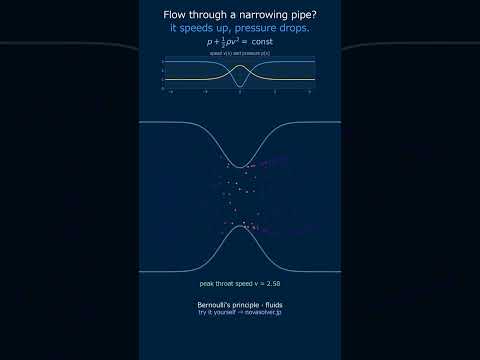
Flow speeds up in narrow spots — Bernoulli's principle #Shorts