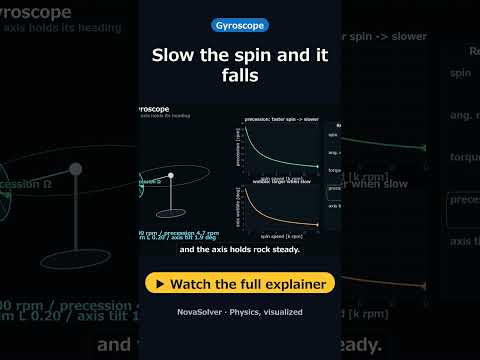
Quick answer A gyroscope precesses at Ω_p = τ/(L·sinθ) = mgd/(Iω), where L = Iω is the angular momentum and τ the torque. For a disc, I = (1/2)·m·r² and ω = 2π·RPM/60 — the faster the spin, the slower the precession.
Set spin rate, rotor mass, radius, pivot distance and tilt angle to compute precession rate and angular momentum in real time. Useful for spacecraft attitude control and rotating machinery design.
Parameters
Presets
Spin rate ω_spin
RPM
Rotor mass m
kg
Rotor radius r
cm
Pivot distance d
cm
Tilt angle θ
°
90° = horizontal spin axis
Results
—
Angular momentum L [kg·m²/s]
—
Gravitational torque τ [N·m]
—
Precession rate Ω_p [rad/s]
—
Nutation freq. [rad/s]
—
Gyroscopic stiffness [N·m·s]
Gyro
Precession rate vs Spin rate
Precess
Angular momentum vs Spin rate
Visualization
Theory & Key Formulas
Fundamental equations of angular momentum and precession:
Nutation frequency estimate: $\omega_n \approx \dfrac{L}{I_{trans}}$ (symmetric top approximation)
What is Gyroscopic Precession?
🙋
What exactly is gyroscopic precession? I see a spinning top doesn't just fall over, but moves sideways. Why?
🎓
Basically, it's the surprising sideways motion you get when you try to tilt a spinning object. In practice, gravity tries to pull the top down, creating a torque. But because it's spinning, that torque changes the direction of its spin axis sideways, not downwards. Try increasing the Tilt angle θ in the simulator above—you'll see the torque vector and the resulting precession motion become much more pronounced.
🙋
Wait, really? So the force of gravity doesn't make it fall, it makes it turn? How fast does it turn?
🎓
Exactly! The rate of that sideways turning is the precession frequency. It depends on the spin speed and the torque. A common case is a bicycle wheel: spin it fast, hold it by one axle end, and it precesses slowly. Try it here: crank up the Spin rate ω_spin. You'll see the angular momentum vector get longer, and the precession rate (the slow circle) actually gets slower.
🙋
What about the mass and size of the wheel? If I made it heavier, would it precess faster or slower?
🎓
Great question! It's all about rotational inertia. A heavier or larger wheel is harder to "steer," so it precesses more slowly. That's captured by the Rotor mass m and Rotor radius r parameters. Increase the radius—the moment of inertia goes up with $r^2$, so for the same spin, the angular momentum is huge and the precession becomes very slow. Play with those sliders to see the direct cause and effect.
Physical Model & Key Equations
The fundamental law is that torque equals the rate of change of angular momentum. For a gyroscope, the gravity-induced torque is perpendicular to the spin axis.
$$\vec{\tau}= \frac{d\vec{L}}{dt}$$
Where $\vec{\tau}= \vec{r}\times m\vec{g}$ is the torque from gravity (depending on pivot distance d and tilt θ ), and $\vec{L}$ is the angular momentum vector.
The magnitude of the angular momentum comes from the spin and the rotor's moment of inertia. For the solid disk model in this simulator:
$$L = I \omega_{spin}, \quad I = \frac{1}{2}m r^2$$
Here, $m$ is Rotor mass , $r$ is Rotor radius , and $\omega_{spin}$ is the Spin rate. The steady precession rate (for slow precession) is then derived from the cross product:
$$\Omega_{precess}= \frac{\tau}{L \sin\theta}= \frac{m g d}{I \omega_{spin}}$$
This shows clearly why a faster spin ($\omega_{spin}\uparrow$) leads to slower precession ($\Omega_{precess} \downarrow$).
Frequently Asked Questions
When the tilt angle is 0 degrees, no gravitational torque is generated, so precession does not occur. On the simulator, the spin axis remains fixed while rotating, and the precession speed is displayed as 0. This reproduces an ideal balanced state.
The unit of precession speed is radians per second (rad/s). Multiplying the displayed value by 2π converts it to rotations per second (Hz), and multiplying by 60 gives rotations per minute (rpm). Please use this for comparison with design values.
Increasing the mass or radius increases the rotor's moment of inertia and angular momentum, so the precession speed decreases for the same torque. Conversely, reducing weight or size speeds up precession, allowing you to check design trade-offs.
It provides an intuitive understanding of how wheel spin speed and mass distribution affect precession response, and is useful for parameter design of torque distribution and wheel saturation prevention during attitude changes. In particular, it can be used to evaluate the stability of the rotation axis under gravitational torque.
Real-World Applications
Spacecraft Attitude Control: Reaction wheels and Control Moment Gyroscopes (CMGs) use precisely controlled gyroscopic torques to turn satellites without firing thrusters. By changing the spin rate of internal flywheels, engineers can point the spacecraft accurately, conserving precious fuel.
Rotating Machinery Analysis: In large turbines and jet engines, gyroscopic effects from the spinning rotor can create dangerous vibrations and loads on bearings, especially during maneuvers. Engineers use Campbell diagrams to predict these critical speeds, which is a standard CAE task.
Vehicle Dynamics & Suspension Design: The spinning wheels and engine crankshaft in a motorcycle or car act as gyroscopes. During a turn or when hitting a bump, they produce torques that affect handling and stability. Suspension systems must be designed to account for or even utilize these forces.
Inertial Navigation Systems (INS): The core of an INS is a set of gyroscopes (often laser or MEMS-based) that measure orientation. Understanding and compensating for errors like drift and nutation (the wobble you can simulate with a large tilt) is critical for submarines, aircraft, and missiles to navigate without GPS.
Common Misconceptions and Points to Note
First, you might think "precession continues forever," right? This is a major misconception. The simulator ignores friction, but in the real world, bearing friction and air resistance slow the spin, causing the precession to gradually become unstable until it eventually topples over. For example, in precision gyro sensors, they use vacuum chambers or ultra-low friction bearings to suppress this damping to the absolute limit.
Next, many people are puzzled by the phenomenon where setting the parameter "tilt angle θ=0" or "θ=90 degrees" stops the precession. This isn't a bug. It's because the gravitational torque causing precession $\tau = mgd \sin\theta$ becomes zero at θ=0. If the axis is perfectly vertical, there's no force trying to tip it over. Conversely, at θ=90 degrees (horizontal), the $\sin\theta$ in the denominator of the theoretical formula becomes 1, but the actual motion often becomes complex and is no longer simple precession. A good tip when experimenting with the simulator is to start with an intermediate value for θ, like 30 to 60 degrees.
Also, are you mistakenly remembering the direction of the "angular momentum vector L"? The direction of L is determined by the right-hand rule and is the "direction of the rotation axis." Think of it as pointing to the "north pole" of the rotating object. Precession is the motion where the tip of this L vector (the north pole) is pulled in the direction of the gravitational torque, tracing a circle. Be careful not to confuse the vector's direction with the object's motion, or you'll get tangled up.