Analyze turbojet and turbofan Brayton cycles. Set pressure ratio, turbine inlet temperature, bypass ratio, and efficiencies to compute thermal efficiency, specific thrust, and TSFC with a live T-s diagram.
Engine Configuration
Bypass Ratio BPR
Pressure Ratio πc
Turbine Inlet Temp T3 (K)
K
Compressor Efficiency ηc
Turbine Efficiency ηt
Flight Mach Number
While paused, moving a slider updates the results immediately.
Results
Results
—
Thermal Efficiency (%)
—
Propulsive Efficiency (%)
—
Specific Thrust (N·s/kg)
—
TSFC (g/kN·s)
T-s Diagram (Brayton Cycle)
—
Specific Thrust (N·s/kg)
—
Exhaust velocity Ve (m/s)
—
Combustion temperature T3 (K)
—
Fuel-air ratio f (g/kg)
Blue: cool intake air is compressed by the compressor (the flow narrows and heats up), fuel burns in the combustor and expands in red, the turbine drives the shaft, and high-speed exhaust from the nozzle produces thrust. Moving a slider updates the animation immediately.
What exactly is the Brayton cycle? I see it mentioned everywhere for jet engines.
🎓
Basically, it's the ideal thermodynamic model for how a gas turbine engine works. Think of it as a four-step process: suck in air, squeeze it, burn fuel to heat it, and then blast it out to create thrust. In practice, the "squeeze" step is key—that's the pressure ratio you set with the slider in the simulator.
🙋
Wait, really? So the pressure ratio is the main thing that controls efficiency? What about the turbine inlet temperature?
🎓
Great question! For the ideal cycle, yes, efficiency depends only on pressure ratio. But in the real world, material limits and component inefficiencies come into play. That's where the Turbine Inlet Temp (T3) and the efficiency sliders (ηc, ηt) matter. Try setting a high pressure ratio but a low compressor efficiency in the tool—you'll see the actual performance drop.
🙋
Okay, that makes sense. But what's the point of the "Bypass Ratio" control? It seems like a whole different thing.
🎓
It's the defining feature of a turbofan! A common case is a modern airliner engine. A high bypass ratio means most of the air is just accelerated by the big fan and bypasses the core (the Brayton cycle part). This gives more thrust at lower fuel consumption. Switch the "Engine Type" in the simulator and watch how the Specific Thrust and SFC change dramatically.
Physical Model & Key Equations
The ideal Brayton cycle thermal efficiency depends solely on the pressure ratio across the compressor and the specific heat ratio of air.
Where $\pi_c$ is the compressor pressure ratio (P₂/P₁) and $\gamma$ (gamma ≈ 1.4) is the ratio of specific heats for air. This shows that, ideally, squeezing the air more (higher πc) leads to higher efficiency.
In reality, components aren't perfect. The actual work and temperature changes account for compressor and turbine isentropic efficiencies.
Here, $T_{2s}$ is the ideal (isentropic) exit temperature, $T_2$ is the actual hotter exit temperature, and $\eta_c$ is the compressor efficiency. A similar equation applies for the turbine. Lower efficiency means more work is wasted as heat, reducing net thrust.
Frequently Asked Questions
Increasing the compression ratio improves theoretical thermal efficiency, but at the same time, the compressor outlet temperature rises, making it easier to reach the turbine inlet temperature limit. Additionally, at high compression ratios, the effects of changes in the specific heat ratio of air and losses cannot be ignored, so adjustments within the practical range (typically around 10 to 40) are recommended.
In the T-s diagram, the vertical axis represents temperature and the horizontal axis represents entropy. In an ideal Brayton cycle, it is represented by a rectangle: isentropic compression (vertical line) → isobaric heating (diagonally upward to the right) → isentropic expansion (vertical line) → isobaric heat rejection (diagonally downward to the left). The larger the area, the greater the cycle work and the higher the efficiency.
Specific impulse is thrust per unit air flow rate (N·s/kg), indicating the thrust efficiency of the engine. TSFC (Thrust Specific Fuel Consumption) is fuel consumption per unit thrust (kg/(N·h)), representing fuel efficiency. A higher specific impulse means less air flow is required for the same thrust, and a lower TSFC means better fuel efficiency.
Increasing the bypass ratio improves propulsive efficiency and reduces fuel consumption (TSFC), but the overall diameter and weight of the engine increase. Additionally, since the core engine flow rate decreases, achieving the same thrust requires increasing the core's compression ratio or combustion temperature, leading to design trade-offs. This tool allows real-time observation of changes in propulsive efficiency due to bypass ratio adjustments.
Real-World Applications
Military Fighter Jets (Low Bypass Turbojets/Turbofans): These prioritize high specific thrust (thrust per unit of airflow) for speed and maneuverability. They use moderate pressure ratios and very high turbine inlet temperatures (T3), which you can simulate by setting Bypass Ratio to 0 or 1 and pushing the T3 slider high.
Commercial Airliners (High Bypass Turbofans): The goal is fuel economy and low noise. Engines like the GE9X on the 777X use bypass ratios above 10:1. In the simulator, set a high Bypass Ratio and observe how Specific Fuel Consumption (SFC) drops significantly compared to a turbojet.
Unmanned Aerial Vehicles (UAVs) & Missiles: Small turbojets or turbofans often operate at fixed, optimized conditions. Engineers use these calculations to balance compressor pressure ratio and weight for a given mission range, tweaking the efficiency parameters you see in the tool.
Engine Health Monitoring & Diagnostics: CAE software and onboard sensors track actual engine performance (e.g., exhaust gas temperature) against the ideal Brayton cycle model. Deviations in expected efficiency for a given pressure ratio can signal compressor fouling or turbine degradation.
Common Misconceptions and Points to Note
When you start experimenting with this tool, there are a few key points you should be aware of. First, there's the misconception that "infinite compression ratio leads to near 100% efficiency". While the equations suggest this, in reality, the compressor outlet temperature becomes excessively high, reducing the amount of heat that can be added by combustion. For instance, setting the compression ratio to 60 might show a thermal efficiency over 70% in the tool, but even with a combustion temperature of 1700K, the actual temperature rise becomes small, and thrust output plateaus. In real engines, material strength and cost are limiting factors, and a compression ratio around 40 is close to the current technological limit.
Next, remember that you shouldn't optimize parameters in isolation. For example, setting both "combustion temperature to max" and "bypass ratio to max" would require an impractically large fan in reality, negated by weight and drag. Try setting "bypass ratio 15, combustion temperature 2200K" in the tool. The specific thrust is indeed high, but this represents an extreme and structurally infeasible "paper engine" due to the severe imbalance between the fan and core. In practice, the first step is to consider the "trade-offs" between parameters based on mission requirements like flight Mach number and airframe size.
Enter bypass ratio (BPR) between 0 (turbojet) and 15 (high-bypass turbofan); typical commercial engines use BPR 9–12
Set compressor pressure ratio (PIC) from 20–40 bar; modern turbofans operate at 35–45 bar for optimal efficiency
Input turbine inlet temperature (T3) in Kelvin, typically 1500–1900 K; higher T3 increases thrust but requires advanced materials
Specify compressor and turbine isentropic efficiencies (0.85–0.95); real hardware typically achieves 0.88–0.92 depending on stage count
Click Calculate to compute thermal efficiency, propulsive efficiency, specific thrust, and TSFC
Worked Example
A CFM56-class turbofan: BPR=6.0, PIC=32 bar, T3=1650 K, compressor efficiency=0.90, turbine efficiency=0.91. Assumed ambient T0=288 K, gamma=1.4 for air. Brayton cycle analysis yields thermal efficiency ~45%, propulsive efficiency ~82%, specific thrust ~110 N·s/kg, and TSFC ~8.5 g/kN·s. Increasing T3 to 1750 K raises specific thrust to ~125 N·s/kg but increases TSFC to ~9.2 g/kN·s due to higher fuel burn.
Practical Notes
Bypass ratio tradeoff: BPR 0–3 favors military jets with high specific thrust (~200 N·s/kg) but poor TSFC; BPR 8–12 suits transport aircraft with TSFC <8 g/kN·s
Pressure ratio limits: exceeding PIC=45 bar demands multi-stage compressors and exotic blade materials; most regional turboprops operate at PIC=20–25
Compressor stall risk: efficiency drops sharply below 0.85; verify stable operating margin away from surge line during transient maneuvers
TSFC sensitivity: each 50 K increase in T3 improves efficiency ~1.5%, reducing TSFC by ~0.4 g/kN·s for fixed PIC and BPR
🎬 Watch it in motion
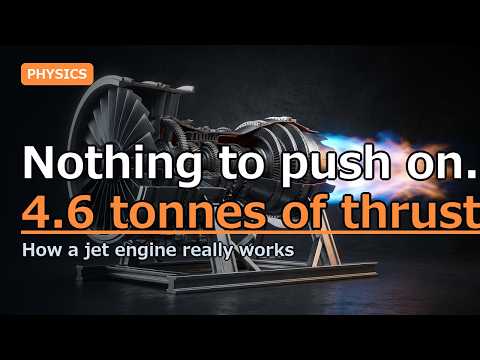
Nothing to Push On — Yet 4.6 Tonnes of Thrust | Jet Engine Explained
Air Becomes Thrust | How a Jet Engine Works
The enclosed area is the work | How a Jet Engine works #Shorts
Open the throttle - then what? | How a Jet Engine works #Shorts
Squeeze harder, fly faster | How a Jet Engine works #Shorts
How does a jet make thrust? | How a Jet Engine works #Shorts