NovaSolver›Loudspeaker Thiele-Small Parameters Simulator Back
Acoustics
Loudspeaker Thiele-Small Parameters Simulator
Compute the Thiele-Small parameters — the "blueprint" of a moving-coil loudspeaker driver. Adjust the moving mass, suspension compliance and force factor to see the resonance frequency fs, the Q factors and the equivalent volume Vas update in real time, and find out whether a sealed or vented box suits the driver.
Parameters
Moving mass Mms
g
Cone, voice coil and added air mass combined
Suspension compliance Cms
mm/N
Softness of surround + spider. Larger = softer
Force factor BL
T·m
Flux density × voice-coil length. Motor strength
Voice-coil DC resistance Re
Ω
DC resistance of the voice coil. Affects electrical damping
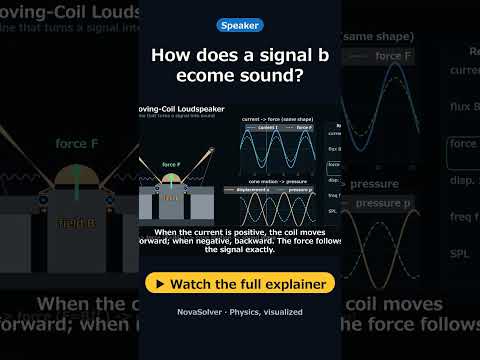
Cross-section of the cone, suspension, voice coil in the magnet gap and magnet. The cone oscillates in and out, with a small relative-response curve at top right showing the resonance peak at fs.
Low-frequency response — relative output vs frequency
Resonance frequency fs (Mms: moving-system equivalent mass, Cms: compliance) and total Q factor Qts. Qts is the combination of the electrical Q (Qes) and mechanical Q (Qms).
$$V_{as}=\rho_0 c^2\,S_d^{2}\,C_{ms}$$
Equivalent compliance volume Vas (ρ₀: air density, c: speed of sound, Sd: effective cone area). The product ρ₀c² ≈ 141855 Pa for air.
Qes: electrical damping via the magnet and voice coil; Qms: mechanical damping from suspension friction. Qts decides which enclosure type (sealed / vented) the driver suits.
What are Thiele-Small Parameters?
🙋
I saw "fs", "Qts" and "Vas" listed on a loudspeaker spec sheet. What do those numbers actually mean?
🎓
Those are the "Thiele-Small parameters". Roughly speaking, they describe the entire low-frequency behaviour of a single driver with just a handful of numbers. Building speaker boxes (enclosures) used to be a craft of intuition and trial and error. But in the 1960s and 70s two Australian engineers, Thiele and Small, showed that a driver's bass response can be predicted with equations. fs, Qts and Vas are the yardsticks for that prediction.
🙋
Predicting it with equations is impressive. Tell me about fs first — when I make the "moving mass Mms" heavier on the left, fs keeps dropping.
🎓
Good thing to grab. fs is the frequency at which the driver naturally resonates when it is "bare", with no box. The mechanism is just like a weight hanging on a spring: the cone mass Mms is the "weight" and the softness of the suspension (surround and spider), the compliance Cms, is the "spring". Since fs = 1/(2π√(Mms·Cms)), making the weight heavier or the spring softer both lower fs. fs is roughly the lowest note that driver can produce on its own — that's why subwoofers have a heavy Mms and a low fs.
🙋
I see. So what is a "Q factor"? There are three — Qes, Qms and Qts — and it's confusing.
🎓
Think of Q as a number for "how strongly and how long the resonance keeps going". Push a swing and let go: if it stops quickly, that's low Q; if it keeps swinging forever, that's high Q. A loudspeaker has two kinds of "brake" on its resonance. The electrical brake from the magnet and voice coil is Qes, and the mechanical brake from suspension friction is Qms. Combine those two and you get the overall damping, Qts = (Qes·Qms)/(Qes+Qms) — and that one matters most.
🙋
Why is that Qts the one that matters? What does it affect?
🎓
Qts decides "what kind of box suits the driver". A driver with low Qts (roughly below 0.4) is well damped, so it extends the bass nicely in a vented box (one with a port). A mid Qts (0.4-0.7) gives a clean, balanced result in a sealed box. A high Qts (above 0.7) needs a very large sealed box or an open baffle to behave. And Vas restates the suspension's softness as "the volume of air with the same softness", which is a guide to the sealed-box volume. Once you know fs, Qts and Vas, you can read the bass response before cutting a single panel.
Frequently Asked Questions
Thiele-Small parameters are a small set of electro-mechanical parameters that completely describe the low-frequency behaviour of a moving-coil loudspeaker driver. They were formalised in the 1960s and 70s by the Australian engineers Neville Thiele and Richard Small. Once you know these numbers you can predict a driver's bass response with equations before putting it in a box. The three key ones are the resonance frequency fs, the total Q factor Qts and the equivalent compliance volume Vas, and this tool computes them from the input quantities.
fs is the resonance frequency of the driver itself in free air, with no enclosure. It is the mechanical resonance formed by the moving-system equivalent mass Mms and the springiness of the suspension (compliance Cms): fs = 1/(2π√(Mms·Cms)). fs is roughly the lowest note the driver wants to reproduce on its own, so to reach deep bass you make the mass heavier and the suspension softer to lower fs. Lowering fs, however, costs sensitivity (sound pressure level).
Qts is a dimensionless number describing how heavily the resonance is damped. It is the combination of electrical damping Qes and mechanical damping Qms: Qts = (Qes·Qms)/(Qes+Qms). As a rule of thumb, a Qts below about 0.4 is a well-damped driver that suits a vented (bass-reflex) box, 0.4-0.7 suits a sealed box, and above 0.7 the driver wants a very large sealed box or an open baffle. This tool automatically reports the recommended enclosure type from Qts.
Vas expresses the springiness of the suspension as the volume of air that would have the same acoustic compliance. It is computed as Vas = ρ₀c²·Sd²·Cms and shown here in litres. A large Vas means a floppy (compliant) suspension, and it is also a guide to the box volume needed for a sealed enclosure. In general small-diameter drivers have a small Vas, while large-diameter drivers or those with a soft suspension have a large Vas.
Real-World Applications
Enclosure (speaker box) design: This is the most basic use of the Thiele-Small parameters. Once you know a driver's fs, Qts and Vas, you can calculate the internal volume for a sealed box, or the port dimensions and tuning frequency for a vented box, before building a single prototype. Speaker-design software such as WinISD and VituixCAD all require these parameters as input. This tool is a first step: it helps you grasp the driver's own raw parameters.
Driver selection and comparison: Manufacturer catalogues always list the T-S parameters for each driver. Even at the same diameter, a driver with a low fs and a large Vas produces bass easily in a small vented box, while a driver with a low Qts gives a tight, controlled bass. When choosing a driver for a DIY speaker or a car-audio install, the numbers alone let you judge "this driver suits this kind of box" without listening.
Subwoofer and low-bass design: Subwoofers conventionally use a heavy moving system to push fs down to 20-40 Hz and a powerful motor (large BL) to damp it firmly. With this tool you can see fs drop and Qes shrink as you increase Mms and BL. Reading T-S parameters is essential knowledge for designing the deep bass of home theatres or live-sound PA.
Fault diagnosis and ageing assessment: In a speaker used for many years, the surround hardens or tears and Cms changes, shifting fs. Comparing the as-new and current fs and Qts gives a quantitative measure of suspension degradation. Measuring the T-S parameters before and after a repair or recone, to confirm the driver has returned to its design values, is another practical use.
Common Misconceptions and Pitfalls
The most common pitfall is thinking the Thiele-Small parameters also describe midrange and treble quality. T-S parameters describe only the driver's behaviour in the low frequencies (roughly tens of Hz to a few hundred Hz) where the cone moves as a piston. The tone, directivity, distortion and resolution of the midrange and treble — where the cone starts to break up — are not captured by T-S parameters at all. A good fs or Qts does not guarantee a clean midrange, and vice versa. Treat them as tools for bass design only.
Next, assuming Mms is the same as the bare cone mass. Mms (the moving-system equivalent mass) includes not only the physical mass of the cone and voice coil but also the "added air mass" (radiation mass) that the cone pushes and pulls. Since this air mass also affects the low-frequency resonance, the published value is heavier than the physical mass. Cms, too, is the suspension softness "before any displacement", and at large excursions it stiffens non-linearly. This tool assumes the small-signal linear region, so behaviour at high drive levels differs.
Finally, the misconception that fs and Qts do not change once the driver is in a box. The fs, Qes, Qms and Qts this tool computes are the "raw" values for a driver in free air. When you actually mount it in a sealed box, the air inside acts as an extra spring, so the system resonance fc is higher than fs and the system Qtc is larger than Qts. A vented box gives an even more complex frequency response. Always remember that T-S parameters are the "bare driver" starting point, and the final in-box response must be calculated separately from there.
How to Use
Enter moving mass Mms (grams) — typically 5–50 g for woofers, 1–8 g for midrange drivers
Set force factor BL (Tesla·meter) — product of magnetic flux density and voice coil length; typical range 5–15 T·m for consumer drivers
Enter voice coil DC resistance Re (ohms) — usually 4–8 Ω for 4 Ω nominal impedance, 8–16 Ω for 8 Ω drivers
Click Compute to generate Thiele-Small parameters: fs, Qes, Qms, Qts, and Vas
Worked Example
A 6.5" woofer driver with Mms = 18 g, Cms = 0.75 mm/N, BL = 8.5 T·m, and Re = 6.2 Ω yields fs ≈ 42 Hz, Qes ≈ 0.38, Qms ≈ 3.2, Qts ≈ 0.34, and Vas ≈ 35 L. This Qts value suggests sealed-box alignment; a 32 L sealed enclosure would exhibit mild peaking and extended bass response to approximately 50 Hz at −3 dB.
Practical Notes
Qts below 0.4 favors sealed boxes with flat response; Qts 0.5–0.7 suits vented enclosures for extended low-frequency output
Vas represents acoustic compliance; smaller Vas drivers require proportionally smaller enclosures to maintain tuning accuracy
Measure Mms and Cms experimentally using impedance sweep (10 Hz–500 Hz) and curve fitting; manufacturer datasheets often omit these critical values
BL scales with voice coil winding length and magnet strength; multi-layer coils typically achieve higher BL at the cost of increased mass
Re increases with temperature (copper coefficient +0.4%/°C); design headroom into amplifier impedance matching for sustained high-power operation
🎬 Watch it in motion
Electricity Becomes Sound | How a Speaker Works
A speaker is a mass on a spring | How a Speaker works #Shorts
Why woofers must be big | How a Speaker works #Shorts
A magnet and coil shake the air | How a Speaker works #Shorts
How does a signal become sound? | How a Speaker works #Shorts