Monte Carlo Pi Estimator Back
Monte Carlo Simulation

Monte Carlo Pi Estimator

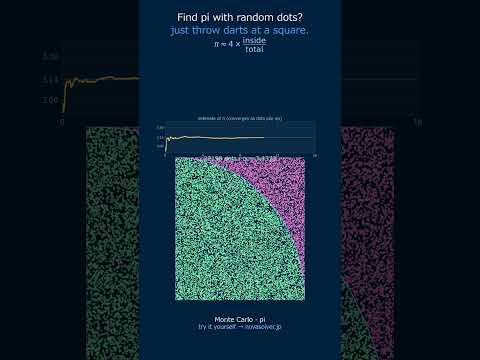
Drop random points into a unit square and count how many land inside the inscribed circle. Watch π emerge from pure probability — and see how error shrinks with more samples.

Parameters
Batch size (pts/step)
Frame interval (ms)
ms
Convergence Log
— Waiting for simulation to start —
Results
95% Confidence Interval
3.14159…
True π
π Estimate
0
Total Samples N
0
Hits Inside Circle
Relative Error
Mc
π Estimate Convergence
CAE & Numerical Analysis Connection Monte Carlo methods are widely used in high-dimensional integration, structural reliability analysis (complementing FORM/SORM), parameter sensitivity studies, and uncertainty quantification. MC-FEM combines random sampling with finite element models to evaluate failure probability under material and geometric variability.
Theory & Key Formulas

For a uniform random point $(x, y)$ in the unit square $[-1,1]^2$, the probability of landing inside the unit circle $x^2+y^2 \le 1$ is $\pi/4$. Therefore:

$$\pi \approx 4 \times \frac{\text{points inside circle}}{\text{total points } N}$$

Standard error: $\sigma_\pi \approx \dfrac{4\sqrt{p(1-p)}}{\sqrt{N}}$, where $p = \pi/4 \approx 0.785$

Convergence rate: error $\propto 1/\sqrt{N}$ — 10× more accuracy requires 100× more samples.

What is Monte Carlo Pi Estimation?

🙋
Wait, you can calculate Pi by just throwing random dots at a square? What exactly is happening in this simulator?
🎓
Basically, yes! The simulator randomly places points inside a square that perfectly frames a circle. The key is probability. Since the area of the circle is $\pi r^2$ and the square's area is $(2r)^2$, the ratio of points landing inside the circle to total points approximates $\pi/4$. Try running the simulation with a small "Batch size"—you'll see the estimate jump around a lot.
🙋
Okay, so more points give a better answer. But the estimate still seems to wiggle even after many points. How do we know how accurate it is?
🎓
Great observation! That wiggle is the "error," and it's fundamental to Monte Carlo methods. The uncertainty shrinks slowly, proportional to $1/\sqrt{N}$. For instance, to cut your error in half, you need four times as many points. That's why the simulator lets you control the "Frame interval"—slowing it down helps you see this convergence (or lack of it) more clearly.
🙋
If it's so slow to get accurate, why would anyone use this in real engineering? Isn't there a better formula for Pi?
🎓
Absolutely, we have better formulas for Pi itself. The real power of Monte Carlo isn't for calculating Pi, but for solving problems where geometry is too complex for simple formulas. Think of this simulator as a training ground. The same logic applies to calculating the volume of a weirdly shaped fuel tank or the stress probability in a bridge under random loads—where "inside the circle" becomes "inside the failure zone."

Physical Model & Key Equations

The core idea is that the probability of a random point landing inside the unit circle is equal to the ratio of the two areas.

$$ P(\text{inside circle}) = \frac{A_{\text{circle}}}{A_{\text{square}}}= \frac{\pi (1)^2}{(2)^2}= \frac{\pi}{4}$$

Rearranging this gives the fundamental estimator, where $N_{\text{in}}$ is the count of points satisfying $x^2 + y^2 \le 1$, and $N$ is the total points sampled.

The estimated value of π and its statistical error are given by:

$$ \pi_{\text{est}}= 4 \times \frac{N_{\text{in}}}{N}, \quad \sigma \approx \frac{4 \sqrt{N_{\text{in}}(1 - N_{\text{in}}/N)}}{N}\propto \frac{1}{\sqrt{N}}$$

Here, $\sigma$ is the standard error. The $1/\sqrt{N}$ scaling is the hallmark of Monte Carlo methods: precision improves slowly with more samples, making it computationally expensive for high accuracy but incredibly robust for complex problems.

Frequently Asked Questions

It approaches probabilistically, but it does not converge monotonically every time. According to the law of large numbers, as the number of samples increases, the probability of approaching the true value increases, but it may deviate from the true value along the way. The standard error decreases in inverse proportion to the square root of the number of samples.
Since the Monte Carlo method uses random numbers, statistical fluctuations (standard error) always exist in the estimated value. Even if the number of samples is increased by a factor of 10, the error only decreases to about 1/3, and it never becomes completely stable. To obtain more stable results, significantly increase the number of samples or take the average of multiple trial runs.
Yes, it does. Using low-quality random numbers (e.g., biased, short period) can cause bias in the distribution of points, leading to systematic errors in the estimated value of π. This tool uses sufficiently random pseudo-random numbers, but if higher precision is required, consider using cryptographically secure random numbers or quasi-random numbers (low-discrepancy sequences).
Use the standard error (σ ≈ π/√N) as a guideline. For example, with N=10,000, the standard error is approximately 0.031. The true value of π is expected to lie within the range of the estimated value ± 2σ with about 95% probability. Additionally, running the simulation multiple times with different sample sizes and checking the variability of the results is also effective.

Real-World Applications

High-Dimensional Integration: In quantum chemistry or financial mathematics, integrals can have hundreds of variables. Monte Carlo methods are often the only feasible way to approximate these high-dimensional volumes, much like estimating the area of a circle here.

Structural Reliability Analysis (FORM/SORM): Engineers use Monte Carlo simulations to complement advanced methods for predicting the probability of a structure failing under uncertain loads. They randomly sample material strengths and load conditions to see how often stresses exceed safe limits.

Uncertainty Quantification (UQ): When simulating physical systems (like airflow over a wing), input parameters are never perfectly known. Monte Carlo sampling is used to propagate these uncertainties through the simulation model to understand the range of possible outcomes.

Radiation Transport & Medical Physics: Monte Carlo methods, like the famous GEANT4 software, are used to simulate the random paths of particles (e.g., photons in radiation therapy) through matter. Each particle's journey is a random "point," and aggregating millions gives accurate dose distributions.

Common Misconceptions and Points to Note

First, let's establish the point that "precisely because it's random, the initial results can sometimes be completely different values." For example, looking at just the first 10 points and concluding "π is 2.8!" is premature. The Monte Carlo method is based on the law of large numbers, so the estimate with a small number of samples is heavily influenced by 'luck'. You must always use a sufficient number of points and observe the settling trend of the graph.

Next, don't confuse the meaning of the "Batch Size" and "Drawing Speed" settings. "Batch Size" is the number of points added in one step, directly affecting the convergence speed (computation time). On the other hand, "Drawing Speed" is just the rate at which those results are displayed on the screen, only impacting visualization for learning. In practical simulations, it's common to increase the batch size to run the calculation all at once and omit the drawing.

Finally, the most critical pitfall is the quality of the "pseudo-random numbers". This demo tool might use simple random numbers, but in serious CAE, bias or periodicity in random numbers can adversely affect results. For instance, in cases requiring millions of trials like risk calculations in financial engineering, selecting a high-quality random number generation algorithm (like the Mersenne Twister) is essential. If you notice points clustering in a certain range in this π calculation, get into the habit of suspecting the random number source.