Thrust Coefficient Simulator — Rocket Nozzle C_F and Specific Impulse
Visualize the thrust coefficient C_F, characteristic velocity c*, specific impulse Isp and exhaust velocity V_e of a rocket nozzle. Tune chamber pressure, exit pressure, gamma and chamber temperature to see how a converging-diverging nozzle performs.
Parameters
Chamber pressure P_c
MPa
Nozzle exit pressure P_e
kPa
Specific heat ratio γ
Chamber temperature T_c
K
Representative rocket combustion gas R = 320 J/(kg·K), g_0 = 9.81 m/s², full-expansion (P_e = P_a) is assumed.
Results
—
Thrust coefficient C_F
—
Characteristic velocity c*
—
Specific impulse Isp
—
Exhaust velocity V_e
Convergent-divergent nozzle and flow
Left = combustion chamber (red, hot) / center waist = throat A_t (white, M=1) / right = divergent section out to ambient (yellow → blue, cooling). Arrow length is flow speed; color indicates temperature.
Thrust coefficient C_F vs pressure ratio P_c/P_e
X-axis is log P_c/P_e (10 to 1000). The curve shows ideal C_F at constant gamma; the yellow marker is the current operating point. C_F approaches a saturation value as the pressure ratio grows.
Thrust is F = C_F · P_c · A_t. C_F depends only on the nozzle (gamma, pressure ratio); c* depends only on the chamber. Isp factors as their product divided by g_0, so chamber and nozzle improvements can be evaluated independently.
What is the Thrust Coefficient Simulator?
🙋
Rocket engine spec sheets show numbers like "vacuum Isp 380 s" and "C_F 1.7". What does C_F actually mean?
🎓
Roughly, C_F is the dimensionless ratio of thrust to (chamber pressure times throat area): F = C_F · P_c · A_t. With the default P_c = 7 MPa, gamma = 1.20, P_e = 100 kPa and T_c = 3500 K the simulator gives C_F = 1.600. That means the nozzle multiplies the chamber's P_c · A_t force by a factor of 1.6. Real engines sit between 1.4 and 1.9. The SSME (LH2/LOX) hits about 1.85 in vacuum, while solid rockets are usually around 1.6.
🙋
How are characteristic velocity c* and specific impulse Isp different? Both seem to capture "combustion quality".
🎓
That split is the elegant part of propulsion analysis. c* depends only on the chamber, not on the nozzle: with the defaults c* = 1632 m/s. Isp is the final figure of merit, thrust per unit weight flow: Isp = c* · C_F / g_0 = 1632 × 1.600 / 9.81 = 266 s. So Isp factorizes into chamber efficiency (c*) and nozzle efficiency (C_F). In real programs the combustor and nozzle teams optimize their pieces independently because of this clean split.
🙋
When I move the P_c slider up, C_F goes up. Why?
🎓
Look at the [1 − (P_e/P_c)^((g-1)/g)] term. Push P_c from 7 to 14 MPa and the pressure ratio P_c/P_e jumps from 70 to 140; (P_e/P_c)^0.167 drops from 0.493 to 0.439, so the bracket grows from 0.507 to 0.561. C_F therefore rises from 1.600 to 1.683. Watch the yellow marker slide up and right on the chart. Higher chamber pressure squeezes more thrust out of the same throat area, which is why high-P_c is a standard trick for raising specific thrust.
🙋
So if I want higher Isp, should I just push P_c up?
🎓
It helps a little, but raising c* is usually more powerful because Isp = c* · C_F / g_0 and c* scales with sqrt(T_c). Going T_c = 3500 → 4000 K lifts c* from 1632 to 1746 m/s (+7%). Doubling P_c from 7 to 14 MPa only adds about 5% to C_F. In practice high Isp comes from picking propellants with high T_c and low average molecular weight (large R). That's exactly why H-IIA uses LH2/LOX while Falcon 9 uses RP-1/LOX with smaller, denser propellants for first-stage thrust.
🙋
Does V_e equal Isp · g_0?
🎓
Yes, when the nozzle is perfectly expanded (P_e = P_a). With the defaults V_e = 2611 m/s and Isp · g_0 = 266 × 9.81 = 2609 m/s, basically identical (the small gap is rounding). When the nozzle is over- or under-expanded a pressure-thrust term (P_e − P_a)·A_e/m-dot kicks in, and the effective exhaust velocity c = Isp · g_0 separates from V_e. This simulator assumes ideal expansion, so V_e and Isp · g_0 always agree.
🙋
Where does the exit Mach number M_e come from? The nozzle picture says "M_e ≈ 2.5" or so.
🎓
Solve P_c/P_e = (1 + (g-1)/2 · M_e²)^(g/(g-1)) for M_e. With P_c/P_e = 70 and gamma = 1.20 you get M_e ≈ 2.86. The expansion ratio A_e/A_t then comes from the geometric isentropic relation A_e/A_t = (1/M_e)·((2/(g+1))(1 + (g-1)/2 · M_e²))^((g+1)/(2(g-1))) ≈ 7. Higher A_e/A_t boosts vacuum performance but hurts at sea level (over-expansion shocks), which is why first-stage and upper-stage nozzles use very different expansion ratios.
Frequently Asked Questions
R = R_u/M (universal gas constant divided by molecular weight) is a representative value for rocket combustion gases. LH2/LOX with H_2O-dominated products and dissociation has effective M ≈ 14 and R ≈ 590; kerolox and solids with CO_2 and N_2 around have M ≈ 22-25 and R ≈ 320-380. This tool uses R = 320 as a generic chemical-rocket value so you can focus on the gamma and T_c sensitivities. For specific propellant combinations use a chemical-equilibrium code such as NASA CEA or RPA.
It is exact only at one design altitude. The Falcon 9 first stage sweeps P_e/P_a from about 0.6 to 2 during ascent, and at low altitude over-expansion costs 5-15% of C_F. The SSME has expansion ratio 77 for vacuum performance, so at sea-level start a normal shock forms inside the bell and performance is reduced. In practice engineers add the pressure-thrust term C_F_actual = C_F_ideal + (P_e - P_a)·A_e/(P_c·A_t) and integrate over the trajectory.
Air's gamma ≈ 1.40 is the upper bound. Real combustion at 3000-3700 K activates molecular vibrational modes and the products are dominated by polyatomic molecules like H_2O and CO_2, dragging gamma down to about 1.10-1.25. Solid rockets and LH2/LOX engines typically operate near gamma = 1.20, which is the simulator default. Sliding gamma from 1.10 to 1.40 changes C_F from about 1.55 to 1.74, giving a feel for how strongly gamma affects nozzle performance.
For full expansion, M_e and gamma uniquely fix A_e/A_t = (1/M_e)·((2/(g+1))(1 + (g-1)/2 · M_e²))^((g+1)/(2(g-1))). The nozzle schematic also shows M_e and A_e/A_t at the exit. With default P_c/P_e = 70 you get M_e ≈ 2.86 and A_e/A_t ≈ 7. Real engines pick the expansion ratio for the design altitude: SSME 77, Merlin 16, Raptor vacuum about 80. Larger ratios help in vacuum but cause over-expansion shocks at sea level, so first-stage nozzles use moderate values (10-30).
Real-World Applications
Liquid rocket engine design trades: Modern programs such as SpaceX Raptor, Blue Origin BE-4 and Aerojet Rocketdyne RS-25 first pick the propellant combination to set c* (about 2300 m/s for LH2/LOX, 1850 m/s for methalox) and then choose the expansion ratio A_e/A_t and chamber pressure to set C_F. Plug P_c = 30 MPa, gamma = 1.15 and T_c = 3700 K into this simulator and you get C_F ≈ 1.79 and Isp ≈ 320 s, close to the targets of full-flow staged-combustion engines. Conceptual studies use exactly this kind of separation between chamber and nozzle.
Solid rocket motor nozzle optimization: Solid rockets such as the Space Shuttle SRB, H-IIA SRB-A and tactical missile motors have a fixed propellant grain, so c* is locked (typically 1500-1600 m/s). The design freedom lives in the throat area and expansion ratio. With gamma = 1.18, T_c = 3000 K and P_c = 5 MPa the tool gives C_F ≈ 1.55 and Isp ≈ 245 s, in good agreement with HTPB-class motors. Sweeping the expansion ratio rapidly narrows down the optimal A_e/A_t for a given payload and altitude profile.
Hot-fire test data interpretation: On a test stand the measured quantities are thrust F, chamber pressure P_c and propellant mass flow m-dot. From those you recover C_F = F/(P_c · A_t), c* = P_c · A_t / m-dot and Isp = F/(m-dot · g_0). When measured Isp falls short of expectations the question is whether the nozzle (low C_F efficiency) or the chamber (low c* efficiency) is responsible. NASA and JAXA test reports always present these three numbers, and the theoretical values from this simulator serve as the benchmark.
University and amateur hybrid rockets: University rocket clubs in the US and Japan (UCLA, Stanford, Tokyo, Hokkaido, Tohoku, etc.) build hybrid rockets such as N_2O + HTPB or LOX + HDPE. For early concept work the question is "what Isp to expect?". With gamma = 1.25, T_c = 3000 K and P_c = 3 MPa this tool gives C_F ≈ 1.50 and Isp ≈ 220 s, matching small hybrid test stands (200-250 s) reasonably well. It is a useful first-pass tool when CEA still feels too heavy.
Common Misconceptions and Pitfalls
The most common misconception is the belief that raising C_F always raises Isp. The product form Isp = c* · C_F / g_0 makes it clear: a 10% gain in C_F is wiped out by a 10% drop in c*. Stretching the expansion ratio to push vacuum C_F from 1.7 to 1.85 can backfire if it drops T_c (and thus c*). Move the simulator's P_c and P_e sliders and you will see C_F change while c* stays put (c* depends only on T_c). Real programs always optimize C_F and c* as decoupled axes.
A related pitfall is assuming that vacuum Isp is always the maximum and sea-level Isp is just a smaller version of the same number. A high-expansion vacuum bell (A_e/A_t around 70) operated at sea level becomes severely over-expanded; the resulting shock inside the nozzle imposes oscillating loads on the wall and can destroy it. The SSME and RL-10 use carefully sequenced startups for exactly this reason. The simulator only shows design-point performance, so any real-engine assessment must include the altitude profile.
A third trap is overestimating how much the gas constant R changes c*. Since c* scales with sqrt(R), going from R = 320 to R = 500 J/(kg·K) only multiplies c* by sqrt(500/320) ≈ 1.25. The dominant levers for c* are T_c and gamma, with R mattering only when the propellant mix is changed. This tool fixes R and lets you focus on gamma and T_c; for accurate cross-propellant studies use a chemical-equilibrium code such as NASA CEA or NIST tools.
Set chamber pressure (Pc) between 10–300 bar using the slider; typical solid rocket motors operate at 60–80 bar.
Adjust chamber temperature (Tc) from 2500–3800 K via the slider; RP-1/LOX engines run ~3600 K, solid propellants ~3200 K.
Define specific heat ratio gamma (γ) between 1.1–1.4 using the slider; combustion products of hydrazine ≈ 1.26, nitrogen tetroxide ≈ 1.30.
Set exit pressure (Pe) or expansion ratio; simulator calculates thrust coefficient C_F, characteristic velocity c*, specific impulse I_sp, and exhaust velocity V_e in real time.
Worked Example
For a LOX/kerosene rocket with Pc=200 bar, Tc=3600 K, γ=1.22, Pe=1 bar (vacuum nozzle): characteristic velocity c*≈1580 m/s, exhaust velocity V_e≈4200 m/s, thrust coefficient C_F≈1.85, and specific impulse I_sp≈428 seconds. Reducing chamber pressure to 100 bar lowers c* to ~1520 m/s and I_sp to ~412 s, demonstrating the sensitivity of sea-level thrust and efficiency to combustion chamber conditions.
Practical Notes
Diverging nozzle geometry (area ratio A_e/A_t≈8–15) extends supersonic expansion; increasing Pe ratio artificially (simulating back-pressure) reduces C_F below vacuum maximum, critical for sea-level vs. altitude trade-off analysis.
Gamma variation with propellant type dominates performance: hydrogen-oxygen (γ≈1.24) achieves ~465 s I_sp; methane-LOX (γ≈1.20) yields ~365 s, illustrating why specific impulse scales directly with exhaust temperature and inversely with molecular weight.
For throttling studies, reduce Pc while holding γ and Tc fixed; characteristic velocity remains nearly constant, but thrust drops linearly—essential for staging and ullage pressure margin calculations in cryogenic stages.
🎬 Watch it in motion
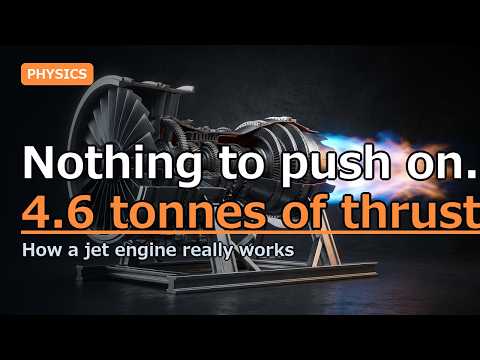
Nothing to Push On — Yet 4.6 Tonnes of Thrust | Jet Engine Explained