NovaSolver›Wave Superposition & Beat Frequency Simulator Back
Physics / Acoustic Engineering
Wave Superposition & Beat Frequency Simulator
Adjust frequency, amplitude, and phase of two sinusoidal waves to observe composite wave, beats, and complete interference in real time. Understand wave relationships from multiple perspectives via spectrum and Lissajous figure.
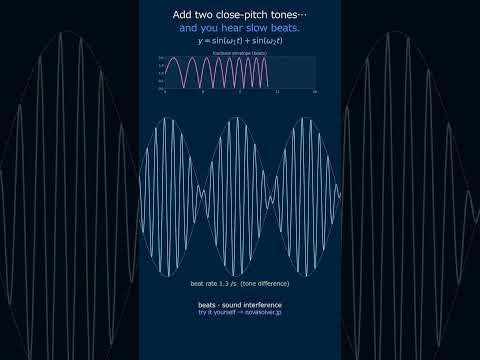
I've heard about 'beats' in music class, but why does playing two close frequencies make that 'wobbling' sound?
🎓
You can calculate it with the addition theorem. When you superpose two waves with f₁ = 440Hz and f₂ = 441Hz, the amplitude of the combined wave varies as A·cos(2π·1·t) — meaning you hear a 'louder-softer' cycle once per second. That's the beat frequency |f₁-f₂| = 1Hz. Try the 'Beats' preset and you'll see the green combined wave's amplitude pulsing.
🙋
When I set the phase difference to 180°, the combined wave became zero! Is this noise cancellation?
🎓
Exactly that. Noise-canceling headphones use a microphone to pick up external noise, then instantly generate an inverted-phase (180° shifted) sound wave and superpose it. With the same frequency, amplitude, and opposite phase, the amplitude becomes zero — the sound 'disappears'. However, because it's real-time processing, there's a tiny time delay — it's not perfect, but it's highly effective for steady noises like the low-frequency engine hum on airplanes.
🙋
Looking at the 'Spectrum' tab, I see bars at f₁ and f₂. If I set f₁=5 and f₂=10, does that become 'harmonics'?
🎓
Yes, f₂ = 2f₁ is the 'second harmonic' (2nd overtone) relationship. The timbre of string instruments differs because the amplitude ratio between the fundamental (f₁) and each harmonic varies. A pure sine wave has zero harmonics. The reason a violin and a flute playing the same 'A' sound different is due to their different harmonic spectrum compositions. Switch to the 'Harmonics' preset in the Spectrum tab and you'll see f₁ and f₂ are not 'right next to each other' but spaced an octave apart.
🙋
I've heard that Lissajous figures form closed shapes when the frequency ratio of two vibrations is an integer ratio. Where is this actually used?
🎓
In the old days, you'd feed two signals into an oscilloscope in X-Y mode to visually determine the frequency ratio. Even today, in control system testing, the phase difference between a reference signal and a measured signal is read from the tilt of the ellipse in a Lissajous figure. In a CAE context, it's useful for visualizing the frequency response of a 2-DOF vibration system. f₁:f₂=1:2 gives a 'figure-8', 1:3 gives a 'twisted M-shape' — try the simulator to see how the pattern gets more complex as the ratio becomes more complicated.
🙋
Is wave superposition also used in structural vibration analysis?
🎓
It's a core concept. 'Modal superposition method' is a technique that computes the vibration response of a complex structure as the superposition of its natural modes — it's a standard algorithm in finite element solvers. Each mode is treated as a simple sine wave, and their sum gives the actual displacement. It's also used in seismic response analysis via the 'response spectrum method', where the input energy at each natural frequency is accumulated mode by mode to find the maximum response.
Frequently Asked Questions
Are there cases where the superposition principle does not hold?
It does not hold in nonlinear media. For example, when high-intensity laser light passes through a nonlinear optical crystal, second harmonic generation (SHG) occurs, doubling the frequency. In sound waves, large amplitudes also produce nonlinear effects, forming shock waves. In CAE, examples include nonlinear soil response and material nonlinearity under large deformation. Under normal engineering conditions (small displacement, linear materials), superposition can be used.
What can we learn from measuring the beat frequency?
The frequency difference between two vibration sources is directly obtained. In musical instrument tuning, a reference tuning fork (440 Hz) and the instrument sound are superimposed; the beat is heard and tuning continues until the beat becomes zero. In ultrasonic flow meters, the difference in propagation speed (Doppler shift) in the fluid appears as a beat and is converted to flow rate. In rotating machinery monitoring, subtle frequency changes due to bearing damage can be detected as beats.
How are Fourier transform and wave superposition related?
The Fourier transform is an operation that decomposes any waveform into a superposition of sine waves. This simulator does the opposite: it shows the superposition of two sine waves. The bar chart displayed in the spectrum tab corresponds to the result of applying a Fourier transform to the composite wave. In CAE, vibration data (time series) is decomposed into frequency components via FFT, and specific natural frequency components are analyzed.
How are standing waves (stationary waves) created?
When two waves of the same frequency and amplitude travel in opposite directions, a standing wave is created: y = A·sin(kx-ωt) + A·sin(kx+ωt) = 2A·sin(kx)·cos(ωt). This produces a pattern of fixed antinodes and nodes depending on position. This is the vibration of strings in string instruments and air columns in wind instruments. For a string fixed at both ends, stable standing waves occur only when the wavelength is an integer fraction of the string length, which determines the harmonic structure.
What happens to the composite wave when the phase difference φ = 90°?
When f₁=f₂ and A₁=A₂, the composite amplitude is A·√2 ≈ 1.414A, forming a sine wave with a 45° phase shift. This is intermediate between complete constructive interference (φ=0°, amplitude 2A) and complete destructive interference (φ=180°, amplitude 0). In general, when A₁=A₂=A, the composite amplitude is given by 2A·cos(φ/2). Moving the phase difference slider from 0° to 180° shows the amplitude of the composite wave smoothly decreasing.
What is the modal superposition method?
This is an analysis method that calculates the dynamic response of a structure by superposing each natural mode. Using n mode shapes (φ₁, φ₂, ..., φₙ) obtained from eigenvalue analysis as a basis, the displacement is expanded as u(t) = Σ qᵢ(t)·φᵢ. Since the response qᵢ of each mode follows the vibration equation of a single-degree-of-freedom system, the analysis becomes simpler. It is widely used in seismic response analysis and unbalance response calculation of rotating machinery, significantly reducing computational cost compared to solving all degrees of freedom directly.
Set Wave 1 frequency (vf1) in Hz and amplitude (va1) in volts or pressure units using the sliders or numeric input fields (sf1Num, sa1Num)
Set Wave 2 frequency (vf2) in Hz and amplitude using corresponding controls; adjust phase offset if required for interference studies
Observe the composite waveform display and read Beat Frequency f_beat (|f1−f2|), Beat Period T_beat (1/f_beat), and amplitude extrema from the output stat labels
Worked Example
Ultrasonic flaw detection: Set Wave 1 to 40 kHz, 5 mV amplitude and Wave 2 to 40.5 kHz, 5 mV amplitude. The simulator calculates f_beat = 0.5 kHz (500 Hz beat frequency) and T_beat = 2 ms. Max amplitude (constructive interference) = 10 mV; Min amplitude (destructive) = 0 mV. This 500 Hz beat pattern is characteristic of swept-frequency inspection systems used in thickness gauging of aircraft skins.
Practical Notes
Small frequency differences (<5 Hz) produce slow beats useful for tuning machinery; 40 kHz pairs generate rapid modulation for sonar and medical imaging bandwidth analysis
Equal amplitudes yield complete cancellation at destructive interference; unequal amplitudes (e.g., 3 mV vs 5 mV) produce residual signal amplitude of 2 mV minimum
Phase offset shifts the beat envelope but does not change f_beat; use this to simulate transducer coupling delays in NDT applications
🎬 Watch it in motion
Beats | two close tones make the volume pulse #Shorts
The Wave Equation | how waves travel, bounce, and overlap #Shorts