Practical Application of ASME V&V Guidelines
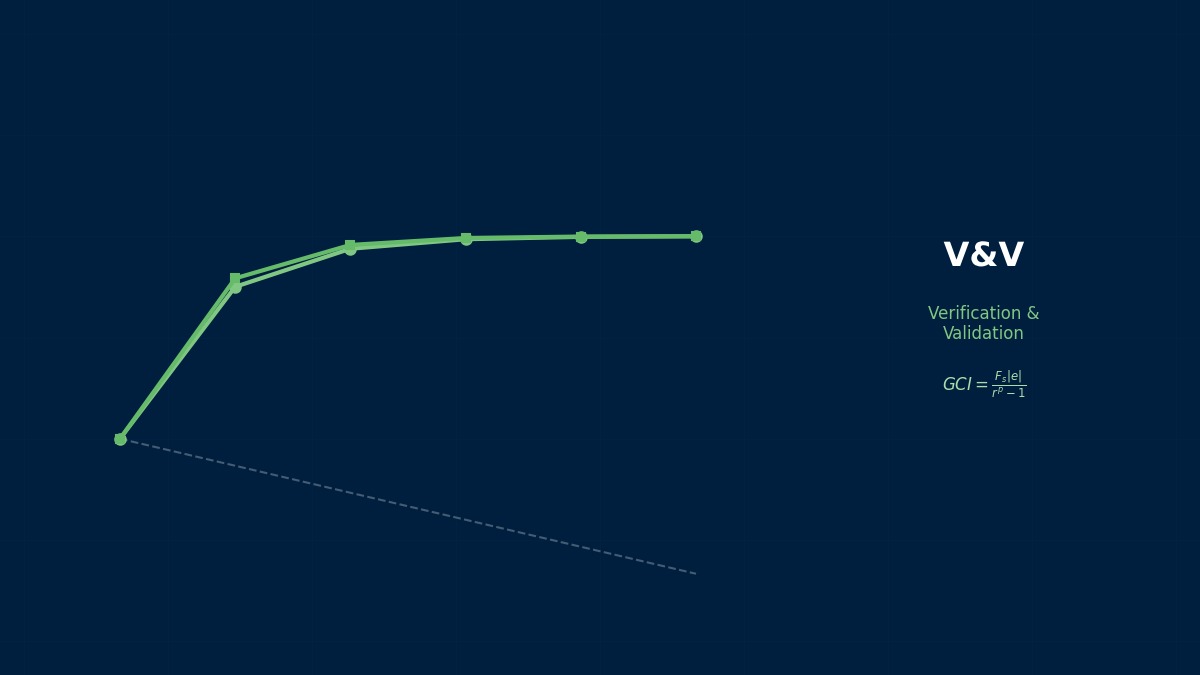
Theory: the V&V flow
Overview
We're introducing V&V in-house. There are several ASME standards and I don't know where to start.
V&V 10 for solids, V&V 20 for fluids and heat transfer, and V&V 40 for medical devices are the entry points — but the underlying flow is common. First decide what the calculation will judge and how accurate it must be. Next confirm the software solves its equations correctly (code verification) and how large discretisation error is on your model's grid (solution verification). Then compare with tests, setting the difference against all the uncertainties (validation). Walking one example from start to finish teaches more than reading the standards.
Solution verification (GCI)
Validation judgement
$S$ is the simulation value and $D$ the test value. The model's intrinsic error $\delta_{model}$ is taken to lie within the difference $E$ plus or minus the validation uncertainty band (about 95% at twice $u_{val}$). If that range fits within the accuracy requirement, the model is valid for its purpose.
The birth of the ASME V&V standards
The American Society of Mechanical Engineers (ASME), seeing the need for common procedures to demonstrate the credibility of computational results, issued V&V 10 for solid mechanics in 2006 and V&V 20 for fluids and heat transfer in 2009. Behind this was growing reliance on computation in place of testing in nuclear and aerospace work. In 2018 V&V 40 followed, for using computational models in medical device review, linked with the US FDA's review approach. The standards differ in scope but share one idea: estimate errors and uncertainties separately and judge against the purpose.
Worked example: validating bracket strain
FE strain at a strain-gauge location near a stress concentration on a metal bracket is compared with tests; the accuracy requirement is 5% of the test mean.
| Step | Content | Result |
|---|---|---|
| Solution verification | Three grids (ratio 2): 812 / 842 / 850 µε | Order 1.91, extrapolated 852.9, GCI 0.43% (±3.6 µε) |
| Test data | 5 specimens: 861, 838, 874, 852, 846 µε; gauge 1% | Mean 854.2, SD 13.9, u_D 10.6 µε |
| Input uncertainty | Modulus 2%, load 1% | u_input 19.0 µε |
| Comparison | E = S − D | −4.2 µε (−0.5%) |
| Validation uncertainty | u_val | 21.8 µε; 95% band ±43.6 µε |
| Model error range | E ± 2u_val | −5.6% to +4.6% |
The difference is only −0.5%, yet we can't say the 5% requirement is met?
That's the crux of V&V. Even with a small difference, the ±5.1% uncertainty band means the model's intrinsic error is only known to lie between −5.6% and +4.6% — the lower end slightly beyond 5%. Breaking down the uncertainty: modulus scatter 76%, test scatter 23%, grid error just 1%. So further refinement is pointless; measuring the specimens' modulus helps most. And had you compared using only the coarse grid, the difference would have been −4.9%, mistaking discretisation error for model error.
Practical workflow
- Document what the calculation decides, the quantities of interest and the accuracy requirement.
- Perform code verification (known or manufactured solutions) and solution verification on your model (three grids).
- Plan tests together with the calculation, recording test scatter and measurement uncertainty.
- Propagate input uncertainties (properties, loads, dimensions) and assemble the validation uncertainty.
- Compare the difference and uncertainty range with the requirement; if short, reduce the largest component.
“The match was a coincidence”
An analysis team reported their model valid because a coarse-grid result matched tests within 2%. Later refinement changed the computed value by 8%, leaving it 6% from the tests. Discretisation error on the coarse grid and material-model error had cancelled in opposite directions — a coincidental match. Without solution verification first to shrink discretisation error, the validation difference mixes both errors. The order of V&V steps matters.
Common mistakes
Mistakes and fixes
| Mistake | Effect | Fix |
|---|---|---|
| Pass/fail from difference alone | Overconfidence ignoring uncertainty | Judge with E ± 2u_val |
| Skipping solution verification | Cancelling errors missed | Estimate grid error first |
| Testing one specimen | Scatter unknown | Test several for statistics |
| Improving a minor component | Band doesn't narrow | Reduce the dominant component |
| Setting requirements afterwards | Arbitrary criteria | Document before computing |
I'd like to learn related topics.
For the standards see ASME V&V 10, ASME V&V 20 and ASME V&V 40; for methods, GCI and validation metrics; for organisational practice, simulation governance and the model review checklist.
Related Topics
Experience the theory firsthand with the interactive simulator for this field
All Simulators