Flag/Membrane FSI Analysis
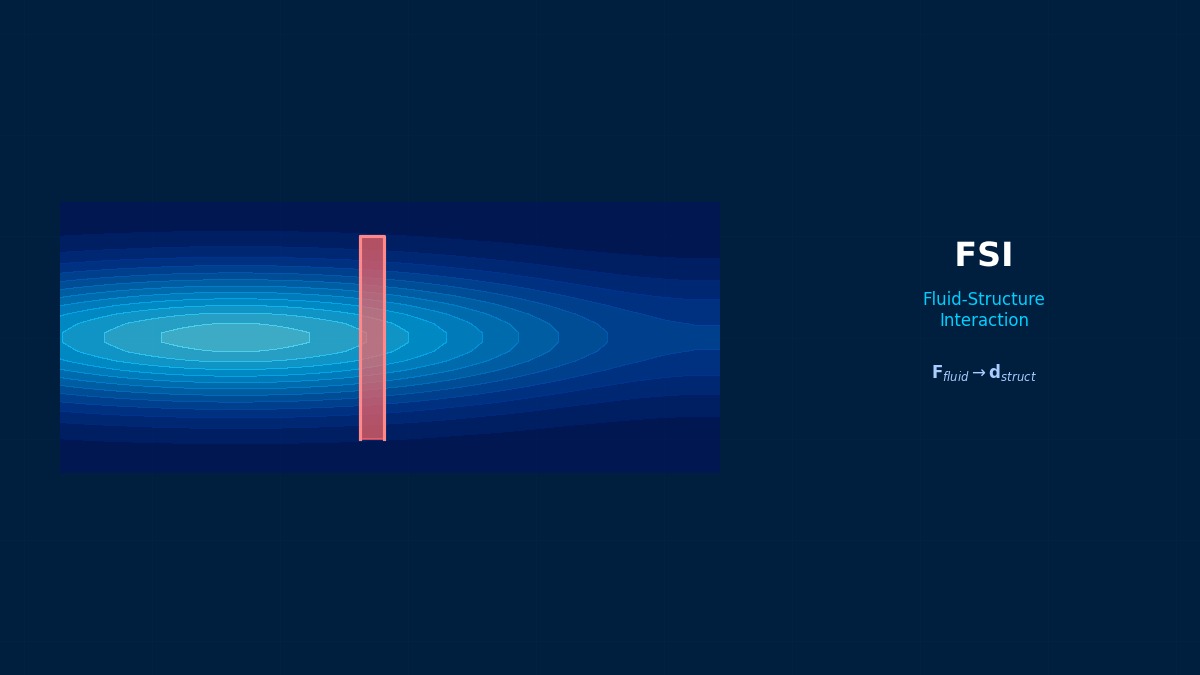
Flag/Membrane FSI: Theoretical Foundations
Physics of the Phenomenon
Is simulating the phenomenon of a flag fluttering difficult?
The fluttering of flags and membranes is a classic fluid-structure interaction (FSI) problem. Because lightweight, flexible structures undergo large deformations in flow, it is necessary to handle both geometric nonlinearity and strong coupling effects simultaneously.
Governing Equations
How is the mechanics of a membrane structure described?
For a membrane model ignoring bending stiffness, the equation of motion is:
Here, $T$ is the membrane tension, $\Delta p$ is the pressure difference from the fluid, and $\mathbf{n}$ is the normal direction of the membrane. When considering bending stiffness, the Kirchhoff-Love plate theory is used.
Here, $D = Eh^3 / (12(1-\nu^2))$ is the bending stiffness.
What parameters govern the stability of a flag?
The main parameters are the mass ratio $M^* = \rho_s h / (\rho_f L)$ and the dimensionless bending stiffness $K_B = D / (\rho_f U^2 L^3)$. A smaller $M^*$ (lighter flag) makes it more prone to instability, and a smaller $K_B$ leads to large-amplitude fluttering.
Linear stability analysis is used to find the critical flow velocity. The dimensionless critical velocity $U^*_c$ is a function of $M^*$ and $K_B$, and can be compared with theoretical analyses by Shelley et al. and experiments by Connell.
The "Critical Velocity" for Flag Fluttering — The Moment Theory Predicts Flapping Begins
Have you noticed that when a flag starts fluttering in the wind, the vibration suddenly begins once a certain critical wind speed is reached? This is the "onset of flutter instability," where the fluid forces acting on the flag exceed the structural damping when the flow velocity surpasses the critical value, causing the amplitude to grow exponentially. Theoretically, the ratio of the flag's mass per unit area ρ_s to the fluid density ρ_f (mass ratio ρ_s/(ρ_f·L), where L is the flag length) is important; a smaller value means flutter begins at a lower wind speed. Conversely, paper or thin films begin to flutter at very low speeds in water—this principle is being utilized in recent research on "flexible membrane energy harvesters using water flow," where flag FSI theory is being applied to power generation technology.
Computational Methods for Flag/Membrane FSI
Selection of Numerical Methods
What methods are used for flag FSI analysis?
Due to large deformations, IB methods or overset meshes are more suitable than ALE methods.
| Method | Characteristics | Representative Codes |
|---|---|---|
| IB Method | Fixed mesh. Robust for large deformations. | IBAMR, IB2d |
| ALE-FEM | High interface accuracy. Requires remeshing. | Ansys, COMSOL |
| LBM-IBM | Lattice Boltzmann + IB | Palabos |
| SPH-FEM | Particle method. Handles free surfaces. | OpenFPM |
Does the IB method treat the membrane thickness as zero?
In Peskin-type IB methods, the Lagrangian structure is treated as a manifold of one lower dimension. A 2D flag is embedded as a 1D fiber, a 3D membrane as a 2D surface. A regularized version of the Dirac delta function is used for force spreading.
Time Integration and Stability
Are there issues with time integration when the membrane is light?
In systems with a small mass ratio, the CFL condition for explicit time integration becomes very strict. Semi-implicit schemes (solving fluid implicitly, structure explicitly) or fully implicit schemes are necessary.
According to the Causin-type stability condition, the stability of weak coupling depends on $\rho_s h / (\rho_f \Delta x)$. Weak coupling becomes unstable when this ratio is small.
Calculating a Flag with ALE Makes the Mesh "Melt" — The Limits of Grid Deformation
When using the ALE (Arbitrary Lagrangian-Eulerian) method for flag FSI calculation, the mesh deforms along with the flag's large deformation. However, when the flag flaps significantly, the mesh near the trailing edge becomes extremely distorted, leading to "mesh collapse" where the matrix becomes nearly singular and the calculation diverges. To avoid this, mesh regeneration (remeshing) or isobaric methods are used, but frequent remeshing drastically increases computational cost. Recently, the Immersed Boundary Method (IBM) has gained attention, as it allows calculation with a fixed fluid mesh regardless of structural deformation, making it suitable for large deformation problems like flags. While IBM may be inferior to ALE in terms of accuracy, it has advantages in stability and computational cost—choosing the right method is where the designer's skill shines.
Flag/Membrane FSI in Practice
Practical Model Setup
Please teach me the steps to set up a 2D flag fluttering problem as a benchmark.
The Turek benchmark (FSI2, FSI3) is a widely used standard problem.
| Parameter | FSI2 | FSI3 |
|---|---|---|
| Re | 100 | 200 |
| Structural Density | 10,000 kg/m³ | 1,000 kg/m³ |
| Young's Modulus | 1.4 MPa | 5.6 MPa |
| Displacement Amplitude | O(cm) | O(cm) |
| Feature | Weak coupling possible | Strong coupling required |
What should I be careful about in mesh settings?
Sufficiently resolve areas around the flag's leading and trailing edges, and the wake region near the flag. A minimum resolution of 4-6 cells in the flag's thickness direction is needed. For ALE methods, since the mesh can collapse under large deformation, design the mesh with a deformation margin of at least 1.5 times the maximum displacement.
Membrane Structure Application: Parabolic Solar Collector
What are some engineering application examples?
Fresnel mirrors for solar concentrators or mirror membranes of parabolic troughs deform under wind load, reducing focusing efficiency. This FSI is solved to achieve structural design satisfying allowable deformation limits. Other examples include inflatable structures (expandable space structures, tent structures) and flapping flags for energy harvesting (piezoelectric flag).
"The Flag Noise is Too Loud to Sleep" — Noise Problems Caused by Thin-Film FSI
The loud flapping noise from construction site protective sheets or temporary fences in strong wind is noise caused by thin-film flutter. This "flapping noise" becomes very noticeable when the flutter frequency enters the audible range (20–20,000 Hz), leading to complaints from neighbors. In practice, applying a certain tension (pre-tension) to the membrane raises its natural frequency to avoid resonance. Experimental data shows that simply changing pre-tension from 0.5 kPa to 2 kPa improves the flutter onset wind speed from 7 m/s to 12 m/s. The same problem occurs in tent structures and outdoor advertising banners, so practical know-how on thin-film FSI is steadily accumulated in the construction industry.
Flag/Membrane FSI: Software & Solver Comparison
Tool Selection
Which tools are suitable for flag/membrane FSI analysis?
Capability to handle large deformation is key for tool selection.
Related Topics
Experience the theory firsthand with the interactive simulator for this field
All Simulators| Tool | Large Deformation Handling | Membrane Element | Features |
|---|---|---|---|
| Ansys Fluent + Mechanical | ALE + remeshing | Shell/Membrane | System Coupling. Proven in industrial applications. |
| STAR-CCM+ | Morphing + overset | Shell (built-in FEA) | Excellent automatic remeshing. |
| COMSOL | ALE | Membrane/Shell | Small-scale monolithic coupling. |
| OpenFOAM + preCICE | IB Method/ALE | CalculiX/FEniCS | OSS. Optimal for research purposes. |