Immersed Boundary Method (IBM)
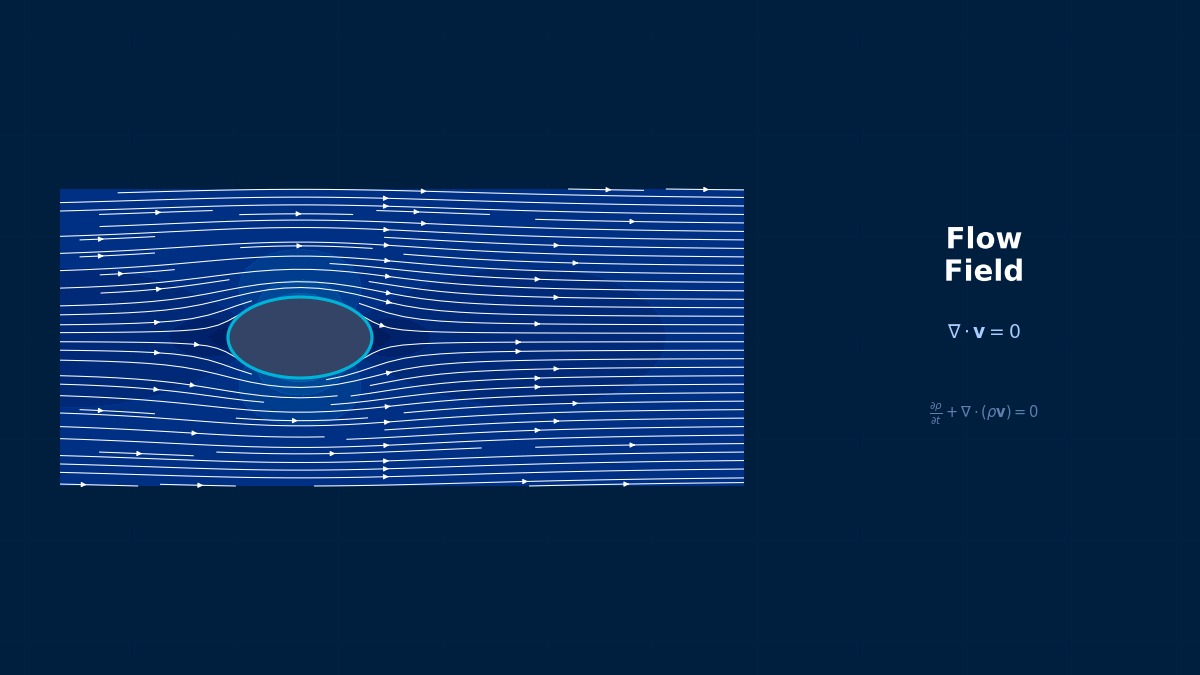
Theory and Physics
Basic Concepts of IBM
Professor, how is the Immersed Boundary Method different from the ALE method?
In the ALE method, the mesh conforms to the structural interface (body-conforming), whereas in IBM, the structure is "immersed" on a fixed Cartesian grid. The structural boundary is defined independently of the mesh, and boundary conditions are imposed via a forcing term or interpolation.
It's a method devised by Peskin (1972) for simulating blood flow in heart valves. The original formulation is as follows.
Here, $\mathbf{F}$ is the force density on the Lagrangian interface, $\delta$ is the Dirac delta function, and $\mathbf{X}(t)$ is the interface position.
How is the Dirac delta function discretized?
Peskin's regularized delta function is used. The standard is the 4-point discrete delta function:
where $h$ is the grid spacing and $\phi$ is a smooth kernel function with a support width of 4.
IBM Classification
Are there different types of IBM?
They can be broadly divided into two main categories.
| Classification | Method | Principle | Accuracy |
|---|---|---|---|
| Continuous forcing | Peskin-type | Add source term to Euler equations | 1st order (delta function smearing) |
| Discrete forcing | Fadlun-type, Ghost cell | Directly modify discrete equations | Can achieve 2nd order |
| Cut-cell method | Cartesian cut cell | Cut cells at the interface | 2nd order |
Continuous forcing (Peskin-type) is simple to implement, but the interface blurs by the support width of the delta function. Controlling wall $y^+$ is difficult, making it unsuitable for high-Re turbulent wall-bounded flows.
Discrete forcing (Ghost cell method, Direct forcing method) can represent the interface sharply and achieve near-ALE accuracy for wall boundary layer resolution. However, implementation is complex, especially stable handling of cut-cells for moving interfaces is challenging.
How is the Cut-cell method different from IBM?
Strictly speaking, the Cut-cell method is a type of IBM, where cells are geometrically cut where the interface crosses them, satisfying conservation laws on the cut cells. It has high conservation and good accuracy, but requires countermeasures for the small cell problem (where cut cell volumes become extremely small). This is addressed with cell merging or flux redistribution.
IBM was born from the struggle to analyze "heart valves"
The original form of the Immersed Boundary Method (IBM) was born in the 1970s when Charles Peskin at New York University tackled the simulation of heart mitral valves. The valve shape moved complexly, and traditional boundary-conforming meshes required remeshing at every step, which was impractical. Thus, the idea of "distributing the influence of the valve onto a fixed Cartesian grid" was born. The fact that IBM, invented for medical applications, is now used in underwater robots and wind turbine design teaches us the far-reaching impact of basic research.
Physical Meaning of Each Term
- Temporal term $\partial(\rho\phi)/\partial t$: Think of the moment you turn on a faucet. At first, water comes out in an unstable, spluttering manner, but after a while, it becomes a steady flow, right? This "period of change" is described by the temporal term. The pulsation of blood flow from a heartbeat, the flow fluctuations each time an engine valve opens and closes—all are unsteady phenomena. So what is steady-state analysis? Looking only at "after sufficient time has passed and the flow has settled"—meaning setting this term to zero. This significantly reduces computational cost, so trying a steady-state solution first is a basic CFD strategy.
- Convection term $\nabla \cdot (\rho \mathbf{u} \phi)$: What happens if you drop a leaf into a river? It gets carried downstream by the flow, right? This is "convection"—the effect where fluid motion transports things. Warm air from a heater reaching the far corner of a room is also because the "carrier," air, transports heat via convection. Here's the interesting part—this term contains "velocity × velocity," making it nonlinear. That is, as the flow speed increases, this term rapidly strengthens, making control difficult. This is the root cause of turbulence. A common misconception: "Convection and conduction are similar things" → They're completely different! Convection is carried by flow, conduction is transmitted by molecules. There's an order of magnitude difference in efficiency.
- Diffusion term $\nabla \cdot (\Gamma \nabla \phi)$: Have you ever put milk in coffee and left it? Even without stirring, after a while, it naturally mixes, right? That's molecular diffusion. Now a question—honey and water, which flows more easily? Obviously water, right? Honey has high viscosity ($\mu$), so it flows poorly. When viscosity is large, the diffusion term becomes strong, and the fluid moves in a "thick" manner. In low Reynolds number flows (slow, viscous), diffusion dominates. Conversely, in high Re flows, convection overwhelms, and diffusion plays a supporting role.
- Pressure term $-\nabla p$: When you push the plunger of a syringe, liquid shoots out forcefully from the needle tip, right? Why? Because the plunger side is high pressure, the needle tip is low pressure—this pressure difference becomes the force pushing the fluid. Dam discharge works on the same principle. On a weather map, where isobars are densely packed? That's right, strong winds blow. "Where there is a pressure difference, flow is generated"—this is the physical meaning of the pressure term in the Navier-Stokes equations. A point of confusion here: "Pressure" in CFD is often gauge pressure, not absolute pressure. When switching to compressible analysis, if results become strange, it might be due to confusing absolute/gauge pressure.
- Source term $S_\phi$: Heated air rises—why? Because it becomes lighter (lower density) than its surroundings, so it's pushed up by buoyancy. This buoyancy is added to the equation as a source term. Other examples: chemical reaction heat generated by a gas stove flame, Lorentz force acting on molten metal in a factory's electromagnetic pump... These are all actions that "inject energy or force into the fluid from the outside," expressed by the source term. What happens if you forget the source term? In natural convection analysis, forgetting buoyancy means the fluid doesn't move at all—a physically impossible result where warm air doesn't rise in a heated winter room.
Assumptions and Applicability Limits
- Continuum assumption: Valid for Knudsen number Kn < 0.01 (mean free path ≪ characteristic length)
- Newtonian fluid assumption: Shear stress and strain rate have a linear relationship (non-Newtonian fluids require viscosity models)
- Incompressibility assumption (for Ma < 0.3): Treat density as constant. For Mach numbers above 0.3, consider compressibility effects
- Boussinesq approximation (Natural convection): Consider density variation only in the buoyancy term, using constant density in other terms
- Non-applicable cases: Rarefied gas (Kn > 0.1), supersonic/hypersonic flow (shock capturing required), free surface flow (requires VOF/Level Set, etc.)
Dimensional Analysis and Unit Systems
| Variable | SI Unit | Notes / Conversion Memo |
|---|---|---|
| Velocity $u$ | m/s | When converting from volumetric flow rate for inlet conditions, pay attention to cross-sectional area units |
| Pressure $p$ | Pa | Distinguish between gauge and absolute pressure. Use absolute pressure for compressible analysis |
| Density $\rho$ | kg/m³ | Air: ~1.225 kg/m³@20°C, Water: ~998 kg/m³@20°C |
| Viscosity coefficient $\mu$ | Pa·s | Note confusion with kinematic viscosity $\nu = \mu/\rho$ [m²/s] |
| Reynolds number $Re$ | Dimensionless | $Re = \rho u L / \mu$. Indicator for laminar/turbulent transition |
| CFL number | Dimensionless | $CFL = u \Delta t / \Delta x$. Directly related to time step stability |
Numerical Methods and Implementation
Direct Forcing Method
Please tell me about practical IBM implementation methods.
The Direct Forcing Method (Mohd-Yusof, 1997; Fadlun et al., 2000) is the most widely used. It forces the velocity to the desired boundary condition value at Eulerian cells near the interface.
Here, $\mathbf{u}^*$ is the intermediate velocity without forcing, and $\mathbf{u}_{BC}$ is the velocity that must be satisfied on the interface (for no-slip conditions, the structure's velocity).
That's quite simple. What about its accuracy?
It's first-order accurate when the interface is at the cell center. Improved versions achieve second-order accuracy using interpolation based on distance from the interface. In the Ghost cell method, virtual cells (ghost cells) are placed inside the interface, and boundary conditions are imposed via reflection interpolation.
IBM-FSI Coupling
How is coupling with structures done in IBM?
The IBM-FSI coupling flow is as follows.
1. Solve the fluid on the Eulerian grid (including IBM forcing)
2. Interpolate fluid forces on the interface and transfer to the Lagrangian structure
3. Advance the structure in time (update displacement/velocity)
4. Update the IBM mask at the new interface position
5. Return to step 1
The advantages and disadvantages of IBM-FSI compared to ALE are as follows.
| Comparison Item | ALE-FSI | IBM-FSI |
|---|---|---|
| Mesh deformation | Required | Not required |
| Large deformation | Difficult (requires remeshing) | Easy |
| Contact / Collision | Very difficult | Possible |
| Wall boundary layer accuracy | High | Somewhat lower |
| Ease of implementation | Medium | Medium to High |
| Conservation | High | Depends on method |
IBM's biggest advantage is its strength against large deformations, right?
Exactly. Problems where structures deform significantly and topology changes, like heart valve opening/closing, parachute deployment, or flag fluttering, are IBM's forte.
IBM in Commercial Software
Is IBM implemented in commercial CFD software?
It exists, but limitedly.
| Software | IBM Feature | Notes |
|---|---|---|
| STAR-CCM+ | Overset (similar to IBM) | Overset effectively serves the role of IBM |
| Ansys Fluent | None (use Overset as alternative) | Direct Forcing can be implemented via UDF |
| OpenFOAM | immersedBoundary (ESI version) | Ghost cell type IBM |
| Palabos | Standard feature | Lattice Boltzmann method based |
If strict IBM is needed, using research codes (Nek5000, CaNS, PeleLM, AFiD, etc.) or custom implementation in OpenFOAM is realistic.
Analyzing fish schooling with IBM—the "energy-saving secret" discovered from it
IBM is strong for problems with multiple objects moving complexly and is actively used in fish schooling simulations. Research from Stanford University and others numerically confirmed that fish behind can skillfully use vortices created by fish ahead, reducing propulsion costs by up to about 50%. Without IBM, calculating many fish swimming while swapping positions would be difficult, and this discovery might not have been made. Nature's energy-saving strategies feeding back into engineering—biofluid mechanics is a quietly interesting field.
Upwind Differencing (Upwind)
1st order upwind: Large numerical diffusion but stable. 2nd order upwind: Improved accuracy but risk of oscillations. Essential for high Reynolds number flows.
Central Differencing (Central Differencing)
2nd order accurate, but numerical oscillations occur for Pe > 2. Suitable for low Reynolds number diffusion-dominated flows.
TVD Scheme (MUSCL, QUICK, etc.)
Suppresses numerical oscillations while maintaining high accuracy via limiter functions. Effective for capturing shocks or steep gradients.
Finite Volume Method vs Finite Element Method
FVM: Naturally satisfies conservation laws. Mainstream in CFD. FEM: Advantageous for complex shapes and multi-physics. Mesh-free methods like SPH are also developing.
CFL Condition (Courant Number)
Explicit method: CFL ≤ 1 is the stability condition. Implicit method: Stable even for CFL > 1, but affects accuracy and iteration count. LES: CFL ≈ 1 recommended. Physical meaning: Information should not travel more than one cell per time step.
Residual Monitoring
Convergence is judged when residuals for continuity, momentum, and energy each drop by 3-4 orders of magnitude. The mass conservation residual is particularly important.
Relaxation Factor
Typical initial values: Pressure: 0.2-0.3, Velocity: 0.5-0.7. If diverging, lower the relaxation factor. After convergence, increase to accelerate.
Internal Iterations for Unsteady Calculations
Iterate within each time step until a steady solution converges. Internal iteration count: 5-20 times is a guideline. If residuals fluctuate between time steps, review the time step size.
Analogy for the SIMPLE Method
The SIMPLE method is an "alternating adjustment" technique. First, tentatively find the velocity (predictor step), then correct the pressure so that mass conservation is satisfied with that velocity (corrector step), then correct the velocity with the corrected pressure—repeating this back-and-forth until...
Related Topics
なった
詳しく
報告