Hydroelasticity Problem
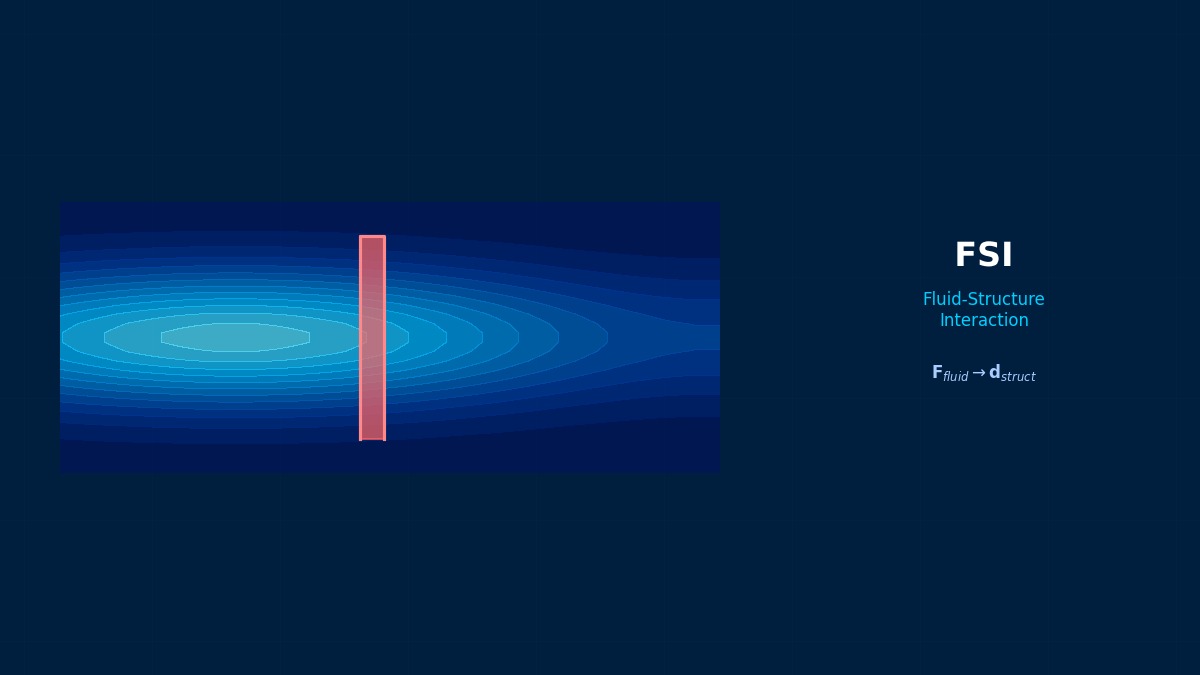
Hydroelasticity Problems: Theoretical Foundations
Physical Background of Hydroelasticity
In what fields is hydroelastic analysis used?
It deals with the interaction where, when ships and offshore structures receive wave loads, the elastic deformation of the structure affects the fluid forces, and those fluid forces in turn alter the deformation. It is essential for evaluating the springing and whipping responses of VLFS (Very Large Floating Structures) and container ships.
Governing Equations
What combination of equations is used?
The fluid side is based on potential flow theory. The Laplace equation is solved for the velocity potential $\phi$.
Linearizing the free surface condition gives,
The structural side uses the mode superposition method. Displacement is expressed as a linear combination of eigenmodes.
The fluid pressure $p = -\rho \partial\phi/\partial t$ becomes the external force on the structure, and the equation of motion for the modal coordinates is,
$a_r$ is the added mass coefficient, $b_r$ is the wave-making damping coefficient. These are calculated by the Boundary Element Method (BEM).
Ship "Slamming" — The Theory of Impact When the Hull Bottom Strikes the Water Surface
When a ship navigating in rough seas undergoes rapid vertical motion, "slamming" occurs where the ship's bottom at the bow strikes the water surface. At this moment, an impact force of hundreds to thousands of tons acts on the hull bottom over an extremely short time of a few milliseconds. In hydroelastic theory, slamming is a "transient FSI phenomenon where the local added mass of water changes rapidly." The peak impact force is proportional to the square of the ship speed, so for a container ship with a wave height of 4m and a speed of 20 knots, the slamming load can reach 2 to 5 times the design static wave load. Since this impact directly leads to fatigue cracks in the hull bottom, hydroelastic analysis is not just a vibration problem but is at the core of fatigue life design.
Computational Methods for Hydroelasticity Problems
Fluid Analysis by BEM
Why use BEM instead of CFD?
When the potential flow assumption holds, BEM only requires discretization of the object surface, significantly reducing computational cost. Using the Wave Green function also eliminates the need to discretize the free surface.
WAMIT, AQWA, and Hydrostar are representative solvers using this method.
Mode Transfer Procedure
How do you transfer FEM eigenmodes to BEM?
Execute dry mode analysis in Nastran or Abaqus, and map the nodal displacements on the object surface to the BEM mesh.
| Step | Tool Example | Output |
|---|---|---|
| FE Model Creation | MSC Patran, HyperMesh | .bdf, .inp |
| Eigenvalue Analysis | MSC Nastran SOL 103 | Eigenmodes |
| Mode Transfer | MpCCI, Custom Script | BEM Input Format |
| Hydroelastic BEM Analysis | WAMIT, AQWA | Added Mass, Damping |
| Response Analysis | HOMER, WASIM | Modal Coordinate Time History |
Up to what mode order should be considered?
Typically, the 6 rigid body modes plus about 10-20 elastic modes. For container ship springing, the vertical 2-node vibration mode is dominant, but for whipping, contributions from higher modes cannot be ignored.
Panel Method vs. CFD — Which to Use for Ship Hydroelasticity
There are two main approaches for ship hydroelasticity calculation. One is the "Panel Method (Boundary Element Method)" — covering only the hull surface with panels and calculating wave forces using potential flow theory. It's fast and suitable for early design stages. The other is "CFD (RANS method)" solving Navier-Stokes equations, which can consider viscous effects and wave breaking but costs 100-1000 times more. Which to choose depends on "what you want to know" — panel method is sufficient for linear wave response (design wave conditions), while CFD is essential for evaluating container ship deck wetness or capsizing limits of floating bodies. In practice, a staged approach "design with panel method → verify worst cases with CFD" is mainstream, and full CFD is limited to research projects with ample computational resources.
Hydroelasticity Problems in Practice
Analysis Procedure Overview
Please teach me the step-by-step procedure for conducting ship hydroelastic analysis from scratch.
The basic flow is as follows.
1. Create structural FE model (hull beam model or 3D FE)
2. Dry mode analysis (obtain natural frequencies and mode shapes with SOL 103)
3. Create BEM model (wetted surface panel model)
4. Hydroelastic frequency response analysis (calculate RAO for each mode)
5. Short-term / long-term response statistics (evaluate fatigue & extreme responses combined with sea state data)
Panel Density Guidelines
How do you decide the BEM panel size?
A guideline is panel size $l_p < \lambda/7$ relative to wavelength $\lambda$.
| Parameter | Recommended Value | Remarks |
|---|---|---|
| Panel Size | < $\lambda_{min}/7$ | Depends on shortest target wavelength |
| Number of Panels (one side) | 300~3000 | Depends on hull form complexity |
| Consistency with FE Mesh | Mandatory | Affects mode transfer accuracy |
How do you verify the results?
The first step is comparing RAOs of rigid body modes (heave, pitch) with experimental values. For elastic modes, compare the natural frequency of the 2-node vibration mode with measured values. DNV benchmark problems (e.g., S175 container ship) are also useful for verification.
Ultra-Large Container Ships Bending — Hydroelastic Practice of Hogging and Sagging
Ultra-Large Container Ships (ULCC) exceeding 400m in length are so massive that they simultaneously straddle wave crests and troughs. "Hogging" where wave crests are at the bow and stern and the ship center sinks into a trough, and the opposite "Sagging" alternate repeatedly, causing the hull to bend like a bow upwards and downwards. This bending deformation (hull girder deflection) induces "springing," a higher harmonic vibration at twice the wave period, a phenomenon unique to hydroelasticity. If overlooked in design, fatigue life can drop to less than one-third of calculated values. In Japanese shipyards, hydroelastic FEM analysis is mandatory for overall strength evaluation of 400m ships, and large-scale batch processing of thousands of cases combining wave conditions and loading conditions is routinely performed.
Hydroelasticity Problems: Software & Solver Comparison
Tool Comparison
Please tell me software that supports hydroelastic analysis.
Let's organize the main tools.
| Tool | Developer | Method | Hydroelastic Support |
|---|---|---|---|
| WAMIT | MIT / WAMIT Inc. | 3D Panel Method | Generalized Mode Support |
| AQWA | Ansys Inc. | 3D Panel Method | Ansys Mechanical Integration |
| Hydrostar | Bureau Veritas | 3D Panel Method | HOMER Time Domain Integration |
| WASIM | DNV | Rankine Panel Method | Nonlinear Time Domain in SESAM Environment |
| OrcaFlex | Orcina | Morison/BEM | Strong for Line Structures |
| OpenFOAM + CalculiX | Open Source | CFD + FEA | Co-simulation via preCICE |
Which is better for beginners?
If you have access to Ansys, AQWA + Mechanical is well-integrated and user-friendly. For learning the principles, starting with WAMIT's manual and sample problems is recommended. OpenFOAM + CalculiX is free but requires programming skills for coupling setup.
The History of Hydroelastic Analysis Software — From FORTRAN to Cloud
The history of hydroelastic analysis software began in the 1970s with FORTRAN programs developed at MIT and NTNU. WAMIT (1987) established the standard for 3D panel methods. In the 1990s, commercial codes like AQWA and Hydrostar emerged, integrated into the CAE suites of Ansys and Bureau Veritas. The 2000s saw the rise of open-source CFD (OpenFOAM) and FEA (CalculiX), enabling low-cost coupled analysis via middleware like MpCCI and preCICE. Recently, cloud-based platforms (SimScale, OnScale) offering hydroelastic analysis as a service have appeared. The evolution from "in-house code for experts" to "cloud service accessible to all engineers" is remarkable, but understanding the underlying theory remains essential regardless of the tool.
Commercial Software Selection Criteria
- Accuracy & Reliability: Verification with benchmark problems (ITTC, ISSC), long track record
- Usability: GUI quality, pre/post-processing integration, automation via scripting
- Computational Performance: Parallel computing support (CPU/GPU), solver speed
- Interoperability: Data exchange with major CAD/CAE, support for standard formats
- Support & Community: Quality of technical support, user community size, training availability
Points for Utilizing Open Source
- Advantages: No license cost, source code access for customization, active community
- Challenges: Steep learning curve, requires in-house expertise, limited official support
- Recommended Approach: Start with commercial software for learning, then introduce open source for specific custom analyses
Potential of Cloud CAE
- Current State: Mainly for preliminary design and education, not yet for final verification
- Future Outlook: Expected to become mainstream for large-scale parametric studies and design optimization
- Considerations: Data security, internet dependency, cost structure for large computations
Related Topics
Experience the theory firsthand with the interactive simulator for this field
All Simulators