Sloshing-Structure Coupling
Sloshing-Structure Coupling: Theoretical Foundations
Sloshing Overview
What kind of phenomenon is sloshing?
It is a phenomenon where liquid inside a container violently oscillates due to external excitation (earthquake, waves, vehicle acceleration, etc.). It becomes important in LNG carrier cargo tanks, spent fuel pools at nuclear power plants, rocket propellant tanks, and so on.
Governing Equations
What is the mathematical model for sloshing?
In linear theory, it is described by the velocity potential $\phi$. The natural sloshing frequency of the free surface for a rectangular tank is:
Where $L$ is the tank length, $h$ is the liquid height, and $n$ is the mode number.
For nonlinear sloshing (large amplitude, wave breaking, accompanied by impact pressure), the Navier-Stokes equations are solved using the VOF method.
The impact pressure on the tank wall (sloshing impact) can reach several MPa locally.
How is coupling with the structure handled?
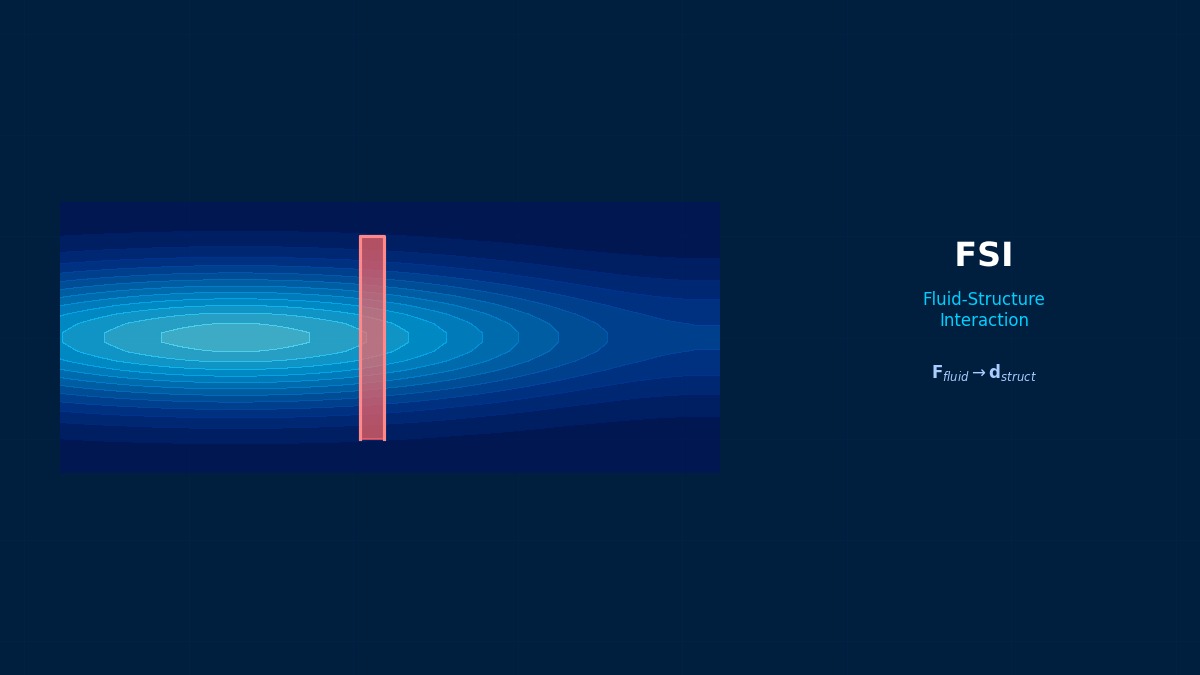
FSI (Fluid-Structure Interaction) becomes necessary when the elastic deformation of the tank wall affects the liquid surface behavior. Particularly in membrane-type LNG tanks (Mark III, NO96), the thin corrugated structure deforms under sloshing impact, which changes the pressure distribution.
Sloshing "Natural Frequency" – The Tank Shape Decides Everything
The most frightening aspect of sloshing is "resonance." The natural frequency of the liquid inside a tank can be calculated for a rectangular tank as f₁ ≈ (1/2π)√(πg/L·tanh(πh/L)) (L is tank length, h is liquid depth). When the tank is about half full and this natural frequency matches the ship's rolling period, the amplitude increases explosively. In the design of early LNG carriers in the 1960s, overlooking this resonance condition led to repeated impact loads on the tank walls and frequent accidents where insulation peeled off. Since then, the industry's operational rule has been to "maintain a full or nearly empty loading condition and avoid passing through the resonance range."
Computational Methods for Sloshing-Structure Coupling
Numerical Methods
What methods are used for sloshing FSI?
Is the MPS method a Japanese-origin technique?
It is the Moving Particle Semi-implicit method developed by Professor Seiichi Koshizuka (University of Tokyo). It has been commercialized as Particleworks by Prometech. It can stably track large deformations and splashing of free surfaces and has many achievements in sloshing analysis.
Impact Pressure Evaluation
How is sloshing impact pressure evaluated?
Impact pressure includes air pocket type (compressed air cushion) and flip-through type (direct impact).
- Air pocket type: Air is trapped and compressed between the liquid surface and the wall. Oscillatory pressure waveform. Peak pressure is lower but duration is longer.
- Flip-through type: The liquid surface rises along the wall and strikes it directly. Very high peak pressure but short duration.
When compressibility is considered, two-phase flow analysis including the polytropic process of air is necessary.
SPH and VOF – The "Two Major Schools" of Sloshing Analysis
In sloshing numerical analysis, the grid-based VOF (Volume of Fluid) method and the meshless SPH (Smoothed Particle Hydrodynamics) method have long competed. VOF has a rich track record in OpenFOAM and STAR-CCM+ and its approach to capturing the gas-liquid interface is intuitive. On the other hand, SPH's strength is its natural handling of large liquid deformations (collision with tank walls, splashing). In the shipbuilding industry, IHI and Samsung Heavy Industries actively utilize SPH for sloshing impact pressure analysis. Recently, environments have been established where SPH calculations are parallelized on GPUs, completing simulations with millions of particles in a few hours. The practical answer is not which one is "correct," but to choose based on the analysis objective.
Sloshing-Structure Coupling in Practice
LNG Tank Analysis Procedure
How do you proceed with sloshing analysis for an LNG carrier?
1. Calculate hull motion via seakeeping analysis (time history of 6-DOF motion).
2. Set tank geometry and liquid level (partial fill ratio is critical. 20-80% is the dangerous range).
3. Perform CFD (VOF/SPH/MPS) sloshing analysis.
4. Statistical processing of wall pressure (short-term / long-term extreme value distribution).
5. Structural response analysis (input impact pressure into FE model).
Why is a mid-range fill ratio dangerous?
If the liquid level is too low, the liquid mass is small; if too high, the liquid movement is restricted. Sloshing becomes most violent at intermediate fill ratios of 40-70%. The IGC Code (International Code for the Construction and Equipment of Ships Carrying Liquefied Gases in Bulk) restricts navigation within dangerous fill ratio ranges.
Impact Pressure Statistical Processing
How is the variation in impact pressure handled?
Sloshing impact pressure shows extremely large probabilistic variation. Even under identical conditions, peak pressure can vary by more than 10 times between impact events.
Extreme value statistical processing using Gumbel or Weibull distribution is performed to estimate the maximum pressure for the design lifetime. Hundreds of impact events are obtained from a short-term 3-hour analysis to estimate the parameters of the extreme value distribution.
LNG Carrier No.96 Type Tanks – The Crystallization of Sloshing Countermeasures
Among the membrane-type tanks that dominate global LNG transport, GTT's No.96 type is designed with a complex insulation structure to absorb sloshing loads. For large LNG carriers with tank capacities of 140,000 to 170,000 cubic meters, sloshing analysis requires hundreds of simulation cases, exhaustively verifying combinations of wave conditions, loading rates, and sailing speeds. Major Japanese shipyards (Mitsubishi Heavy Industries, Kawasaki Heavy Industries) have dedicated sloshing test equipment (placing a 1/50 scale model on a 6-DOF motion platform) used to validate CFD results. The cost of sloshing analysis for building one LNG carrier reaches tens of millions of yen.
Sloshing-Structure Coupling: Software & Solver Comparison
Tool Comparison
What tools are available for sloshing analysis?
| Tool | Method | Features |
|---|---|---|
| Particleworks (Prometech) | MPS Method | Japanese-made. Many achievements in LNG sloshing. |
| FLOW-3D (Flow Science) | VOF (TruVOF) | Specialized in free surface tracking. |
| OpenFOAM (interFoam) | VOF | OSS. Free customization. |
| STAR-CCM+ | VOF/Euler multiphase | Easy setup of tank motion. |
| LS-DYNA | SPH | Originally for impact/crash, also used for sloshing. |
Related Topics
Experience the theory firsthand with the interactive simulator for this field
All Simulators