Fire Thermal Fluid Simulation
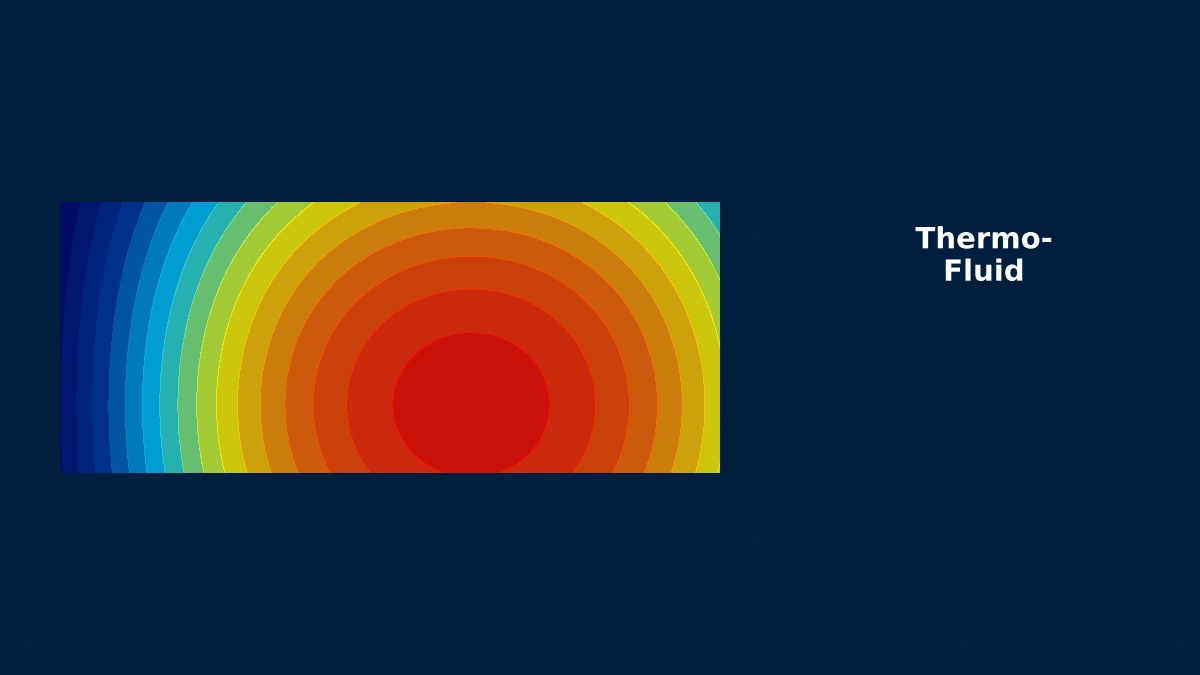
Fire Thermal Fluid Theory Basics
Overview
Professor! Today we're talking about fire thermal fluid simulation, right? What is it?
Fire plume and smoke flow simulation using FDS. Radiation heat transfer and ignition determination for combustibles. Evacuation safety evaluation.
Governing Equations
Discretization Methods
How do we actually solve these equations on a computer?
We use Finite Element Method (FEM) with spatial discretization. Assemble element stiffness matrices and construct the global stiffness equations.
We perform a transformation to weak form (variational form) and use Galerkin method formulation with trial functions and shape functions. Element type selection (low-order vs. higher-order elements, full integration vs. reduced integration) directly affects the accuracy and computational cost trade-off.
Matrix Solution Algorithm
What exactly is a matrix solution algorithm?
Direct methods (LU decomposition, Cholesky decomposition) or iterative methods (CG method, GMRES method) solve the linear system. For large-scale problems, preconditioned iterative methods are effective.
| Solver | Classification | Memory Usage | Applicable Scale |
|---|---|---|---|
| LU Decomposition | Direct Method | O(n²) | Small to Medium |
| Cholesky Decomposition | Direct Method (Symmetric Positive Definite) | O(n²) | Small to Medium |
| PCG Method | Iterative Method | O(n) | Large-Scale |
| GMRES Method | Iterative Method | O(n·m) | Large-Scale, Non-Symmetric |
| AMG Preconditioner | Preconditioner | O(n) | Ultra Large-Scale |
So if we skimp on the finite element method part, we'll suffer later. I'll keep that in mind!
Implementation in Commercial Tools
So what software can be used for fire thermal fluid simulation?
| Tool Name | Developer/Current | Main File Format |
|---|---|---|
| Ansys Fluent | ANSYS Inc. | .cas, .dat, .msh, .jou |
| Simcenter STAR-CCM+ | Siemens Digital Industries Software | .sim, .java, .csv |
| COMSOL Multiphysics | COMSOL AB | .mph |
| OpenFOAM | Open Source (OpenCFD/ESI, OpenFOAM Foundation) | Dictionary files (blockMeshDict, etc.), .foam |
Vendor Genealogy and Product Integration History
Is the history of each software development quite dramatic?
Ansys Fluent
Now we're talking about Ansys Fluent. What's the story?
Fluent Inc. developed it. ANSYS acquired it in 2006. Unstructured grid-based general-purpose CFD solver.
Current Owner: ANSYS Inc.
Simcenter STAR-CCM+
Now we're talking about Simcenter STAR. What's the story?
CD-adapco developed it. Siemens acquired it in 2016 and integrated it into the Simcenter brand. Polyhedral meshing is its characteristic feature.
Current Owner: Siemens Digital Industries Software
Now I finally understand why the development history is important!
COMSOL Multiphysics
Tell me about "COMSOL Multiphysics"!
Founded in Sweden in 1986. Started as FEMLAB with MATLAB integration, later renamed to COMSOL. Strong in multiphysics.
Current Owner: COMSOL AB
Wow, the story about software development is so interesting! Tell me more.
File Formats and Interoperability
Are there any precautions when exchanging data between different software?
| Format | Extension | Type | Overview |
|---|---|---|---|
| STEP | .stp/.step | Neutral CAD | ISO 10303 compliant 3D CAD data exchange format. Shape + PMI support. |
| CGNS | .cgns | CFD Data | CFD General Notation System. Standard exchange format for CFD results. |
| VTK | .vtk/.vtu | Visualization | Visualization Toolkit format. Used in ParaView and others. |
When converting models between different solvers, pay careful attention to element type correspondence, material model compatibility, and differences in how loads and boundary conditions are expressed. Solver-specific elements (cohesive elements, user-defined elements, etc.) often cannot be directly converted between solvers.
I see... formats look simple on the surface, but they're actually very deep.
Practical Considerations
Are there "tricks of the trade" that aren't covered in textbooks?
Mesh convergence verification, boundary condition validity checks, and material parameter sensitivity analysis are really important.
Yes, you're on the right track! Actually getting hands-on is the best learning. Ask anytime you're unsure.
Plume and Buoyancy—The Physics That Drives Fire
Fire thermal flow is dominated by "buoyancy." High-temperature gas near the fire source (with density 1/3 to 1/5 of surrounding air) rises rapidly and entrains surrounding air, forming a thermal plume. The upward velocity of this plume is proportional to the 1/3 power of fire source output (Q̇^(1/3))—a useful rule of thumb. For a 10 MW fire, the center upward velocity reaches 10-20 m/s. Critical in simulation is "fire source modeling"—rather than modeling the actual flame in detail, the standard approach is to input the "heat release rate (HRR)." FDS can reproduce actual fires by inputting time-varying HRR based on Drysdale or Chandler equations.
Fire Thermal Fluid Numerical Methods
Numerical Methods Details
What specific algorithms are used to solve fire thermal fluid simulation?
Wow, fire thermal fluid simulation is so interesting! Tell me more.
Discretization Formulation
Using shape functions $N_i$, we approximate the unknown quantities as:
This is expressed mathematically as:
Discrete Form of Governing Equations
This is expressed mathematically as:
Hmm, equations alone don't really help... What do they represent?
Discretizing the continuum governing equations yields the following algebraic system:
Here $[K]$ is the global stiffness matrix (or equivalent system matrix), $\{u\}$ is the unknown nodal variable vector, and $\{F\}$ is the load vector.
Ah, I see! The discretization of the continuum governing equations works that way.
Element Technology
I've heard the term "element technology," but I'm not sure I fully understand it...
| Element Type | Order | Nodes (3D) | Accuracy | Computational Cost |
|---|---|---|---|---|
| Tetrahedron 1st Order | Linear | 4 | Low (Shear Locking) | Low |
| Tetrahedron 2nd Order | Quadratic | 10 | High | Medium |
| Hexahedron 1st Order | Linear | 8 | Medium | Medium |
| Hexahedron 2nd Order | Quadratic | 20 | Very High | High |
| Prism | Linear/Quadratic | 6/15 | Medium to High | Medium |
Integration Scheme
What exactly is an integration scheme?
Now I finally understand why element type is important!
Convergence and Stability
What should I check first if convergence fails?
Convergence Rate: Error decreases at O(h^2) order for quadratic elements (for smooth solutions)
I see... mesh refinement looks simple on surface, but it's actually very deep.
Solver Setting Recommendations
What specific algorithms are used to solve fire thermal fluid simulation?
| Parameter | Recommended Value | Notes |
|---|---|---|
| Iterative Method Convergence Criterion | $10^{-6}$ | Residual norm basis |
| Preconditioning Method | ILU(0) or AMG | Depends on problem size |
| Maximum Iterations | 1000 | Review settings if non-convergent |
| Memory Mode | In-core | When possible |
Monolithic Method
Solve all physical fields simultaneously in a single linear system. Stable for strong coupling but requires dedicated solvers and large memory.
Partitioned Method (Separate Iteration)
Solve each physical field independently, exchange data at interfaces, iterate until convergence. Easy to implement and can reuse existing solvers. Suited to weak coupling.
Interface Data Transfer
Nearest neighbor method (simplest but low accuracy), projection method (conservative), RBF interpolation (strong for non-matching meshes). Balance between conservation and accuracy is important.
Sub-iteration
Sufficient iterations within each coupling step ensure interface condition consistency. Scale residual criteria based on each field's typical values.
Aitken Relaxation
Automatically adjust relaxation coefficient of coupling iterations. Prevent divergence from over-relaxation and accelerate convergence adaptively.
Stability Conditions
Watch for added mass effect (when fluid density ≈ structure density in FSI). Apply Robin-type interface conditions or IQN-ILS method if unstable.
Fire Thermal Fluid Practical Application
Practical Guide
Professor, tell me about "Practical Guide"!
I'll explain the practical analysis workflow and precautions for fire thermal fluid simulation.
Wow, fire thermal fluid simulation is so interesting! Tell me more.
Analysis Workflow
Teach me from the very first step! Where do I start?
1. Preprocessing
- Import and simplify CAD data
- Define material properties
- Mesh generation (determine element type and size)
- Set boundary and loading conditions
2. Solving
- Configure solver (method, convergence criteria, output control)
- Submit and run analysis
- Monitor convergence
3. Postprocessing
- Visualize results (displacement, stress, other quantities)
- Verify and validate results
- Prepare report
Mesh Generation Best Practices
How do we judge the quality of a mesh?
Element Quality Metrics
Tell me about "element quality metrics"!
| Metric | Ideal Value | Acceptable Range | Impact |
|---|---|---|---|
| Aspect Ratio | 1.0 | < 5.0 | Accuracy Reduction |
| Jacobian Ratio | 1.0 | > 0.3 | Element Distortion |
| Warping | 0° | < 15° | Accuracy Reduction |
| Skewness | 0° | < 45° | Convergence Deterioration |
| Taper Ratio | 0 | < 0.5 | Accuracy Reduction |
Mesh Density Determination
What exactly is mesh density determination?
Boundary Condition Setting Guidelines
I heard that if you get boundary conditions wrong, everything falls apart...
Ah, I see! Over-constraint means that mechanism.
Implementation Procedures by Commercial Tool
There are many different software packages, right? Tell me their characteristics!
| Tool Name | Developer/Current | Main File Format |
|---|---|---|
| Ansys Fluent | ANSYS Inc. | .cas, .dat, .msh, .jou |
| Simcenter STAR-CCM+ | Siemens Digital Industries Software | .sim, .java, .csv |
| COMSOL Multiphysics | COMSOL AB | .mph |
| OpenFOAM | Open Source (OpenCFD/ESI, OpenFOAM Foundation) | Dictionary files (blockMeshDict, etc.), .foam |
Ansys Fluent
Now we're talking about Ansys Fluent. What's the story?
Fluent Inc. developed it. ANSYS acquired it in 2006. Unstructured grid-based general-purpose CFD solver.
Current Owner: ANSYS Inc.
Simcenter STAR-CCM+
Now we're talking about Simcenter STAR. What's the story?
CD-adapco developed it. Siemens acquired it in 2016 and integrated it into the Simcenter brand. Polyhedral meshing is its characteristic feature.
Current Owner: Siemens Digital Industries Software
Your explanations are clear! The tool names are no longer confusing.
Common Failures and Countermeasures
What are rookie mistake patterns? I want to know in advance!
| Symptom | Cause | Solution |
|---|---|---|
| Analysis won't converge | Poor mesh quality, inappropriate boundary conditions | Improve mesh, review constraints |
| Stress abnormally large | Stress singularity, mesh dependence | Avoid singularity, local mesh refinement |
| Displacement unrealistic | Material constant error, unit system inconsistency | Verify input data |
| Computation time excessive | Unnecessary refinement, inefficient solver | Optimize mesh, parallel computing |
Quality Assurance Checklist
Are there "tricks of the trade" that aren't covered in textbooks?
Yes, you're on the right track! Actually getting hands-on is the best learning. Ask anytime you're unsure.
Building Performance Design—How Fire CFD Changed Fire Safety Code
In Japan, the 2000 major revision of the Building Standard Law approved "performance-based design." Before that, it was prescription-based: "Install sprinklers at ○m intervals." But performance design allows free design if fire CFD simulation (like FDS) demonstrates evacuation safety. For example, large-span atrium shopping centers and airport terminals can skip full sprinkler coverage in favor of "smoke evacuation simulation" to calculate evacuation time and optimize required smoke exhaust and vent positioning. Fire CFD is no longer just academic—it's embedded in actual building design practice.
Fire Thermal Fluid Fire Thermal Fluid: Software & Solver Comparison
Commercial Tool Comparison
There are many different software, right? Tell me their characteristics!
I'll detail the feature comparison of major commercial CAE tools supporting fire thermal fluid simulation, and the historical background of each product.
Wow, fire thermal fluid simulation is so interesting! Tell me more.
Supported Tools List
So what software can be used for fire thermal fluid simulation?
| Tool Name | Developer/Current | Main File Format |
|---|---|---|
| Ansys Fluent | ANSYS Inc. | .cas, .dat, .msh, .jou |
| Simcenter STAR-CCM+ | Siemens Digital Industries Software | .sim, .java, .csv |
| COMSOL Multiphysics | COMSOL AB | .mph |
| OpenFOAM | Open Source (OpenCFD/ESI, OpenFOAM Foundation) | Dictionary files (blockMeshDict, etc.), .foam |
Ansys Fluent
Now we're talking about Ansys Fluent. What's the story?
Fluent Inc. developed it. ANSYS acquired it in 2006. Unstructured grid-based general-purpose CFD solver.
Current Owner: ANSYS Inc.
Simcenter STAR-CCM+
Now we're talking about Simcenter STAR. What's the story?
CD-adapco developed it. Siemens acquired it in 2016 and integrated it into the Simcenter brand. Polyhedral meshing is its characteristic feature.
Current Owner: Siemens Digital Industries Software
Now I finally understand why the development history is important!
COMSOL Multiphysics
Tell me about "COMSOL Multiphysics"!
Founded in Sweden in 1986. Started as FEMLAB with MATLAB integration, later renamed to COMSOL. Strong in multiphysics.
Current Owner: COMSOL AB
OpenFOAM
What exactly is OpenFOAM?
Open-source CFD from Imperial College London. OpenCFD Ltd (ESI Group subsidiary) and The OpenFOAM Foundation develop in parallel.
Current Owner: Open Source (OpenCFD/ESI, OpenFOAM Foundation)
Ah, I see! Development works that way.
Feature Comparison Matrix
With limited budget and time, which is the best value?
| Feature | Fluent | STAR-CCM+ | COMSOL | OpenFOAM |
|---|---|---|---|---|
| Basic Features | ○ | ○ | ○ | ○ |
| Advanced Features | ○ | ○ | ○ | △ |
| Automation/Scripting | ○ | ○ | ○ | ○ |
| Parallel Computing | ○ | ○ | ○ | ○ |
| GPU Support | △ | △ | △ | ○ |
Conversion Risks
What exactly are conversion risks?
Ah, I see! Model conversion between different tools works that way.
License Models
I've heard "license model," but I'm not sure I fully understand it...
| Tool | License | Characteristics |
|---|---|---|
| Commercial FEA | Node-Locked/Floating | Expensive but with official support |
| OpenFOAM | GPL | Free but paid support only |
| COMSOL | Node-Locked/Floating | Purchase by module |
| Code_Aster | GPL | EDF-developed open-source solver |
Selection Guidelines
Which one should I choose in the end? Give me selection criteria.
For fire thermal fluid simulation tool selection, consider:
Yes, you're on the right track! Actually getting hands-on is the best learning. Ask anytime you're unsure.
Why Use Commercial Tools When FDS Is Free?
NIST's FDS (Fire Dynamics Simulator) is free open-domain software and the de facto standard for fire CFD. Yet commercial wrapper tools like Pyrosim (Thunderhead Engineering) and OFi (OpenFire by TNO) are widely used in construction/fire safety consulting because of "GUI and automated report generation." Performance-based design submissions to authorities require documentation of analysis conditions, mesh, boundary condition rationale—commercial tools greatly streamline this documentation. Technical capability and regulatory compliance documentation are evaluated together in this industry's unique selection criteria.
Fire Thermal Fluid Advanced Research
Advanced Topics and Research Trends
Where is fire thermal fluid simulation heading as a field?
Let's look at the latest research trends and advanced methods in fire thermal fluid simulation.
Wow, fire thermal fluid simulation is so interesting! Tell me more.
Latest Numerical Methods
Now we're talking about latest numerical methods. What's the story?
Equations alone don't really help... What do they represent?
High Performance Computing (HPC) Support
| Parallelization Method | Overview | Applicable Solvers |
|---|---|---|
| MPI (Domain Decomposition) | Distributed memory. Standard for large-scale problems | All major solvers |
| OpenMP | Shared memory. Multi-threaded within node | Many solvers |
| GPU (CUDA/OpenCL) | GPGPU utilization. Effective especially for explicit methods | LS-DYNA, Fluent, etc. |
| Hybrid MPI+OpenMP | Inter-node + intra-node parallelism | HPC environments |
Fire Thermal Fluid Fire Thermal Fluid: Common Issues & Debugging
Troubleshooting
Wow, fire thermal fluid simulation is so interesting! Tell me more.
Common Errors and Countermeasures
Professor, have you ever done all-nighters debugging fire thermal fluid simulation? (laughs)
1. Convergence Failure
What exactly is convergence failure?
Symptom: Solver fails to converge within specified iterations and terminates abnormally
Possible Causes:
- Insufficient mesh quality (excessively distorted elements)
- Improper material parameter settings
- Inappropriate initial conditions
- Nonlinearity too strong (insufficient load steps)
Solutions:
- Perform mesh quality check (aspect ratio, Jacobian)
- Verify material parameter units
- Subdivide load into multiple steps (increase substep count)
- Relax convergence criteria (but watch accuracy)
Skimping on convergence failure will hurt me later. I'll remember that.
2. Non-Physical Results
Now we're talking about non-physical results. What's the story?
Symptom: Stress/displacement/temperature etc. show unrealistic values
Possible Causes:
- Boundary condition error
- Unit system mixing (SI vs. engineering units)
- Inappropriate element type selection
- Stress singularity presence
Solutions:
- Verify reaction force sum (force balance)
- Verify unit system consistency
- Reconsider element type appropriateness
- Remove singularity or apply submodeling
Now I understand what my senior meant by "handle convergence failure properly."
3. Excessive Computation Time
What exactly is excessive computation time?
Symptom: Computation takes many times longer than expected
Solutions:
- Optimize mesh coarse/fine distribution
- Exploit symmetry (1/2, 1/4 models)
- Optimize solver settings (iterative method, preconditioner selection)
- Leverage parallel computing
4. Out of Memory
Tell me about "Out of Memory"!
Symptom: Out of Memory error
Now I understand what my senior meant by "handle convergence failure properly."
Solutions:
- Use out-of-core solver
- Reduce mesh size
- Verify 64-bit solver version
- Increase memory allocation
Wow, convergence failure is so interesting! Tell me more.
Nastran Typical Errors
What exactly are typical errors?
Abaqus Typical Errors
Tell me about "typical errors"!
So if we get the tool setup right, we're mostly OK?
"When Analysis Doesn't Match Expectations"
- Take a deep breath first—panicking and randomly changing settings makes things worse
- Create minimal reproducer—reproduce the problem in simplest form. "Subtraction debugging" is most efficient
- Change one thing at a time—simultaneous changes obscure what worked. Follow "control experiment" principle from science
- Return to physics—if results show "objects floating against gravity," that's non-physical, suggesting fundamental input errors
Related Topics
Details
Error