Building Wind Load Analysis
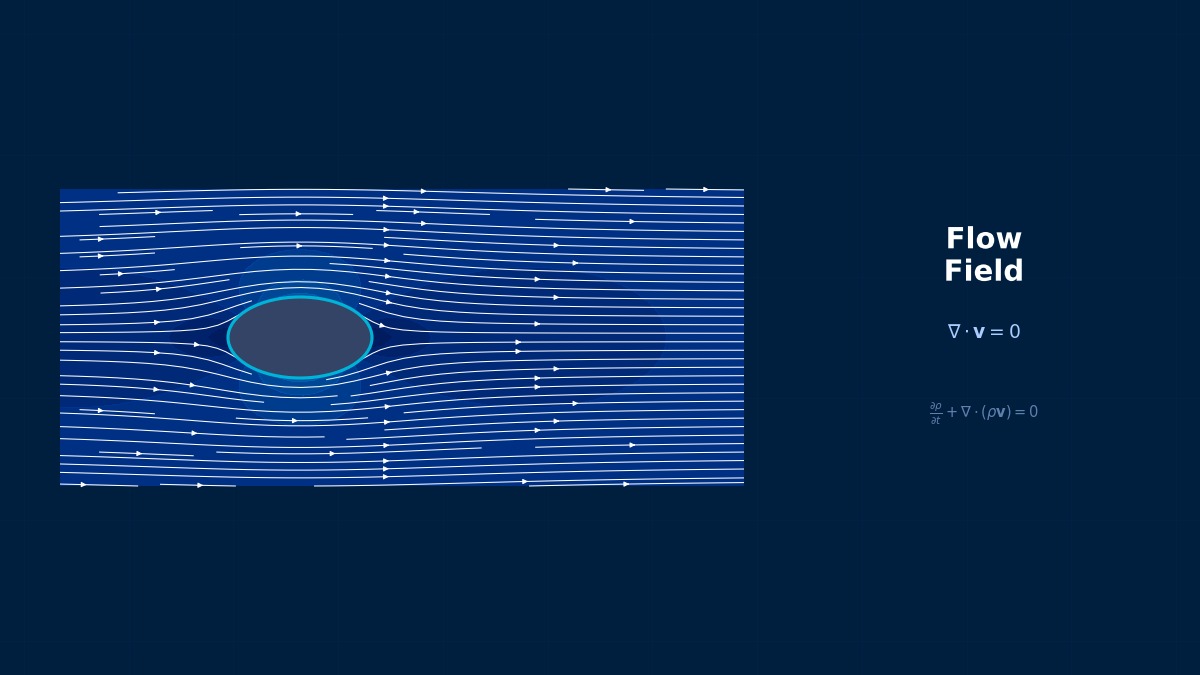
Theory and Physics
Overview
Professor, what exactly are we trying to determine with wind analysis around buildings?
There are three main objectives. (1) Determining wind loads for structural design, (2) Evaluating wind environment at pedestrian level (pedestrian comfort), and (3) Planning for natural ventilation.
For super high-rise buildings, wind loads become the governing factor in structural design. The Building Standards Act uses wind force coefficients to calculate design wind pressure, but CFD analysis is required for complex building shapes or when interference with surrounding buildings is a factor.
Cases where CFD is used instead of wind tunnel tests are increasing, right?
Exactly. However, in the architectural field, CFD is not a complete replacement for wind tunnel tests; they have a complementary relationship. The Architectural Institute of Japan's "Recommendations for Loads on Buildings" also provides guidelines for CFD analysis.
Governing Equations
What equations describe the wind around buildings?
The incompressible Navier-Stokes equations are fundamental. Since wind speeds around buildings are M < 0.3, compressibility can be ignored.
The wind pressure coefficient is defined as follows.
Here, $p$ is the local pressure, $p_\infty$ is the reference pressure, and $V_H$ is the reference wind speed at the building height.
The wind speed profile in the atmospheric boundary layer is often expressed by a power law.
Here, $\alpha$ is the power exponent dependent on surface roughness. It is approximately $\alpha \approx 0.25$--$0.35$ in urban areas and $\alpha \approx 0.10$--$0.15$ over the sea.
I see. So we give the atmospheric boundary layer profile as the inlet boundary condition.
Turbulence Models
Let's organize the turbulence models used in architectural CFD.
Model Characteristics Suitability for Building Wind Analysis
Standard k-epsilon Isotropic turbulence. Low computational cost. Tends to underpredict separation for bluff bodies.
RNG k-epsilon Vorticity-dependent viscosity. Improved separation prediction. Effective for flow around square cylinders.
SST k-omega Good accuracy near walls. Recommended for wind pressure distribution on building surfaces.
LES (Smagorinsky) Directly solves large-scale eddies. Essential for peak and fluctuating wind pressures.
DES/DDES RANS+LES hybrid. Predicts fluctuating wind pressure at practical computational cost.
Does k-epsilon fail to correctly predict separation around buildings?
The standard k-epsilon model tends to underpredict the wake vortices behind bluff bodies (like square cylinders or rectangular prisms). The reattachment length at the roof corner of a building often doesn't match experiments. While RNG k-epsilon or Realizable k-epsilon improve this, LES is desirable for predicting peak wind pressures.
Pedestrian Level Wind Environment
What are the evaluation criteria for building wind?
The Architectural Institute of Japan defines wind environment evaluation scales. The target is wind speed at pedestrian height (1.5m above ground).
Rank Annual Cumulative Exceedance Probability Environmental Guideline
1 (Good) Exceeding 10m/s less than 1% Residential areas, parks
2 (Acceptable) Exceeding 10m/s less than 5% General urban areas
3 (Slightly Poor) Exceeding 10m/s less than 10% Commercial districts
4 (Poor) Exceeding 10m/s 10% or more Countermeasures required
For wind environment evaluation, the annual wind direction frequency distribution is also considered, right?
Exactly. The standard method is to conduct CFD for 16 wind directions (22.5-degree increments), then combine it with the wind direction frequency data from AMeDAS at the target location to calculate the annual exceedance probability.
Coffee Break Yomoyama Talk
The Aerodynamic Reason Why Tokyo Skytree "Rotates a Triangle with Height"
The cross-section of Tokyo Skytree is an equilateral triangle at the base, but the design gradually rotates the cross-section with height, approaching a circular shape near the top. This is not just a design feature but an aerodynamic design to suppress resonance (swaying due to building wind) caused by Kármán vortices. Cylindrical or simple triangular cross-sections can cause Kármán vortices to synchronize at specific wind speeds, leading to large vibrations. By varying the cross-section with height, vortices find it difficult to synchronize across the entire height. This ingenious solution, validated through a combination of CFD and wind tunnel experiments, supports the safety of the world's tallest self-supporting radio tower.
Physical Meaning of Each Term
- Temporal Term $\partial(\rho\phi)/\partial t$: Think of the moment you turn on a faucet. At first, water comes out erratically and unstably, but after a while, the flow becomes steady, right? This "period of change" is described by the temporal term. The pulsation of blood flow with each heartbeat, or the flow fluctuation each time an engine valve opens and closes—all are unsteady phenomena. So what is steady-state analysis? It looks only at "after sufficient time has passed and the flow has settled"—meaning this term is set to zero. This significantly reduces computational cost, so starting with a steady-state solution is a basic CFD strategy.
- Convection Term $\nabla \cdot (\rho \mathbf{u} \phi)$: What happens if you drop a leaf into a river? It gets carried downstream by the flow, right? This is "convection"—the effect where fluid motion transports things. Warm air from a heater reaching the far corner of a room is also because the "carrier," air, transports heat via convection. Here's the interesting part—this term contains "velocity × velocity," making it nonlinear. That is, as flow speed increases, this term rapidly strengthens, making control difficult. This is the root cause of turbulence. A common misconception: "Convection and conduction are similar" → They are completely different! Convection is transport by flow, conduction is transfer by molecules. There's an order of magnitude difference in efficiency.
- Diffusion Term $\nabla \cdot (\Gamma \nabla \phi)$: Have you ever put milk in coffee and left it? Even without stirring, after a while, they naturally mix. That's molecular diffusion. Now a question—honey and water, which flows more easily? Obviously water, right? Honey has high viscosity ($\mu$), so it flows poorly. Higher viscosity strengthens the diffusion term, making the fluid move "sluggishly." In low Reynolds number flows (slow, viscous), diffusion dominates. Conversely, in high Re number flows, convection overwhelms and diffusion plays a minor role.
- Pressure Term $-\nabla p$: When you push the plunger of a syringe, liquid shoots out forcefully from the needle tip, right? Why? The piston side is high pressure, the needle tip is low pressure—this pressure difference provides the force that pushes the fluid. Dam discharge works on the same principle. On a weather map, where are isobars tightly packed? That's right, strong winds blow there. "Flow is generated where there is a pressure difference"—this is the physical meaning of the pressure term in the Navier-Stokes equations. A common point of confusion here: "Pressure" in CFD is often gauge pressure, not absolute pressure. If results go wrong immediately after switching to compressible analysis, mixing up absolute/gauge pressure might be the cause.
- Source Term $S_\phi$: Warmed air rises—why? Because it becomes lighter (lower density) than its surroundings, so buoyancy pushes it upward. This buoyancy is added to the equation as a source term. Other examples: chemical reaction heat generated by a gas stove flame, Lorentz force acting on molten metal in a factory's electromagnetic pump... These are all actions that "inject energy or force into the fluid from the outside," expressed by the source term. What happens if you forget the source term? In natural convection analysis, forgetting to include buoyancy means the fluid doesn't move at all—a physically impossible result, like turning on a heater in a winter room but the warm air doesn't rise.
Assumptions and Applicability Limits
- Continuum Assumption: Valid for Knudsen number Kn < 0.01 (mean free path of molecules ≪ characteristic length).
- Newtonian Fluid Assumption: Shear stress and strain rate have a linear relationship (non-Newtonian fluids require viscosity models).
- Incompressibility Assumption (for Ma < 0.3): Density is treated as constant. For Mach numbers above 0.3, compressibility effects must be considered.
- Boussinesq Approximation (Natural Convection): Density variation is considered only in the buoyancy term; constant density is used in other terms.
- Non-applicable Cases: Rarefied gases (Kn > 0.1), supersonic/hypersonic flows (shock wave capturing required), free surface flows (VOF/Level Set, etc., required).
Dimensional Analysis and Unit Systems
Variable SI Unit Notes / Conversion Memo
Velocity $u$ m/s When converting from volumetric flow rate for inlet conditions, pay attention to cross-sectional area units.
Pressure $p$ Pa Distinguish between gauge and absolute pressure. Use absolute pressure for compressible analysis.
Density $\rho$ kg/m³ Air: approx. 1.225 kg/m³ @20°C, Water: approx. 998 kg/m³ @20°C
Viscosity Coefficient $\mu$ Pa·s Be careful not to confuse with kinematic viscosity coefficient $\nu = \mu/\rho$ [m²/s].
Reynolds Number $Re$ Dimensionless $Re = \rho u L / \mu$. Indicator for laminar/turbulent transition.
CFL Number Dimensionless $CFL = u \Delta t / \Delta x$. Directly related to time step stability.
Let's organize the turbulence models used in architectural CFD.
| Model | Characteristics | Suitability for Building Wind Analysis |
|---|---|---|
| Standard k-epsilon | Isotropic turbulence. Low computational cost. | Tends to underpredict separation for bluff bodies. |
| RNG k-epsilon | Vorticity-dependent viscosity. Improved separation prediction. | Effective for flow around square cylinders. |
| SST k-omega | Good accuracy near walls. | Recommended for wind pressure distribution on building surfaces. |
| LES (Smagorinsky) | Directly solves large-scale eddies. | Essential for peak and fluctuating wind pressures. |
| DES/DDES | RANS+LES hybrid. | Predicts fluctuating wind pressure at practical computational cost. |
Does k-epsilon fail to correctly predict separation around buildings?
The standard k-epsilon model tends to underpredict the wake vortices behind bluff bodies (like square cylinders or rectangular prisms). The reattachment length at the roof corner of a building often doesn't match experiments. While RNG k-epsilon or Realizable k-epsilon improve this, LES is desirable for predicting peak wind pressures.
What are the evaluation criteria for building wind?
The Architectural Institute of Japan defines wind environment evaluation scales. The target is wind speed at pedestrian height (1.5m above ground).
| Rank | Annual Cumulative Exceedance Probability | Environmental Guideline |
|---|---|---|
| 1 (Good) | Exceeding 10m/s less than 1% | Residential areas, parks |
| 2 (Acceptable) | Exceeding 10m/s less than 5% | General urban areas |
| 3 (Slightly Poor) | Exceeding 10m/s less than 10% | Commercial districts |
| 4 (Poor) | Exceeding 10m/s 10% or more | Countermeasures required |
For wind environment evaluation, the annual wind direction frequency distribution is also considered, right?
Exactly. The standard method is to conduct CFD for 16 wind directions (22.5-degree increments), then combine it with the wind direction frequency data from AMeDAS at the target location to calculate the annual exceedance probability.
The Aerodynamic Reason Why Tokyo Skytree "Rotates a Triangle with Height"
The cross-section of Tokyo Skytree is an equilateral triangle at the base, but the design gradually rotates the cross-section with height, approaching a circular shape near the top. This is not just a design feature but an aerodynamic design to suppress resonance (swaying due to building wind) caused by Kármán vortices. Cylindrical or simple triangular cross-sections can cause Kármán vortices to synchronize at specific wind speeds, leading to large vibrations. By varying the cross-section with height, vortices find it difficult to synchronize across the entire height. This ingenious solution, validated through a combination of CFD and wind tunnel experiments, supports the safety of the world's tallest self-supporting radio tower.
Physical Meaning of Each Term
- Temporal Term $\partial(\rho\phi)/\partial t$: Think of the moment you turn on a faucet. At first, water comes out erratically and unstably, but after a while, the flow becomes steady, right? This "period of change" is described by the temporal term. The pulsation of blood flow with each heartbeat, or the flow fluctuation each time an engine valve opens and closes—all are unsteady phenomena. So what is steady-state analysis? It looks only at "after sufficient time has passed and the flow has settled"—meaning this term is set to zero. This significantly reduces computational cost, so starting with a steady-state solution is a basic CFD strategy.
- Convection Term $\nabla \cdot (\rho \mathbf{u} \phi)$: What happens if you drop a leaf into a river? It gets carried downstream by the flow, right? This is "convection"—the effect where fluid motion transports things. Warm air from a heater reaching the far corner of a room is also because the "carrier," air, transports heat via convection. Here's the interesting part—this term contains "velocity × velocity," making it nonlinear. That is, as flow speed increases, this term rapidly strengthens, making control difficult. This is the root cause of turbulence. A common misconception: "Convection and conduction are similar" → They are completely different! Convection is transport by flow, conduction is transfer by molecules. There's an order of magnitude difference in efficiency.
- Diffusion Term $\nabla \cdot (\Gamma \nabla \phi)$: Have you ever put milk in coffee and left it? Even without stirring, after a while, they naturally mix. That's molecular diffusion. Now a question—honey and water, which flows more easily? Obviously water, right? Honey has high viscosity ($\mu$), so it flows poorly. Higher viscosity strengthens the diffusion term, making the fluid move "sluggishly." In low Reynolds number flows (slow, viscous), diffusion dominates. Conversely, in high Re number flows, convection overwhelms and diffusion plays a minor role.
- Pressure Term $-\nabla p$: When you push the plunger of a syringe, liquid shoots out forcefully from the needle tip, right? Why? The piston side is high pressure, the needle tip is low pressure—this pressure difference provides the force that pushes the fluid. Dam discharge works on the same principle. On a weather map, where are isobars tightly packed? That's right, strong winds blow there. "Flow is generated where there is a pressure difference"—this is the physical meaning of the pressure term in the Navier-Stokes equations. A common point of confusion here: "Pressure" in CFD is often gauge pressure, not absolute pressure. If results go wrong immediately after switching to compressible analysis, mixing up absolute/gauge pressure might be the cause.
- Source Term $S_\phi$: Warmed air rises—why? Because it becomes lighter (lower density) than its surroundings, so buoyancy pushes it upward. This buoyancy is added to the equation as a source term. Other examples: chemical reaction heat generated by a gas stove flame, Lorentz force acting on molten metal in a factory's electromagnetic pump... These are all actions that "inject energy or force into the fluid from the outside," expressed by the source term. What happens if you forget the source term? In natural convection analysis, forgetting to include buoyancy means the fluid doesn't move at all—a physically impossible result, like turning on a heater in a winter room but the warm air doesn't rise.
Assumptions and Applicability Limits
- Continuum Assumption: Valid for Knudsen number Kn < 0.01 (mean free path of molecules ≪ characteristic length).
- Newtonian Fluid Assumption: Shear stress and strain rate have a linear relationship (non-Newtonian fluids require viscosity models).
- Incompressibility Assumption (for Ma < 0.3): Density is treated as constant. For Mach numbers above 0.3, compressibility effects must be considered.
- Boussinesq Approximation (Natural Convection): Density variation is considered only in the buoyancy term; constant density is used in other terms.
- Non-applicable Cases: Rarefied gases (Kn > 0.1), supersonic/hypersonic flows (shock wave capturing required), free surface flows (VOF/Level Set, etc., required).
Dimensional Analysis and Unit Systems
| Variable | SI Unit | Notes / Conversion Memo |
|---|---|---|
| Velocity $u$ | m/s | When converting from volumetric flow rate for inlet conditions, pay attention to cross-sectional area units. |
| Pressure $p$ | Pa | Distinguish between gauge and absolute pressure. Use absolute pressure for compressible analysis. |
| Density $\rho$ | kg/m³ | Air: approx. 1.225 kg/m³ @20°C, Water: approx. 998 kg/m³ @20°C |
| Viscosity Coefficient $\mu$ | Pa·s | Be careful not to confuse with kinematic viscosity coefficient $\nu = \mu/\rho$ [m²/s]. |
| Reynolds Number $Re$ | Dimensionless | $Re = \rho u L / \mu$. Indicator for laminar/turbulent transition. |
| CFL Number | Dimensionless | $CFL = u \Delta t / \Delta x$. Directly related to time step stability. |
Numerical Methods and Implementation
Computational Domain and Mesh
For CFD around buildings, how large should the computational domain be?
There are recommended values based on the AIJ (Architectural Institute of Japan) Guidelines.
| Parameter | Recommended Value | Remarks |
|---|---|---|
| Inlet to building | 5H or more | H is building height |
| Building to outlet | 15H or more | For wake development |
| To side boundaries | 5H or more | Blockage ratio 5% or less |
| To top boundary | 5H or more | Blockage ratio 5% or less |
| Blockage ratio | 3% or less recommended | Building cross-section / Domain cross-section |
So the blockage ratio needs to be kept low.
Yes. A high blockage ratio creates an artificial acceleration effect, leading to overestimation of wind pressure. Below 3% is ideal, and it should not exceed 5% at maximum.
Inlet Boundary Conditions
How do we set the inlet condition for the atmospheric boundary layer?
Provide a profile based on the power law or log law. Turbulence quantities also need to be specified simultaneously.
Velocity profile (log law):
Turbulent kinetic energy:
Here, $u_*$ is the friction velocity, $\kappa = 0.41$ is the von Kármán constant, $z_0$ is the roughness length, and $C_\mu = 0.09$.
How is $z_0$ (roughness length) determined?
Use values corresponding to surface roughness categories.
| Surface Category | $z_0$ [m] | Power Exponent $\alpha$ | Example |
|---|---|---|---|
| I (Sea) | 0.0002--0.005 | 0.10 | Coast, airport |
| II (Open country) | 0.01--0.05 | 0.15 | Farmland, low-rise housing |
| III (Suburban) | 0.1--0.5 | 0.20 | Medium-density urban area |
| IV (Urban) | 0.5--2.0 | 0.27 | High-rise building clusters |
Mesh Strategy
Let's organize the key points for mesh generation around buildings.
- On building surfaces: Minimum 10 divisions per edge (refine at corners).
- Near ground surface: $y^+ < 1$ (to ensure accuracy of wall shear stress).
- Refinement around building: Refine area within 2 times building height.
- Wake region: Do not coarsen too much up to 10H behind the building.
- Cell growth rate: 1.2 or less.
SnappyHexMesh is often used to create meshes around buildings, right?
OpenFOAM's snappyHexMesh is widely used in architectural CFD. It reads building geometry in STL format and automatically performs local refinement and prism layer addition. STAR-CCM+'s trim mesh follows a similar efficient approach.
When to Use Steady RANS vs. LES
In what cases is LES necessary?
Here are guidelines for selection.
| Objective | Recommended Method | Reason |
|---|---|---|
| Mean wind pressure distribution | Steady RANS | Sufficient accuracy for practical work. |
| Peak wind pressure | LES/DES | Prediction of fluctuating component is needed. |
| Pedestrian wind environment (mean) | Steady RANS | Efficient calculation for 16 wind directions. |
| Vortex-induced vibration evaluation | LES | Prediction of vortex shedding frequency. |
| Natural ventilation | Unsteady RANS/LES | Fluctuating wind pressure at openings is important. |
Related Topics
なった
詳しく
報告