Airfoil and Wing Aerodynamic Analysis
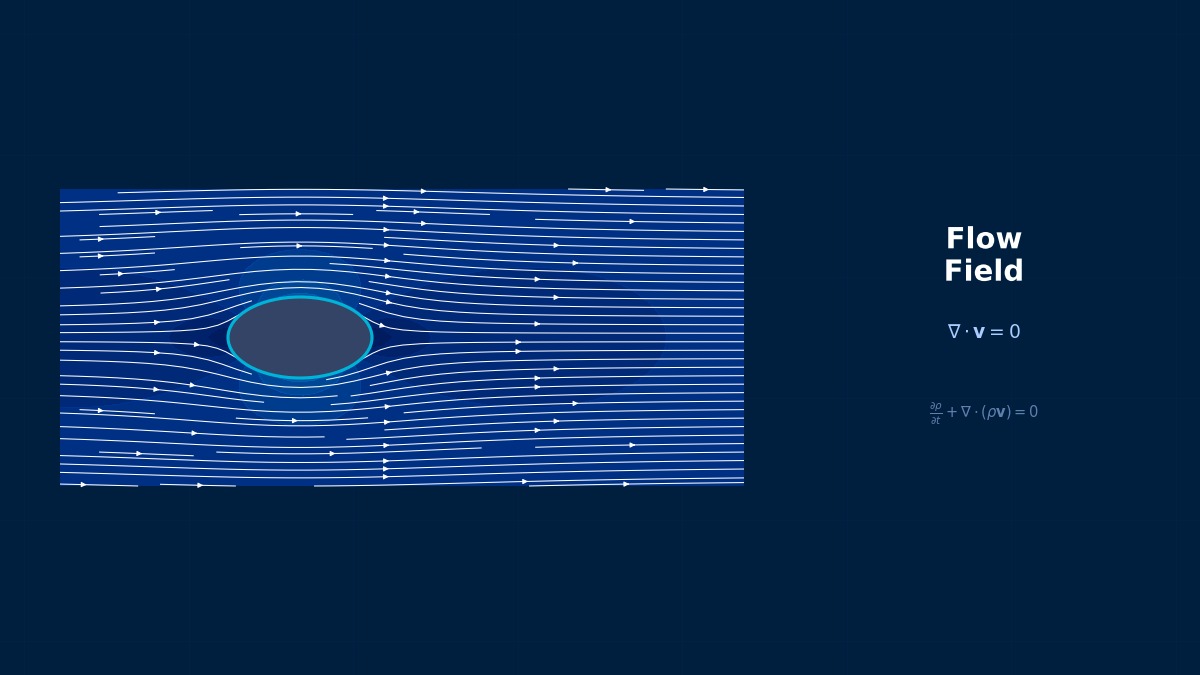
Airfoil and Wing Aerodynamic: Theoretical Foundations
Overview
Professor, how do you perform aerodynamic analysis around an aircraft wing using CFD?
It's an analysis to predict the lift and drag characteristics of an airfoil, and to evaluate stall behavior and the effects of high-lift devices. It's a fundamental technology underpinning aircraft design.
Starting from the NACA airfoil series, CFD has become indispensable for designing modern supercritical and natural laminar flow airfoils. CFD expands the design space that cannot be fully explored by wind tunnel testing alone.
Isn't the wind tunnel enough?
Wind tunnel testing costs on the order of millions of yen per condition. The standard modern workflow is to narrow down design candidates using CFD before bringing them to the wind tunnel.
Governing Equations
Please tell me the equations that describe the flow around a wing.
The compressible Navier-Stokes equations are fundamental. They are described by a set of three equations: the continuity equation, the momentum equation, and the energy equation.
The lift coefficient and drag coefficient are defined as follows.
Here, $L$ is lift, $D$ is drag, $\rho_\infty$ is freestream density, $V_\infty$ is freestream velocity, and $S$ is wing area.
What range does the Reynolds number typically fall into?
The chord-based Reynolds number for a passenger aircraft at cruise is around $Re_c \approx 2 \times 10^7$. The Mach number is primarily in the transonic range of $M \approx 0.78$--$0.85$.
In the transonic regime, a local supersonic region forms on the upper surface of the wing, generating a shock wave. The interaction between this shock wave and the boundary layer triggers buffet phenomena and can lead to stall.
I see. So accurately capturing the shock wave position is crucial.
Turbulence Model Selection
Which turbulence models are used for wing analysis?
They are chosen according to the application. The options change depending on whether transition prediction is needed or if fully turbulent flow is assumed.
| Model | Features | Suitability for Wing Analysis |
|---|---|---|
| Spalart-Allmaras (SA) | One-equation model. Widely used in aerospace. | Good for cruise conditions. Slightly less capable near stall. |
| SST k-omega | Blends k-omega near walls with k-epsilon far away | Strong for adverse pressure gradients and separation |
| gamma-Re_theta Transition Model | Combined with SA/SST to predict natural transition | Essential for natural laminar flow wing design |
| DDES/IDDES | Hybrid RANS+LES | For large-scale separation and buffet analysis |
The Spalart-Allmaras model is really major in aerospace, isn't it?
That's right. The SA model was originally developed by NASA for airfoil analysis. Both Boeing and Airbus use it extensively. However, for large-scale separation near stall, SST k-omega or DDES becomes necessary.
Airfoil Aerodynamic Characteristics
What kind of numerical results specifically come out of this?
Let's organize the aerodynamic parameters of typical airfoils.
| Airfoil | Application | Design $C_L$ | $C_{L,max}$ | Stall Angle of Attack |
|---|---|---|---|---|
| NACA 0012 | Benchmark | 0 (symmetric) | Approx. 1.5 | Approx. 16 deg |
| NACA 23012 | General purpose | 0.3 | Approx. 1.8 | Approx. 18 deg |
| RAE 2822 | Transonic benchmark | 0.74 (M=0.73) | -- | -- |
| SC(2)-0710 | Supercritical | 0.7 (M=0.78) | -- | -- |
RAE 2822 has publicly available wind tunnel data, so it's often used for CFD validation, right?
Exactly. Case 9 ($M=0.73$, $\alpha=2.79°$, $Re=6.5 \times 10^6$) is an industry-standard benchmark. In CFD, the pressure distribution on the upper surface and the shock wave position are compared with wind tunnel data.
Practical Considerations
What are the key points to be especially careful about in wing analysis?
The most important is boundary layer resolution. It's necessary to set the $y^+$ value of the first wall layer to 1 or less and ensure sufficient prism layers within the boundary layer.
- $y^+ \approx 1$: Recommended value for SA/SST models. Resolves the viscous sublayer without wall functions.
- Number of prism layers: At least 20 layers or more. Growth rate recommended to be 1.2 or less.
- Trailing edge treatment: Sharp trailing edges become singular points, so round them to a finite thickness (about 0.1% of chord).
- Far-field boundary: Place at a distance 20-50 times the chord length away.
So, boundary layer treatment is critical for wing analysis. I understand now.
That's right. Drag prediction accuracy is directly linked to boundary layer mesh quality. Sometimes accuracy of $\Delta C_D = 0.0001$ (1 count) is required, so meticulous attention to the mesh is necessary.
The "Numbers" in NACA Airfoils Have Meaning
The numbers in NACA 4-digit airfoils, for example NACA 2412, are not random. The first "2" means the maximum camber is 2% of the chord length, the "4" means its location is at 40% from the leading edge, and "12" means the maximum thickness is 12%. In the 1930s, NACA systematically measured hundreds of airfoil types in wind tunnels and established this naming convention. Thanks to this, just by looking at the airfoil number, you can visualize the shape like, "Ah, it's thin and suitable for swept wings." When creating models in CAE, knowing this system allows you to check the validity of the shape before importing coordinate data, which is subtly useful.
Computational Methods for Airfoil and Wing Aerodynamic
Spatial Discretization
When solving the flow around a wing with CFD, what specific numerical methods are used?
The Finite Volume Method (FVM) is mainstream. It uses a cell-centered scheme, discretizing by integrating the governing equations over the volume of each cell.
Discretization of the convection term holds the key to accuracy. Schemes of second-order accuracy or higher are essential, with specific choices like these.
| Scheme | Accuracy | Features | Application Scenario |
|---|---|---|---|
| 2nd Order Central Difference | 2nd Order | Low numerical dissipation | LES/DES |
| 2nd Order Upwind Difference | 2nd Order | High stability | RANS Steady-State Analysis |
| MUSCL (van Leer) | 2nd Order TVD | Suitable for shock wave capture | Transonic/Supersonic |
| Roe Approximate Riemann Solver | 2nd Order | High resolution for shock waves | Transonic Airfoils |
For transonic airfoils, there are shock waves, so schemes like Roe are used, right?
That's right. In Fluent, Roe-FDS is often used; in STAR-CCM+, the AUSM+ scheme is common for transonic airfoils. In OpenFOAM, the rhoCentralFoam solver supports shock wave capture.
Pressure-Velocity Coupling
Does the solution method change between incompressible and compressible flow?
Related Topics
Experience the theory firsthand with the interactive simulator for this field
All Simulators