ALE Method for FSI
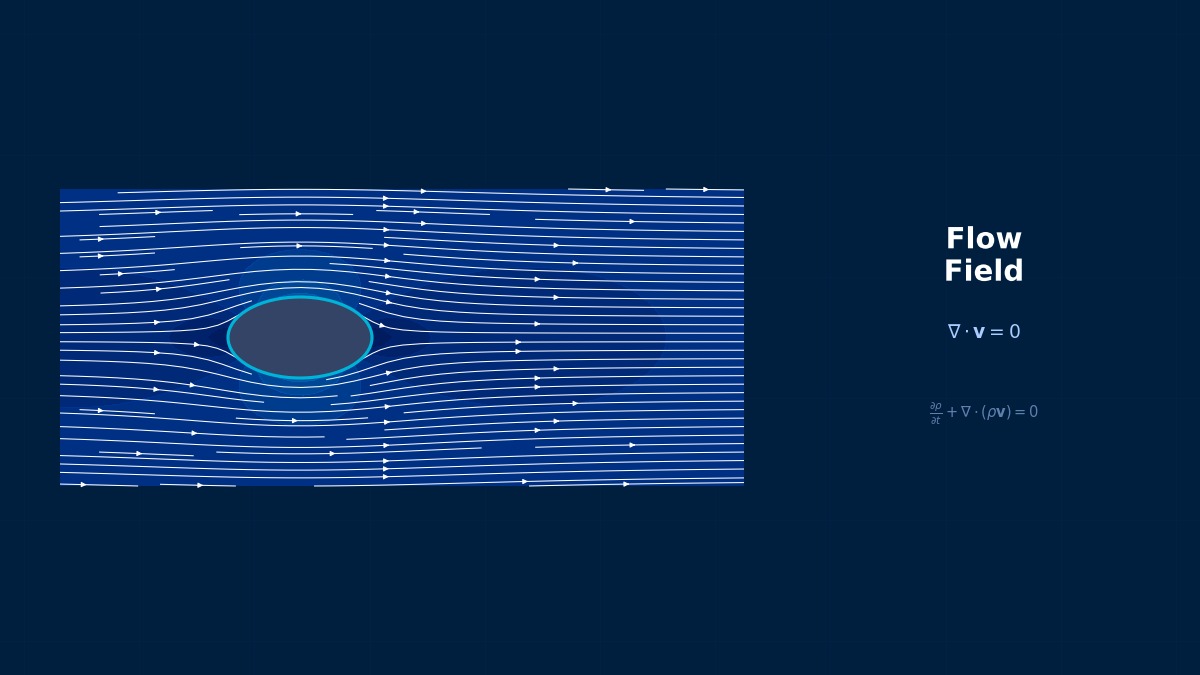
ALE Method for FSI: Theoretical Foundations
Basic Concepts of the ALE Method
Professor, ALE stands for "Arbitrary Lagrangian-Eulerian," right? What are the best aspects it combines from the Lagrangian and Eulerian descriptions?
In the Eulerian description, the grid is fixed and fluid passes through it. It's robust for large deformations but poor at interface tracking. In the Lagrangian description, the grid moves with the material, so interfaces are sharp, but the mesh can become distorted under large deformations. The ALE method is a middle ground, where the grid velocity can be set arbitrarily (Arbitrary). At interfaces, the grid moves with the material (Lagrangian-like), while internally, the grid is moved appropriately to maintain mesh quality (Eulerian-like).
The momentum conservation law of the Navier-Stokes equations in the ALE description becomes this.
Here, $\mathbf{c} = \mathbf{u} - \hat{\mathbf{u}}$ is the relative velocity (convective velocity) between the fluid velocity $\mathbf{u}$ and the mesh velocity $\hat{\mathbf{u}}$.
So if the mesh velocity $\hat{\mathbf{u}}$ is zero, it becomes Eulerian, and if $\hat{\mathbf{u}} = \mathbf{u}$, it becomes Lagrangian, right?
Exactly. In FSI problems, on the fluid-structure interface, we set $\hat{\mathbf{u}} = \dot{\mathbf{d}}_s$ (the structure's velocity), and the internal mesh velocity is determined by a smoothing algorithm.
GCL (Geometric Conservation Law)
Are there any specific points to note for the ALE method?
The most important is satisfying the GCL (Geometric Conservation Law). When the mesh moves, if the discretization of the conservation laws is not consistent, spurious source terms can appear even for a uniform flow.
This equation requires that the temporal change in cell volume matches the flux of the mesh velocity. In Fluent or STAR-CCM+, the GCL is automatically satisfied, but caution is needed for custom solvers in OpenFOAM.
What happens if the GCL is not satisfied?
Even with a uniform flow input, non-physical fluctuations in pressure or energy will occur. GCL errors become particularly pronounced with first-order time accuracy. It's important to use second-order time integration and correctly use the mesh positions from the previous step when calculating mesh velocity.
Mesh Smoothing Techniques
What kinds of smoothing algorithms are there to determine the internal mesh velocity?
Let's compare typical methods.
| Method | Principle | Large Deformation Tolerance | Cost |
|---|---|---|---|
| Laplacian Smoothing | Move to average position of adjacent nodes | Low | Very Low |
| Spring Analogy | Propagate deformation via spring network | Medium | Low |
| Diffusion-based | Solve diffusion equation to propagate displacement | High | Medium |
| RBF (Radial Basis Function) | RBF interpolation from interface displacement | Very High | High |
| Elasticity-based | Propagate displacement via elastic body equations | High | High |
In Fluent's Diffusion-based smoothing, setting the diffusivity as the inverse of the distance from the wall (the Boundary Distance option) suppresses mesh deformation near walls and preserves the quality of prism layers.
Lagrange and Euler—The Fusion of Two Classical Mechanics Viewpoints in FSI
The Lagrangian description is the viewpoint of "moving with the particles," while the Eulerian description is the viewpoint of "observing the flow at a fixed point in space." Structural analysis favors Lagrangian, and fluid analysis mainly uses Eulerian. The ALE method was born from the idea of "appropriately combining" both. It's remarkable that the descriptive methods conceived by 19th-century mathematicians have become the key to solving complex 21st-century FSI problems, showing the surprisingly long lifespan of fundamental theory.
Computational Methods for ALE Method for FSI
Weak Coupling and Strong Coupling
How does the choice of fluid-structure coupling algorithm affect analysis stability?
Stability and accuracy change significantly depending on the coupling strength.
| Coupling Method | Flow per Step | Stability | Accuracy | Cost |
|---|---|---|---|---|
| Weak Coupling (Explicit) | F→S→F (once only) | Low | Low-Medium | Low |
| Strong Coupling (Implicit) | F⇆S (iterate until convergence) | High | High | High |
| Monolithic | Solve F+S simultaneously | Highest | Highest | Very High |
Weak coupling has a one-step delay (time lag). It can remain stable for large density ratios $\rho_s/\rho_f$ (e.g., metal structure + air), but for $\rho_s/\rho_f \approx 1$ (e.g., blood vessel + blood, rubber + water), added mass instability occurs and weak coupling cannot be used.
Which should be used for aircraft wing flutter analysis?
For structures in air ($\rho_s/\rho_f \gg 1$), weak coupling is often stable enough. However, use strong coupling if accuracy is prioritized. For structures in water ($\rho_s/\rho_f \sim 1-10$), strong coupling is always necessary.
Aitken Relaxation Method
Is there a way to accelerate the convergence of strong coupling iterations?
The Aitken $\Delta^2$ acceleration method is the simplest and most effective. It dynamically optimizes the relaxation factor for coupling iterations.
Here, $\mathbf{r}^k$ is the interface residual at the $k$-th iteration. While fixed relaxation factors (e.g., $\omega = 0.5$) often require 10-20 iterations, Aitken acceleration often converges in 3-5 iterations.
Which software can use Aitken acceleration?
It's standard in preCICE. It was also recently added to Ansys System Coupling. In OpenFOAM, custom implementation is needed for coupling solidDisplacementFoam and pimpleFoam, but it's easy if you use the preCICE adapter.
Limitations of the ALE Method: Remeshing
What should I do if the mesh inevitably fails in the ALE method?
When structural deformation becomes comparable to the original mesh size, smoothing alone cannot cope. At that point, automatic remeshing is necessary.
- Fluent:
Remeshingoption in Dynamic Mesh Zone. Automatically regenerates tetrahedral mesh locally when cell quality falls below a threshold. - STAR-CCM+: Remeshing possible as a fallback when Morpher fails.
- OpenFOAM: Local refinement/coarsening with
dynamicRefineFvMesh, remeshing withtetDecomposition.
However, remeshing introduces interpolation errors in the solution. Quality control is particularly difficult for remeshing boundary layer prism meshes. For extremely large deformations, consider switching to the Overset mesh method or IBM (Immersed Boundary Method).
The Curious Quantity "Mesh Velocity" in the ALE Method
In the ALE method, a third velocity, "mesh velocity," appears in addition to "fluid velocity" and "structure velocity." It's not uncommon for engineers seeing the ALE settings screen for the first time in practice to be puzzled, asking, "What is this?" Mesh velocity is ultimately a virtual quantity born for computational convenience and has no physical meaning. But by skillfully controlling this "virtual velocity," calculations can continue without mesh failure even under unreasonable deformations—numerical analysis is indeed profound.