混合対流

Category: 流体解析(CFD) | Integrated 2026-04-06
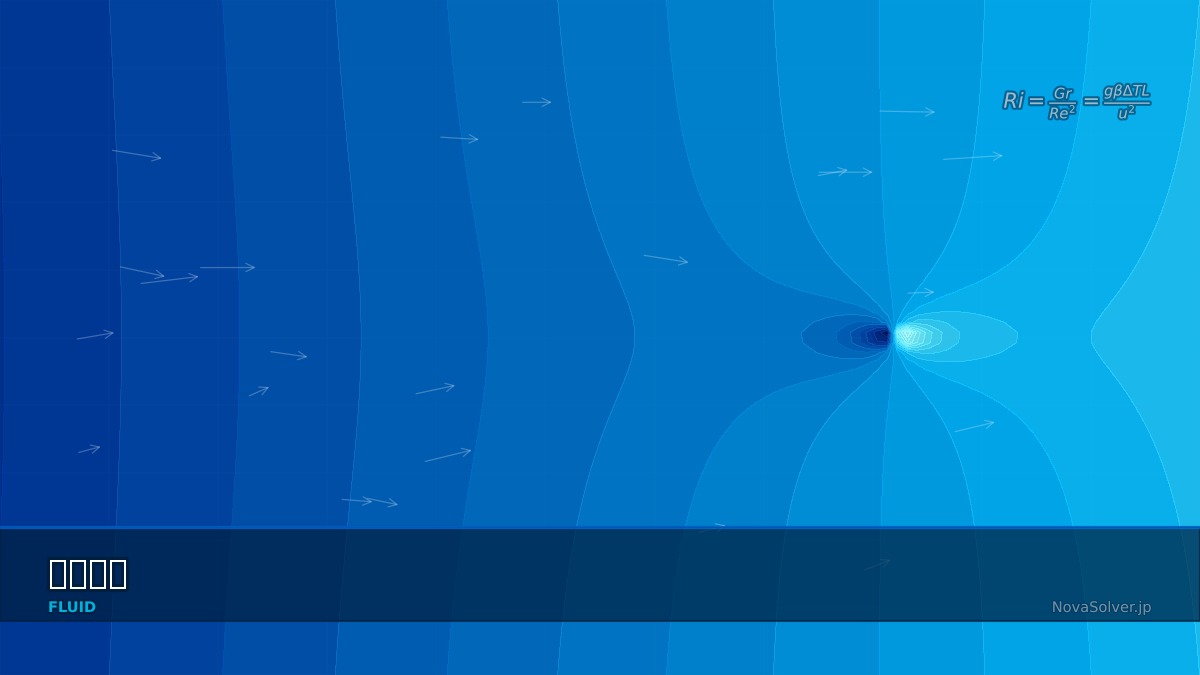
CAE visualization for mixed convection theory - technical simulation diagram
混合対流 — Richardson数による流れレジームの分類

Theory and Physics

What is Mixed Convection?

🧑‍🎓

Professor, mixed convection is a state where forced convection and natural convection occur simultaneously, right?


🎓

Exactly. When external flow (from fans or pumps) and buoyancy-driven flow coexist with comparable strength, it is called mixed convection. For example, in upward flow inside a vertical pipe with heated walls, the forced flow from the pump and the upward flow due to buoyancy superimpose.


🧑‍🎓

How do we determine which one is dominant?


🎓

It is judged by the Richardson number $Ri$.


$$ Ri = \frac{Gr}{Re^2} = \frac{g \beta \Delta T L}{u^2} $$

If $Ri \ll 1$, forced convection is dominant; if $Ri \gg 1$, natural convection is dominant; if $Ri \sim O(1)$, it is mixed convection. Practically, the range $0.1 < Ri < 10$ can be considered the mixed convection region.


Aiding Flow and Opposing Flow

🧑‍🎓

Is the directional relationship between buoyancy and forced flow important?


🎓

It is very important. In upward flow in a heated vertical pipe, buoyancy acts in a direction that aids the flow (aiding flow). Conversely, in downward flow, buoyancy and flow are in opposite directions (opposing flow).


🎓

In aiding flow, the Nusselt number increases compared to pure forced convection. In opposing flow, flow deceleration, reverse flow, and relaminarization can occur, causing the Nusselt number to change complexly. Particularly, the relaminarization phenomenon in opposing flow is known to be difficult to predict accurately with CFD.


🧑‍🎓

What about in horizontal pipes?


🎓

In horizontal pipes, buoyancy generates secondary flow (longitudinal vortices). High-temperature fluid accumulates in the upper part of the pipe cross-section, and low-temperature fluid pools in the lower part. To accurately predict this asymmetric temperature distribution, 3D calculation is essential; 2D axisymmetric approximation cannot be used.

Coffee Break Coffee Break Talk

The Richardson Number Decides "Which is Stronger?"

The Richardson number (Ri = Gr/Re²), which is key in mixed convection, indicates "how many times stronger buoyancy is compared to forced flow." If Ri ≪ 1, forced convection is dominant and can be solved simply, but near Ri ≈ 1, buoyancy and inertial forces compete, causing complex flow interactions. The interior of electronic equipment enclosures often falls into this troublesome zone—airflow is created by fans while buoyancy flow also occurs due to temperature differences on circuit boards. In practice, a stepwise approach is common: "First solve with forced convection only, and if wall temperatures become too high, add the Boussinesq term." The region where Ri ≫ 1 is dominated by natural convection, such as calculations for emergency cooling when fans are stopped.

Physical Meaning of Each Term
  • Temporal Term $\partial(\rho\phi)/\partial t$: Imagine the moment you turn on a faucet. At first, water comes out in an unstable, splashing manner, but after a while, it becomes a steady flow, right? This "period of change" is described by the temporal term. The pulsation of blood flow due to heartbeats and flow fluctuations each time an engine valve opens or closes are all unsteady phenomena. So what is steady-state analysis? It looks only at "after sufficient time has passed and the flow has settled down"—meaning this term is set to zero. Since computational cost is significantly reduced, trying to solve first with a steady-state approach is a basic CFD strategy.
  • Convection Term $\nabla \cdot (\rho \mathbf{u} \phi)$: What happens if you drop a leaf into a river? It gets carried downstream by the flow, right? This is "convection"—the effect where fluid motion transports things. Warm air from a heater reaching the far end of a room is also because the "carrier," air, transports heat via convection. Here's the interesting part—this term contains "velocity × velocity," making it nonlinear. That is, as flow speed increases, this term rapidly strengthens, making control difficult. This is the root cause of turbulence. A common misconception: "Convection and conduction are similar" → They are completely different! Convection is carried by flow, conduction is transmitted by molecules. There is an order of magnitude difference in efficiency.
  • Diffusion Term $\nabla \cdot (\Gamma \nabla \phi)$: Have you ever put milk in coffee and left it? Even without stirring, it naturally mixes after a while. That's molecular diffusion. Now, next question—honey and water, which flows more easily? Obviously water, right? Honey has high viscosity ($\mu$), so it flows poorly. When viscosity is high, the diffusion term becomes strong, and the fluid moves in a "thick" manner. In low Reynolds number flow (slow, viscous), diffusion is dominant. Conversely, in high Re number flow, convection overwhelmingly dominates, and diffusion plays a supporting role.
  • Pressure Term $-\nabla p$: When you push the plunger of a syringe, liquid shoots out forcefully from the needle tip, right? Why? Because the plunger side is high pressure, and the needle tip is low pressure—this pressure difference provides the force that pushes the fluid. Dam discharge works on the same principle. On a weather map, where isobars are densely packed? That's right, strong winds blow. "Flow occurs where there is a pressure difference"—this is the physical meaning of the pressure term in the Navier-Stokes equations. A point of confusion here: "Pressure" in CFD is often gauge pressure, not absolute pressure. If results become strange immediately after switching to compressible analysis, it might be due to confusion between absolute/gauge pressure.
  • Source Term $S_\phi$: Heated air rises—why? Because it becomes lighter (lower density) than its surroundings and is pushed up by buoyancy. This buoyancy is added to the equation as a source term. Other examples: chemical reaction heat from a gas stove flame, Lorentz force acting on molten metal in a factory's electromagnetic pump... These are all actions that "inject energy or force into the fluid from the outside," expressed by the source term. What happens if you forget the source term? In natural convection analysis, forgetting to include buoyancy means the fluid doesn't move at all—a physically impossible result like turning on a heater in a winter room but the warm air doesn't rise.
Assumptions and Applicability Limits
  • Continuum Assumption: Valid for Knudsen number Kn < 0.01 (mean free path of molecules ≪ characteristic length)
  • Newtonian Fluid Assumption: Shear stress and strain rate have a linear relationship (non-Newtonian fluids require viscosity models)
  • Incompressibility Assumption (for Ma < 0.3): Density is treated as constant. For Mach numbers above 0.3, compressibility effects must be considered
  • Boussinesq Approximation (Natural Convection): Density variation is considered only in the buoyancy term; constant density is used in other terms
  • Non-applicable Cases: Rarefied gases (Kn > 0.1), supersonic/hypersonic flow (shock wave capturing required), free surface flow (requires VOF/Level Set, etc.)
Dimensional Analysis and Unit Systems
VariableSI UnitNotes / Conversion Memo
Velocity $u$m/sWhen converting from volumetric flow rate for inlet conditions, pay attention to cross-sectional area units
Pressure $p$PaDistinguish between gauge pressure and absolute pressure. Use absolute pressure for compressible analysis
Density $\rho$kg/m³Air: approx. 1.225 kg/m³ @20°C, Water: approx. 998 kg/m³ @20°C
Viscosity Coefficient $\mu$Pa·sBe careful not to confuse with kinematic viscosity coefficient $\nu = \mu/\rho$ [m²/s]
Reynolds Number $Re$Dimensionless$Re = \rho u L / \mu$. Criterion for Laminar/turbulent transition
CFL NumberDimensionless$CFL = u \Delta t / \Delta x$. Directly related to time step stability

Numerical Methods and Implementation

Applicability Range of the Boussinesq Approximation

🧑‍🎓

I've heard that handling density is crucial in CFD for mixed convection.


🎓

To correctly handle the buoyancy term, how to model the temperature dependence of density is key. The simplest is the Boussinesq approximation, which linearly approximates density as


$$ \rho = \rho_0 [1 - \beta (T - T_0)] $$

and reflects this variation only in the buoyancy term. Density is treated as constant in other terms of the momentum equation. In Ansys Fluent, set Gravity in Operating Conditions and set Material Density to Boussinesq.


🧑‍🎓

When can't the Boussinesq approximation be used?


🎓

Accuracy degrades when the temperature difference is large, around $\beta \Delta T > 0.1$~$0.2$. For air, caution is needed for $\Delta T > 30$°C or so. In such cases, the nonlinear temperature dependence of density should be handled directly using ideal gas or polynomial density. Fluent's Incompressible Ideal Gas setting is convenient.


Notes on Turbulence Models

🧑‍🎓

Are there any specific points to note when selecting turbulence models for mixed convection?


🎓

The buoyancy-induced turbulence generation/damping effect becomes important. In k-ε type models, the buoyancy production term $G_b = -g_i \frac{\mu_t}{\rho Pr_t} \frac{\partial \rho}{\partial x_i}$ is added. In Fluent, it is strongly recommended to turn ON "Full Buoyancy Effects" in the Viscous Model Options.


🎓

Also, the Transition SST model is effective for predicting relaminarization phenomena in opposing flow. Standard turbulence models cannot predict laminarization and overestimate the Nusselt number.


🧑‍🎓

Are mesh requirements different from forced convection?


🎓

Wall-normal mesh requirements are similar (recommended $y^+ \approx 1$), but the mesh in the pipe cross-sectional direction must also be sufficiently fine to resolve secondary flow due to buoyancy. For horizontal pipes, at least 40~60 divisions in the cross-sectional direction are necessary. If too coarse, secondary flow cannot be resolved, and the asymmetry of the Nusselt number will be underestimated.

Coffee Break Coffee Break Talk

Boussinesq Approximation—The Contradiction of "Density is Constant, but Buoyancy is Calculated"

The Boussinesq approximation seems like a strange assumption at first glance. "Density ρ is assumed constant, but only the buoyancy term uses temperature-dependent density variation"—this appears contradictory. But actually, this approximation is physically correct. For small temperature differences ΔT (ΔT < approx. 20~30°C as a guideline), the density change is sufficient to move the fluid as a buoyancy force, but its effect on inertial forces and the continuity equation is negligibly small. This separation significantly reduces nonlinearity, stabilizing the calculation. On the other hand, for large ΔT environments like inside high-temperature furnaces or building exterior walls exposed to sunlight, a "full density model (ideal gas, etc.)" that considers the full density variation is necessary. A guideline for model selection is to check that βΔT < 0.1.

Upwind Scheme

First-order upwind: Large numerical diffusion but stable. Second-order upwind: Improved accuracy but risk of oscillations. Essential for high Reynolds number flow.

Central Differencing

Second-order accurate, but numerical oscillations occur for Pe number > 2. Suitable for low Reynolds number diffusion-dominated flow.

TVD Schemes (MUSCL, QUICK, etc.)

Maintain high accuracy while suppressing numerical oscillations via limiter functions. Effective for capturing shock waves or steep gradients.

Finite Volume Method vs Finite Element Method

FVM: Naturally satisfies conservation laws. Mainstream in CFD. FEM: Advantageous for complex shapes and multiphysics. Mesh-free methods like SPH are also developing.

CFL Condition (Courant Number)

Explicit methods: CFL ≤ 1 is the stability condition. Implicit methods: Stable even for CFL > 1, but affects accuracy and iteration count. LES: CFL ≈ 1 is recommended. Physical meaning: Information should not travel more than one cell per time step.

Residual Monitoring

Convergence is judged when residuals for each equation—Continuity, momentum, energy—decrease by 3~4 orders of magnitude. The mass conservation residual is particularly important.

Relaxation Factors

Typical initial values: Pressure: 0.2~0.3, Velocity: 0.5~0.7. If diverging, lower the relaxation factors. After convergence, increase to accelerate.

Internal Iterations for Unsteady Calculations

Iterate within each time step until a steady solution converges. Internal iteration count: 5~20 iterations is a guideline. If residuals fluctuate between time steps, review the time step size.

Analogy for the SIMPLE Method

The SIMPLE method is a "sequential adjustment" technique. First, velocity is tentatively determined (predictor step), then pressure is corrected so that mass conservation is satisfied with that velocity (corrector step), and velocity is revised using the corrected pressure—this back-and-forth is repeated to approach the correct solution. It resembles two people leveling a shelf: one adjusts the height, the other balances it, and they repeat this alternately.

Analogy for the Upwind Scheme

The upwind scheme is a method that "stands in the river flow and prioritizes upstream information." A person in the river cannot tell where the water comes from by looking downstream—it reflects the physics that upstream information determines downstream. Although first-order accurate, it is highly stable because it correctly captures flow direction.

Practical Guide

Mixed Convection in Building Environments

🧑‍🎓

Is mixed convection also important in HVAC design for buildings?


🎓

Extremely important. In office air conditioning, supply air from the ceiling (forced convection) coexists with buoyancy from heat sources inside the room (PCs, people, lighting). If the cold air from ceiling diffusers does not have sufficient momentum, a warm air layer (warm layer) stagnates in the upper part of the room, causing thermal stratification.


🧑‍🎓

So that's predicted with CFD.


🎓

Exactly. In Fluent, for steady RANS, Realizable k-ε + Enhanced Wall Treatment is the standard choice for indoor environment CFD. In OpenFOAM, combine buoyantSimpleFoam with kOmegaSST. Human body heat generation is modeled as a heat source of about 80~120W, and a practical workflow includes comfort evaluation via PMV-PPD.


Thermal Design of Electronic Equipment Enclosures

🧑‍🎓

Is the inside of electronic equipment enclosures also mixed convection?


🎓

In enclosures with fans, forced convection is dominant, but in fanless (natural air cooling) or fan failure scenarios, it becomes buoyancy-driven. Design-wise, both cases need to be evaluated, which is precisely a mixed convection problem.


🎓

In practice, a 3D enclosure model is created, and components are modeled as volume heat sources. Circuit boards are modeled as orthotropic (anisotropic) thermal conductors, with in-plane and out-of-plane thermal conductivities input separately. Solving solid-fluid simultaneously using STAR-CCM+ or Fluent's CHT function is standard.


🧑‍🎓

I have the impression that natural convection inside enclosures is difficult to converge.


🎓

Sharp observation. Natural convection in sealed enclosures may not have a steady-state solution (at high Ra numbers, it becomes unsteady oscillatory flow). If residuals oscillate in steady-state calculations, you should switch to unsteady calculation and take a time average. In Fluent, using adaptive time stepping in Transient settings is practical.


Verification Methods

関連シミュレーター

この分野のインタラクティブシミュレーターで理論を体感しよう

シミュレーター一覧

関連する分野

この記事の評価
ご回答ありがとうございます!
参考に
なった
もっと
詳しく
誤りを
報告
参考になった
0
もっと詳しく
0
誤りを報告
0
Written by NovaSolver Contributors
Anonymous Engineers & AI — サイトマップ