Curvature and Rotation Corrections for Turbulence Models
Curvature and Rotation Corrections for Turbulence: Theoretical Foundations
Overview
Teacher! My swirling flow simulation doesn't match the experiment. Can it be fixed with that curvature/rotation correction thing?
Good point. Standard eddy viscosity models (k-epsilon, k-omega SST, SA) assume isotropic eddy viscosity, so they cannot correctly capture the increase or decrease in turbulence due to streamline curvature or system rotation. Curvature/Rotation Correction (CC) is an additional term to correct that shortcoming.
Specifically, what kind of flows does it cause problems in?
These are typical examples.
- Swirling flows in cyclone separators or swirl burners
- Secondary flows between turbine blade rows
- Curved flow in U-shaped pipes
- Flows inside casings of rotating machinery (fans, compressors)
On the concave side, turbulence increases due to centrifugal instability, while on the convex side, it stabilizes and turbulence is suppressed. Standard models cannot predict this asymmetry.
Governing Equations
How does the correction change the model's equations?
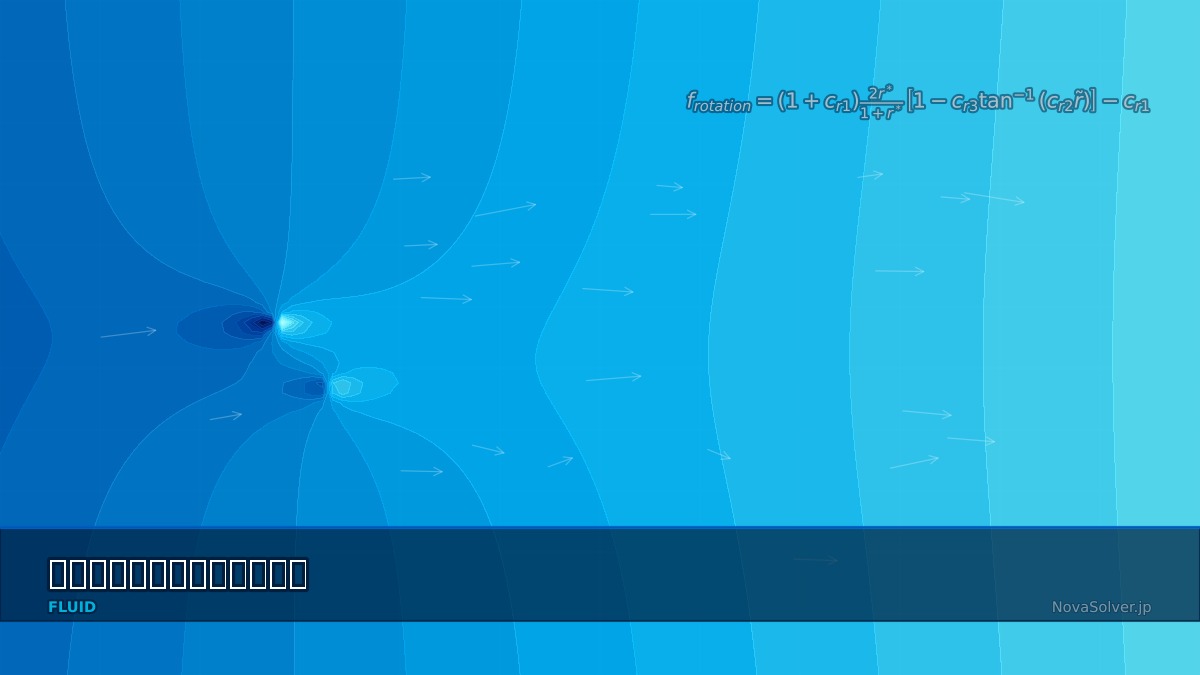
In the Spalart-Shur rotation/curvature correction (used in SA-RC, SST-RC), a multiplier $f_{rotation}$ is introduced for the production term.
Here, $r^*$ and $\tilde{r}$ are dimensionless parameters constructed from the strain rate tensor $S_{ij}$ and the rotation rate tensor $\Omega_{ij}$.
The standard values for the constants are $c_{r1}=1.0$, $c_{r2}=12.0$, $c_{r3}=1.0$. Finally, $f_{rotation}$ is clipped.
Is it just multiplying the production term?
Yes. In the case of SST-RC, the production term $P_k$ in the k-equation is replaced with $\tilde{P}_k = P_k \cdot f_{rot}$. On a convex wall, $f_{rot}<1$ suppresses turbulence production, and on a concave wall, $f_{rot}>1$ increases it. The Spalart-Allmaras model similarly modifies the production term in the SA equation.
So this will improve the prediction of swirling flows.
It improves it, but it's not a panacea. Since the correction is calculated only from local quantities, it has limitations in cases where rotational effects accumulate non-locally (e.g., long vortex tubes). Approaches like RSM (Reynolds Stress Model), which transport each stress component individually, are more physically accurate but computationally expensive.
Curvature-Corrected Turbulence Models—The Reason "Curved Flow is Less Turbulent than Straight Flow"
In flows where streamlines curve (curved pipes, swirling flows), wall curvature strongly modulates the turbulence structure. On the convex side (stabilized by centrifugal force), turbulence is suppressed, while on the concave side (destabilized), it is promoted. The generation of Taylor-Görtler vortices (longitudinal vortices) on the concave side is also a manifestation of this instability. Standard k-ε and k-ω SST do not explicitly account for this curvature effect in their scalar transport equations, leading to low prediction accuracy for swirling flows, curved pipes, and cyclones. Speziale (1987) and Rothe/Spalart (1997) proposed curvature corrections, and modifications incorporating the curvature Richardson number into turbulence models have become mainstream.
Computational Methods for Curvature and Rotation Corrections for Turbulence
Details of Numerical Implementation
When implementing curvature correction in a solver, are there any numerical points to be careful about?
There are several points. First, the calculation of $f_{rot}$ includes the material derivative of the strain rate $DS_{ij}/Dt$, so evaluation of the unsteady term and advection term is necessary. Even in steady calculations, it can be approximated from pseudo-time step information, but it affects accuracy.
Calculation Procedure for $f_{rotation}$
Please tell me the specific steps.
Calculate the following in each cell.
1. Calculate strain rate $S_{ij}$ and rotation rate $\Omega_{ij}$ from the velocity gradient tensor $\partial u_i / \partial x_j$
2. Compute $S = \sqrt{2S_{ij}S_{ij}}$, $\Omega = \sqrt{2\Omega_{ij}\Omega_{ij}}$
3. Approximate the material derivative of strain rate $DS_{ij}/Dt$ using difference from the previous time step
4. Calculate dimensionless parameters $r^*$ and $\tilde{r}$
5. Compute $f_{rotation}$ and clip it to $[0, 1.25]$
Why is clipping necessary?
If $f_{rot}$ becomes negative, the production term becomes negative (non-physical turbulence dissipation), and exceeding 1.25 causes excessive turbulence generation leading to numerical instability. Clipping is a safety mechanism.
Compatibility with Discretization Schemes
What advection scheme should I use?
The curvature correction itself modifies the production term of the turbulence model, so it is independent of the discretization schemes for the momentum or turbulence equations. However, in swirling flows, numerical dissipation can cause decay of the swirl, so second-order or higher schemes (Bounded Central Difference, LUST, etc.) should be used. First-order upwind difference excessively damps the swirl.
| Parameter | Recommended Setting | Remarks |
|---|---|---|
| Momentum Discretization | Bounded Central or LUST | Suppresses swirl decay |
| Turbulence Quantity Discretization | Second-Order Upwind | Balance of stability and accuracy |
| Time Discretization | Second-Order Backward Difference | For unsteady calculations |
| $f_{rot}$ Clipping | $[0, 1.25]$ | Numerical Stability |
Implementation Example in OpenFOAM
How do you set it up in OpenFOAM?
Enable the curvatureCorrection flag in constant/turbulenceProperties.
```
RAS
{
RASModel kOmegaSST;
turbulence on;
curvatureCorrection yes;
printCoeffs on;
}
```
OpenFOAM's kOmegaSST model has the Spalart-Shur correction built-in. No additional source files are needed.
If it's enabled with just one setting, that's convenient.
However, verification that the results are reasonable is essential. Check if the swirl number matches experimental data and how the wall friction coefficient distribution changes.
Numerical Implementation of Curvature Correction—Spalart-Shur Correction Factor and β Factor
The Spalart-Shur (1997) curvature correction incorporates the effects of curvature and rotation by multiplying the turbulence production term by a "correction factor r* and r (coefficient)." The correction factor is calculated from the ratio of the streamline curvature tensor and the vorticity tensor, decreasing the production rate on convex (stable) sides and increasing it on concave (unstable) sides. This correction has been implemented in many commercial CFD packages as an application to the k-ω SST model (SSTcc). However, a challenge is that the adjustment coefficients (Cr1, Cr2) for the correction factor are not universal constants based on physics and are case-dependent. Data-driven tuning of curvature correction coefficients using machine learning (ML) has become a research direction in the 2020s.
Curvature and Rotation Corrections for Turbulence in Practice
Curvature and Rotation Corrections for Turbulence in Practice
Please tell me the workflow for using curvature correction in an actual project.
Practical CAE quality notes for Curvature and Rotation Corrections for Turbulence Models
Curvature and Rotation Corrections for Turbulence Models should be treated as an engineering model, not as an isolated formula. In fluid simulation, reliable results come from a clear chain of assumptions: governing physics, material data, boundary conditions, numerical discretization, solver settings, and post-processing criteria. Before using this note in a design review, identify which quantities are prescribed, which are solved, and which are only diagnostic indicators.
Model setup checklist
- Define the scope: decide whether Curvature and Rotation Corrections for Turbulence Models is being used for screening, detailed design, failure investigation, or verification of another simulation.
- Check dimensions and units: keep SI units internally and document every conversion applied to loads, geometry, material constants, and time or frequency scales.
- State assumptions explicitly: record linearity, steady-state or transient behavior, small-deformation limits, continuum assumptions, and any symmetry or ideal boundary conditions.
- Compare with a baseline: use a hand calculation, limiting case, mesh refinement trend, or independent solver result before accepting the final value.
Validation signals
| Review item | What to verify | Typical warning sign |
|---|---|---|
| Inputs | Geometry, material data, loads, and constraints match the intended fluid simulation problem. | Correct-looking plots with unrealistic magnitudes or units. |
| Numerics | Mesh, time step, convergence tolerance, and solver options are adequate for Curvature Correction. | Large changes after small mesh or tolerance adjustments. |
| Physics | The selected theory remains valid in the expected stress, temperature, velocity, or frequency range. | Results are used outside the assumptions stated in the model. |
For production use, keep the model file, input table, result plots, and review comments together. This makes Curvature and Rotation Corrections for Turbulence Models traceable and prevents the page from being used as a black-box answer without engineering judgment.
Related Topics
Experience the theory firsthand with the interactive simulator for this field
All Simulators