Curve Fitting — CAE Glossary
What is Curve Fitting
Definition and Basic Principles
What situations in CAE require curve fitting? This isn't just about drawing a line on a graph, right?
The most common application is material parameter identification. From stress-strain data obtained in tensile or compression tests, we determine the parameters of a constitutive relation (material model). For example, when analyzing a rubber seal component, we fit the Mooney-Rivlin model parameters $C_{10}$ and $C_{01}$ to the experimental data. CAE cannot exist without test data, so curve fitting is like the entrance to analysis.
I see—it's like a bridge connecting test data to model equations. In general, what steps are involved?
Basically three steps: (1) choose a mathematical model (e.g., Mooney-Rivlin, Ogden, Arruda-Boyce, etc.), (2) optimize the unknown parameters of that model to minimize the error between it and the test data, and (3) validate the fitting results. The part where we "minimize the error" uses the least squares method.
Mathematical Foundation of Least Squares Method
I often hear about the least squares method. Can you explain how it works in simple terms?
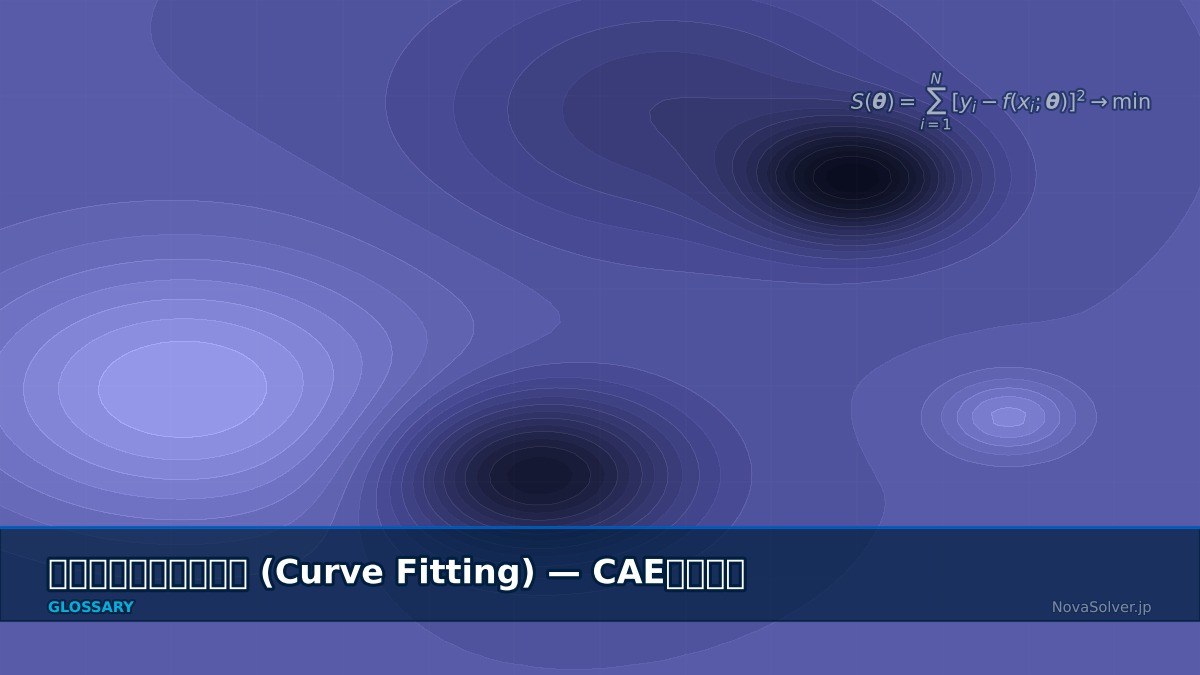
The method squares the differences (residuals) between measured values $y_i$ and model predictions $f(x_i; \boldsymbol{\theta})$, sums them across all data points, and adjusts parameters $\boldsymbol{\theta}$ to minimize this sum. Mathematically:
$$S(\boldsymbol{\theta}) = \sum_{i=1}^{N} \left[ y_i - f(x_i; \boldsymbol{\theta}) \right]^2 \to \min$$
We square the residuals so that positive and negative deviations don't cancel each other out.
I've heard that linear cases can be solved analytically. What about material fitting in CAE?
Linear models like $f = a + bx$ can be solved in one step using the normal equations. However, nearly all material models used in CAE are nonlinear, so we use nonlinear least squares methods. The most common is the Levenberg-Marquardt algorithm, which combines gradient descent and the Gauss-Newton method. Abaqus's material calibration tool and Ansys's "Curve Fitting" feature often use this internally.
Applications to Material Parameter Identification
How specifically do you fit a Mooney-Rivlin model?
The strain energy density function for the Mooney-Rivlin model is:
$$W = C_{10}(I_1 - 3) + C_{01}(I_2 - 3)$$
where $I_1$ and $I_2$ are invariants of the right Cauchy-Green deformation tensor. For uniaxial tension, using stretch ratio $\lambda$, the nominal stress becomes:
$$\sigma_{\text{eng}} = 2\left(\lambda - \frac{1}{\lambda^2}\right)\left(C_{10} + \frac{C_{01}}{\lambda}\right)$$
We fit this equation to test data $(\lambda_i, \sigma_i)$ to determine $C_{10}$ and $C_{01}$. For silicone rubber, typical values are around $C_{10} \approx 0.2$ MPa and $C_{01} \approx 0.05$ MPa.
Is fitting to uniaxial tensile data alone sufficient?
That's the most common trap. Fitting only to uniaxial tensile data often produces poor predictions for equibiaxial tension or pure shear behavior. Since real components experience complex multiaxial stress states, the standard practice is to fit at least two types of data (uniaxial tension + equibiaxial or pure shear) simultaneously. I've seen cases where a model built on uniaxial data alone gave 30% error in stiffness predictions for an engine mount analysis.
There are several hyperelastic models besides Mooney-Rivlin. How do you choose between them?
Roughly, they're distinguished by strain range. Mooney-Rivlin works well for moderate strains (up to ~150%). For large strains (300% and above), the Ogden model is stronger. If you want to capture molecular chain locking behavior, use the Arruda-Boyce model. In practice, fit all candidate models and select the one with the highest $R^2$ and the least systematic bias in residuals. Built-in calibration tools in solvers let you compare multiple models at once.
Evaluation of Fitting Quality
How do you judge whether a fit is good? Is $R^2$ alone sufficient?
The coefficient of determination $R^2$ being close to 1 is basic, but it's not enough. Three things matter: First, examine the residual plot—are residuals randomly scattered with no systematic bias (no U-shaped pattern)? Second, check extrapolation validity—do stresses become negative or diverge outside the fitted range? For hyperelastic models, check if the Drucker stability condition is satisfied. Third, verify physical reasonableness of parameters—if $C_{10}$ becomes negative, that's physically nonsensical and the fit cannot be used.
What if the test data is noisy? Should I just fit it as-is?
Fitting noisy data directly to a high-order model causes overfitting. The curve passes perfectly through the data points but oscillates wildly between them, becoming physically meaningless. Remedies include: (1) smoothing the data (moving average or Savitzky-Golay filter), (2) reducing model order, (3) adding regularization terms. But the real solution is improving the test data quality itself—better specimen preparation and measurement environment are the fundamental fix.
For metallic materials, like the Johnson-Cook model, is parameter fitting done the same way?
Exactly. The Johnson-Cook model is:
$$\sigma = \left(A + B\varepsilon_p^n\right)\left(1 + C\ln\dot{\varepsilon}^*\right)\left(1 - T^{*m}\right)$$
We need to identify five parameters: $A, B, n, C, m$. A standard phased approach is: first fit quasi-static tensile tests to get $A, B, n$; then use tests at different strain rates to determine $C$; finally use high-temperature tests to find $m$. For impact and forming analysis, the accuracy of this calibration directly affects result reliability—it's a step that cannot be skipped.
Related Terms
- Least Squares Method: The most basic technique to minimize the sum of squared residuals to estimate parameters
- Levenberg-Marquardt Algorithm: An iterative algorithm for efficiently solving nonlinear least squares problems
- Hyperelastic Model: A constitutive relation describing large deformation behavior of rubber and elastomers
- Parameter Identification: The overall process of determining material model constants from test data
- Coefficient of Determination $R^2$: A statistical measure of fit quality, ranging from 0 to 1
- Overfitting: A state where fit to data is good but generalization capability is poor
Precise understanding of CAE terminology is the foundation of team communication. — NovaSolver Project also supports learning for practitioners.
Tell us about challenges you face with curve fitting in your work
NovaSolver Project aims to solve the challenges CAE engineers face daily—complexity of setup, computational cost, interpretation of results. Your practical experience drives better tool development.
Contact Us (Coming Soon)Related Topics
Detail
Error