Casting Defect Prediction
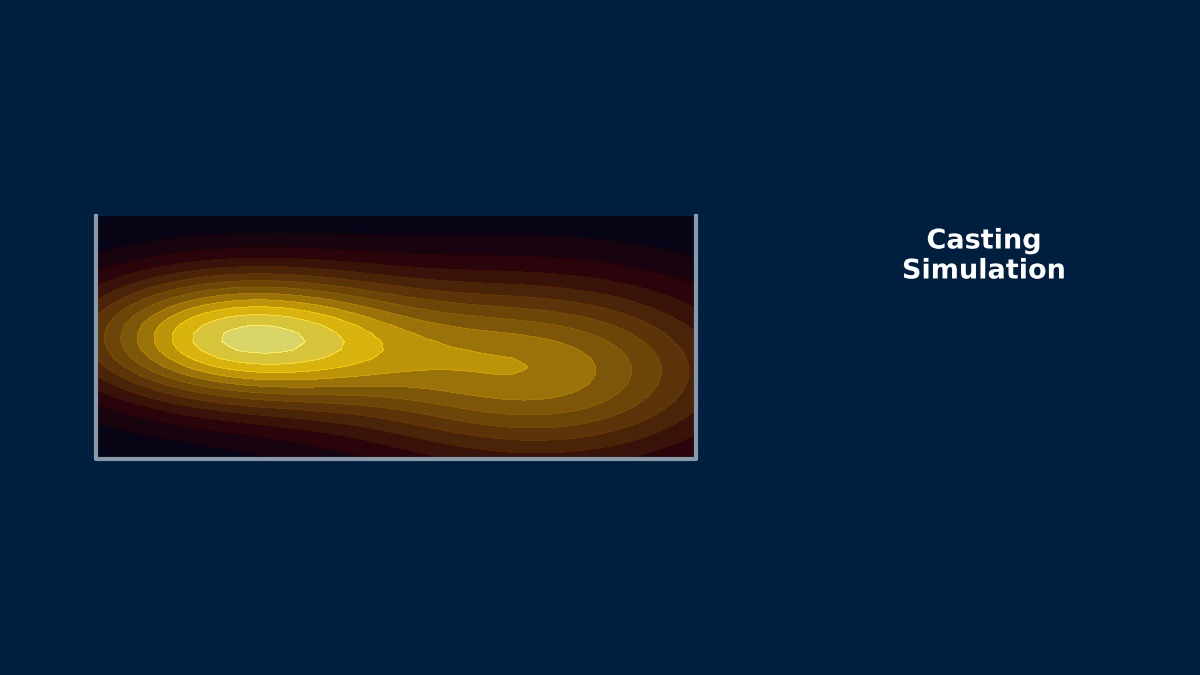
Casting Defect Prediction: Theoretical Foundations
Overview
Professor! Today's topic is about casting defect prediction, right? What is it about?
Predicting casting defects such as shrinkage porosity, gas porosity, and hot tearing (hot cracking) through simulation. Quantitative evaluation using the Niyama criterion, Hot Spot analysis, and HTI (Hot Tearing Indicator).
Wait, wait, shrinkage porosity... so does that mean it can also be used in cases like this?
Governing Equations
Expressing this with an equation, it looks like this.
Hmm, just the equation doesn't really click for me... What does it represent?
Feeding flow due to Darcy flow:
Theoretical Foundation
I've heard of "theoretical foundation," but I might not fully understand it...
Casting defect prediction simulation is formulated as a coupled problem of thermodynamics, solid mechanics, and fluid dynamics. Since the physical phenomena of manufacturing processes span multiple time and spatial scales, an appropriate combination of macro-scale continuum models and meso/micro-scale material models is required. The goal is to quantitatively predict the causal relationship between process parameters (temperature, velocity, load, etc.) and product quality (dimensional accuracy, defects, mechanical properties).
Governing Equations for Manufacturing Processes
I'm not good with equations... Could you explain the "meaning" of the casting defect prediction equations?
Manufacturing process simulation is formulated as a coupled problem of thermodynamics, fluid dynamics, and solid mechanics.
Heat Conduction Equation (Energy Conservation)
What exactly is the heat conduction equation?
Here, $T$ is temperature, $\mathbf{v}$ is the material velocity field, $k$ is thermal conductivity, and $Q$ is internal heat generation (Joule heating, latent heat, frictional heat, etc.).
Now I understand what my senior meant when he said, "At least do manufacturing process simulation properly."
Solidification and Phase Change
Please tell me about "Solidification and Phase Change"!
During solidification, the release/absorption of latent heat significantly affects the temperature field. Formulation using the enthalpy method:
Expressing this with an equation, it looks like this.
Hmm, just the equation doesn't really click for me... What does it represent?
Here, $L$ is the latent heat, and $f_l(T)$ is the liquid fraction (takes a value between 0 and 1 in the solid-liquid coexistence region).
Constitutive Law for Plastic Deformation
What exactly is the constitutive law for plastic deformation?
Plastic deformation of metals is described by constitutive laws such as the Johnson-Cook model:
$A$: Initial yield stress, $B$: Hardening coefficient, $n$: Hardening exponent, $C$: Strain rate sensitivity, $m$: Thermal softening exponent.
After hearing all this, I finally understand why manufacturing process simulation is so important!
Flow Analysis (Filling / Casting)
Next is flow analysis. What's it about?
The flow of molten metal or resin follows the Navier-Stokes equations, but high viscosity and non-Newtonian fluid characteristics must be considered. The Cross-WLF model is standard for injection molding:
I see... Manufacturing process simulation seems simple at first glance, but it's actually very profound.
Assumptions and Applicability Limits
Isn't this equation universal? When can't it be used?
- Scales where the assumptions of continuum mechanics hold (particle size >> intermolecular distance)
- When the temperature range of phase change is sufficiently large, the modeling of the mushy zone affects accuracy
- High-speed deformation (impact forging
Related Topics
Related fields
Rate this articleThank you for your feedback!HelpfulMore detailsReport error