Welding Residual Stress Analysis
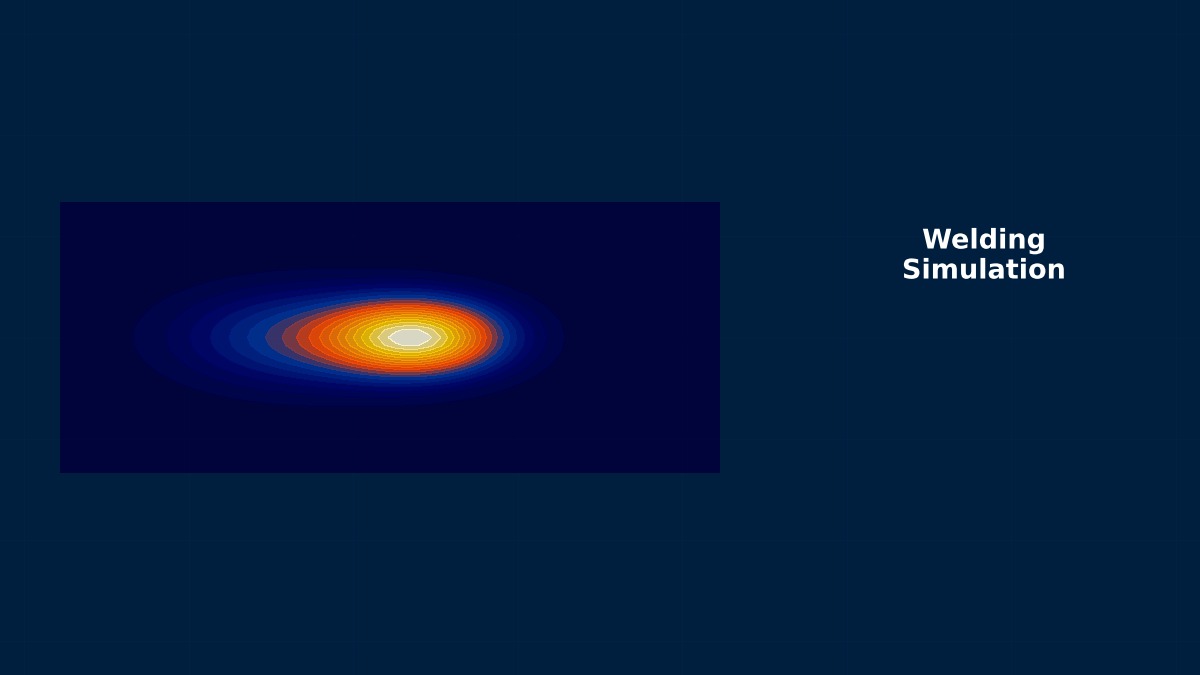
Welding Residual Stress: Theoretical Foundations
Overview
Professor! Today's topic is about welding residual stress analysis, right? What is it exactly?
It's the prediction of residual stress distribution caused by the welding process and the evaluation of the relaxation effect through PWHT (Post-Weld Heat Treatment). It directly relates to fatigue and fracture evaluation via its influence on the stress intensity factor.
Governing Equations
Expressing this in a formula, it looks like this.
Hmm, just the formula doesn't really click for me... What does it represent?
Creep relaxation after PWHT:
Now I understand what my senior meant when he said, "At least make sure you handle the post-creep relaxation properly."
Theoretical Foundation
I've heard the term "theoretical foundation," but I might not fully understand it...
Simulation for welding residual stress analysis is formulated as a coupled problem of thermodynamics, solid mechanics, and fluid dynamics. The physical phenomena of the manufacturing process span multiple time and spatial scales, requiring an appropriate combination of macro-scale continuum models and meso/micro-scale material models. The goal is to quantitatively predict the causal relationship between process parameters (temperature, speed, load, etc.) and product quality (dimensional accuracy, defects, mechanical properties).
Wow, the very basics of welding residual stress analysis are incredibly interesting! Please tell me more.
Material Constitutive Laws
Professor, please teach me about "Material Constitutive Laws"!
The accuracy of manufacturing process simulation heavily depends on the fidelity of the material model. It's necessary to properly define elastoplastic constitutive laws, creep laws, phase transformation models, etc., as functions of temperature and strain rate. Data obtained from material testing (tensile, compression, torsion) is fitted, and validity in extrapolation ranges is verified. Thermodynamic databases like JMatPro or Thermo-Calc are also utilized.
I see... Manufacturing process simulation seems simple at first glance, but it's actually very profound.
Governing Equations for Manufacturing Processes
Manufacturing process simulation is formulated as a coupled problem of thermodynamics, fluid dynamics, and solid mechanics.
Heat Conduction Equation (Energy Conservation)
What exactly is the heat conduction equation?
Here, $T$ is temperature, $\mathbf{v}$ is the material velocity field, $k$ is thermal conductivity, and $Q$ is internal heat generation (Joule heating, latent heat, frictional heat, etc.).
Now I understand what my senior meant when he said, "At least make sure you handle manufacturing process simulation properly."
Solidification and Phase Change
Please teach me about "Solidification and Phase Change"!
During solidification, the release/absorption of latent heat significantly affects the temperature field. Formulation using the enthalpy method:
Expressing this in a formula, it looks like this.
Hmm, just the formula doesn't really click for me... What does it represent?
Here, $L$ is the latent heat, and $f_l(T)$ is the liquid fraction (taking a value between 0 and 1 in the solid-liquid coexistence region).
Constitutive Law for Plastic Deformation
What exactly is the constitutive law for plastic deformation?
Plastic deformation of metals is described by constitutive laws like Johnson-Cook:
$A$: Initial yield stress, $B$: Hardening coefficient, $n$: Hardening exponent, $C$: Strain rate sensitivity, $m$: Thermal softening exponent.
After hearing all this, I finally understand in my gut why manufacturing process simulation is so important!
Flow Analysis (Filling / Casting)
Next is the topic of flow analysis. What's it about?
Flow analysis for casting processes involves solving the Navier-Stokes equations for incompressible flow with a free surface. The Volume of Fluid (VOF) method is commonly used to track the interface between air and molten metal.