Delamination Analysis
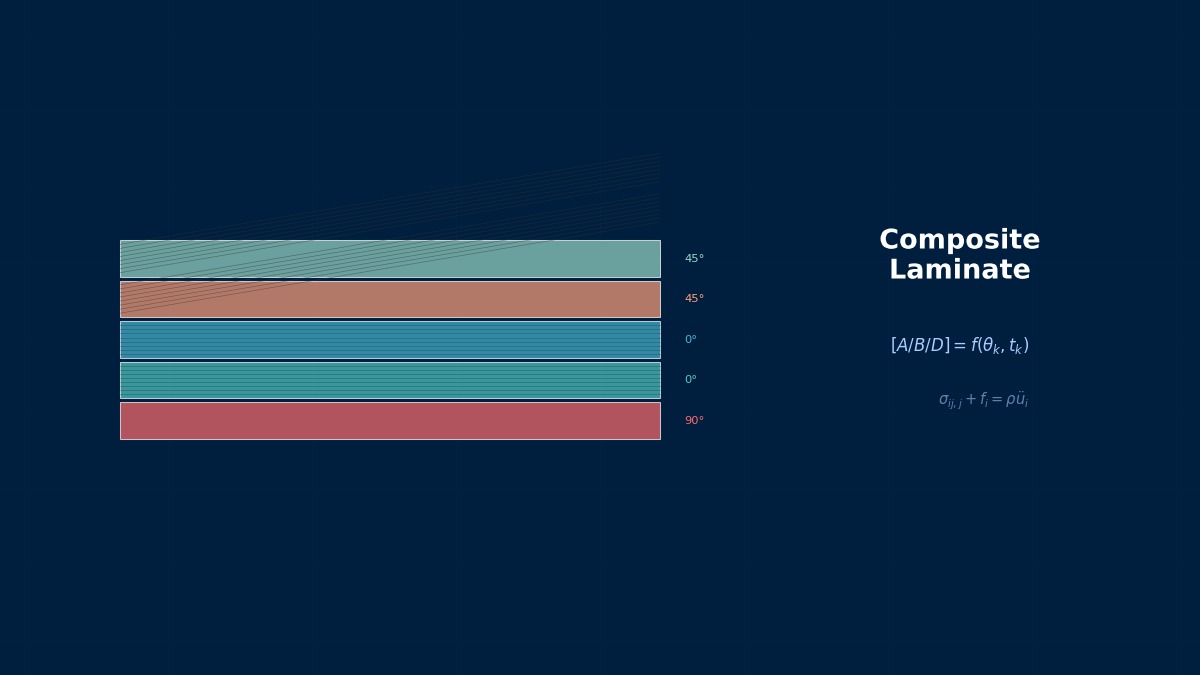
Delamination Analysis: Theoretical Foundations
What is Delamination?
Professor, is "delamination" the most dangerous failure mode for composites?
Exactly. Delamination is failure where the layers of a laminate separate, and it is the most common and dangerous damage mode for composites. It is an "internal damage" that is invisible from the surface, and this difficulty in detection increases its danger.
Invisible from the surface! That's scary.
With low-velocity impact (falling objects, dropped tools, etc.), there may be almost no trace on the surface, yet extensive delamination has spread internally. This is called BVID (Barely Visible Impact Damage) and is the most important design condition for composite aircraft structures.
Mechanism of Delamination
Delamination occurs when the interlaminar shear stresses ($\tau_{xz}, \tau_{yz}$) and peel stress ($\sigma_z$) exceed the interface strength.
From a fracture mechanics perspective, there are three modes:
| Mode | Stress | Deformation | Standard Test |
|---|---|---|---|
| Mode I (Opening) | $\sigma_z$ (Tension) | Layers open | DCB |
| Mode II (In-plane shear) | $\tau_{xz}$ | Layers slide | ENF / 4ENF |
| Mode III (Out-of-plane shear) | $\tau_{yz}$ | Layers twist | ECT |
Is Mode I the most dangerous?
The critical energy release rate for Mode I, $G_{Ic}$, is the lowest ($\approx 0.1 \sim 0.3$ kJ/m²). Mode II's $G_{IIc}$ is 2 to 4 times higher. Therefore, Mode I opening often initiates first.
Energy Release Rate
The condition for delamination propagation is described by the Energy Release Rate (ERR):
$G$ is the current energy release rate, $G_c$ is the critical value (material property).
For mixed-mode (Mode I + Mode II acting simultaneously), a mixed-mode criterion is used:
$\alpha = \beta = 1$ is a special case of the Benzeggagh-Kenane (BK) criterion.
Modeling Delamination in FEM
How do you model delamination in FEM?
Two main methods:
1. VCCT (Virtual Crack Closure Technique)
Calculates the energy release rate from nodal forces and opening displacements at the crack tip. A method for tracking the propagation of an existing crack.
2. CZM (Cohesive Zone Model)
Places cohesive elements at the interface and represents delamination using a constitutive law (traction-separation law) relating stress to opening displacement. Can handle both crack nucleation and propagation.
Is CZM more versatile?
CZM does not require the crack location to be assumed in advance (cohesive elements can be placed on all interfaces). VCCT is only for propagation of existing cracks. CZM is currently the mainstream method.
Summary
Let me organize the theory of delamination.
Key points:
- Delamination is the most dangerous damage in composites — invisible from the surface (BVID)
- Three fracture modes — Mode I (opening), II (shear), III (twisting)
- Propagation occurs when Energy Release Rate $G \geq G_c$ — mixed-mode criterion
- CZM (Cohesive Zone Model) is mainstream — can handle both nucleation and propagation
- VCCT is only for existing crack propagation — more limited than CZM but computationally lighter
BVID (Barely Visible Impact Damage) dictates aircraft design... It's a design battle against an "invisible enemy".
Exactly. Aircraft composite design is performed under the premise that "the worst BVID exists." That's why CAI (Compression After Impact) strength becomes the design allowable value.
Discovery of Delamination and its Impact on Aerospace
The CFRP interlaminar delamination problem became a serious challenge during the introduction of CFRP in aircraft in the 1970s. Delamination discovered in the CFRP horizontal stabilizer of the F-14 fighter caused a 40% reduction in design strength, prompting the US Navy to conduct NDT inspections on all aircraft in 1975. This incident was the catalyst for treating "delamination" as a primary failure mode in CFRP design.
Computational Methods for Delamination Analysis
CZM (Cohesive Zone Model) Implementation
Please teach me the specific implementation of CZM.
CZM describes interface behavior using a traction-separation law.
Bilinear traction-separation law:
1. Linear elastic region — Stress increases with initial stiffness $K$.
2. Damage initiation — Stress reaches interface strength $t^0$.
3. Softening region — Stress decreases while opening displacement increases.
4. Complete separation — Fracture occurs when the energy released reaches $G_c$.
What parameters are needed?
- Interface strength — $t_n^0$ (Mode I), $t_s^0$ (Mode II), $t_t^0$ (Mode III)
- Critical energy release rate — $G_{Ic}$, $G_{IIc}$, $G_{IIIc}$
- Initial stiffness — $K_n$, $K_s$, $K_t$ (Penalty-like. Sufficiently large values)
- Mixed-mode criterion — Parameter $\eta$ for the BK criterion
Abaqus Settings
```
*COHESIVE SECTION, RESPONSE=TRACTION SEPARATION
1.0,
*SURFACE INTERACTION, NAME=cohesive_prop
*COHESIVE BEHAVIOR
1e6, 1e6, 1e6
*DAMAGE INITIATION, CRITERION=QUADS
60., 90., 90.
*DAMAGE EVOLUTION, TYPE=ENERGY, MIXED MODE BEHAVIOR=BK, POWER=1.5
0.28, 0.79, 0.79
```
The initial stiffness of $10^6$ is quite large.
The initial stiffness is a penalty parameter expressing "no deformation in the bonded state". Too large and the condition number worsens, causing convergence difficulties. Too small and deformation occurs before separation. A guideline is $K \approx E / t_{ply}$ (ply elastic modulus / ply thickness) times 10 to 100.
VCCT vs. CZM
| Characteristic | VCCT | CZM |
|---|---|---|
| Crack Nucleation | × | ○ |
| Existing Crack Propagation | ○ | ○ |
| Mesh Dependency | Present | Low (regularized by $G_c$) |
| Parameters | Only $G_{Ic}, G_{IIc}$ | Strength + $G_c$ + Stiffness |
| Computational Cost | Low | High |
| Stability | Somewhat unstable | More stable |
So CZM is more versatile and stable, but has more parameters and higher cost.
Exactly. Choose based on your analysis needs. For research on delamination nucleation and growth, CZM is preferred. For design verification with known crack locations, VCCT is more efficient.