Progressive Damage Analysis
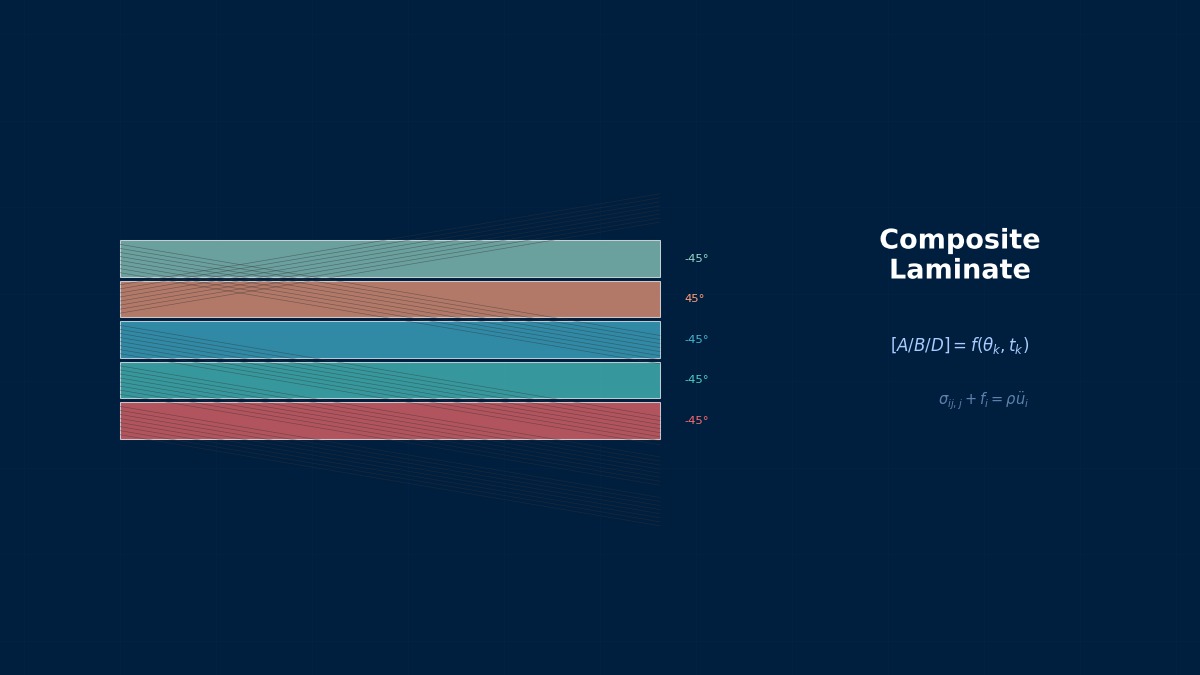
Progressive Damage: Theoretical Foundations
What is Progressive Damage?
Professor, what is "Progressive Damage Analysis (PDA)"?
Unlike metals, composite materials may not cause the entire structure to collapse even if local failure occurs. Even if matrix cracks appear, the fibers continue to bear the load. PDA simulates this progressive damage propagation and load redistribution.
So failure criteria (Tsai-Wu, Hashin) alone are insufficient?
Tsai-Wu and Hashin predict "First Ply Failure (FPF)". However, the final failure load (Last Ply Failure, LPF) of a composite structure can be 2-3 times the initial failure load. PDA tracks the entire process from "initial failure to final collapse".
The 3 Elements of PDA
PDA consists of three elements:
1. Damage Initiation Criteria
"When does damage start?". Hashin criteria, Puck criteria, LaRC criteria, etc. Determine the onset of each failure mode.
2. Damage Evolution Law
"How does damage progress?". How to represent stiffness reduction after damage initiation.
- Instantaneous Reduction — Stiffness drops to zero immediately upon damage initiation (sudden degradation model). Simple but high mesh dependency.
- Progressive Reduction — Stiffness reduces gradually based on fracture energy. Low mesh dependency.
3. Element Deletion
Removes elements from the analysis when the damage variable reaches 1.0 (complete damage). Represents areas where the material is completely fractured.
Is progressive reduction more physically accurate?
Yes. Progressive reduction using fracture energy $G_c$ produces mesh-independent (regularized) results. Abaqus's Hashin Damage Evolution uses this method.
Damage Variable
The degree of damage is represented by the damage variable $d$ (0~1):
- $d = 0$: Intact (no damage)
- $0 < d < 1$: Partial damage
- $d = 1$: Complete failure
Are there damage variables for each of Hashin's 4 modes?
Yes. Four independent damage variables are defined: fiber tension $d_{ft}$, fiber compression $d_{fc}$, matrix tension $d_{mt}$, matrix compression $d_{mc}$.
Stiffness matrix after damage:
Damage in each mode progresses independently, reducing the corresponding components of the stiffness matrix.
This is CDM (Continuum Damage Mechanics)-based PDA. Because it treats damage within the continuum mechanics framework, it can be naturally incorporated into the standard FEM framework.
Summary
Let me organize the theory of PDA.
Key points:
- Simulates the entire process from initial failure to final collapse — From FPF to LPF.
- 3 Elements — Damage initiation criteria + Damage evolution law + Element deletion.
- Damage variable $d$ (0~1) — Tracks the damage degree of each failure mode.
- CDM (Continuum Damage Mechanics) based — Can be naturally integrated into FEM.
- Regularization using fracture energy — Eliminates mesh dependency.
So PDA is an analysis method to "squeeze out the strength of composites to the very end".
PDA, which can evaluate the post-failure strength of composites, is an essential technology for pushing the limits of lightweight design.
Integration of Fracture Mechanics and Progressive Damage
Progressive damage in composite materials is the process where local material damage sequentially expands with increasing load. In the 1990s, Chaboche, Ladevèze, and others applied Continuum Damage Mechanics (CDM) to CFRP and formulated evolution equations for the damage variable d (0=undamaged, 1=completely damaged). CDM-based progressive analysis enables the prediction of final failure loads in FEM and is used to quantify design safety margins.
Computational Methods for Progressive Damage
PDA Implementation
Please teach me the specific implementation methods for PDA.
Two main implementation approaches:
1. Abaqus Built-in Hashin Damage
Abaqus's DAMAGE INITIATION (HASHIN) + DAMAGE EVOLUTION. With the settings explained on the previous page, the entire process—damage initiation → progressive reduction → element deletion—runs automatically.
2. User Subroutines (UMAT/VUMAT)
To use more advanced damage models (Puck, LaRC05, custom CDM), you create your own user subroutine. For Abaqus:
- UMAT — For implicit (Standard) solver. Requires calculation of tangent stiffness matrix.
- VUMAT — For explicit (Explicit) solver. Only stress update required. Simpler implementation.
Is VUMAT easier to implement?
VUMAT does not require derivation of the tangent stiffness matrix; it only updates stress from the given strain increment. VUMAT + Explicit is recommended for first-time PDA implementation. Implicit UMAT is difficult due to tangent stiffness derivation and also affects convergence.
Convergence Issues
PDA has convergence difficulties, right?
Stiffness reduction due to damage causes local softening, which can lead to snap-back in the load-displacement path. Countermeasures:
| Method | Characteristics |
|---|---|
| Viscous Regularization | "Smoothes" softening with tiny viscosity. $\eta \approx 10^{-5}$ |
| Explicit Solver | No convergence issues (no iterations). High computational cost. |
| Arc-length Method (Riks) | Can track snap-back. Complex setup. |
| Stabilization Method | *STATIC, STABILIZE. Verify with energy ratio. |
Is the explicit solver the most stable?
In the sense of having no convergence worries, it is the most stable. However, solving quasi-static problems with the explicit solver requires mass scaling, and inertial effects must be considered. In practice, explicit solver + mass scaling is becoming mainstream for PDA.
PDA in LS-DYNA
In LS-DYNA, MAT54 (Chang-Chang criteria) and MAT58 (Continuum Damage Mechanics) are the standards for PDA:
| Model | Characteristics |
|---|---|
| MAT54 | Sudden degradation model. Simple but high mesh dependency. |
| MAT58 | CDM-based. Progressive reduction. More accurate than MAT54. |
MAT54/58 are widely used in automotive crash analysis, right?
Crash analysis of CFRP crash boxes and bumpers uses LS-DYNA MAT54/58 as the de facto standard. Predicts energy absorption during impact.
Summary
Let me organize the numerical methods for PDA.
Key points:
- Abaqus built-in Hashin Damage is the easiest — Works with settings only.
- VUMAT (Explicit) is recommended for custom PDA — No tangent stiffness required.
- Explicit solver + mass scaling is mainstream for PDA — No convergence
Related Topics
Experience the theory firsthand with the interactive simulator for this field
All Simulators