Kirchhoff-Love Thin Shell Theory
Category: 構造解析 | Integrated 2026-04-06
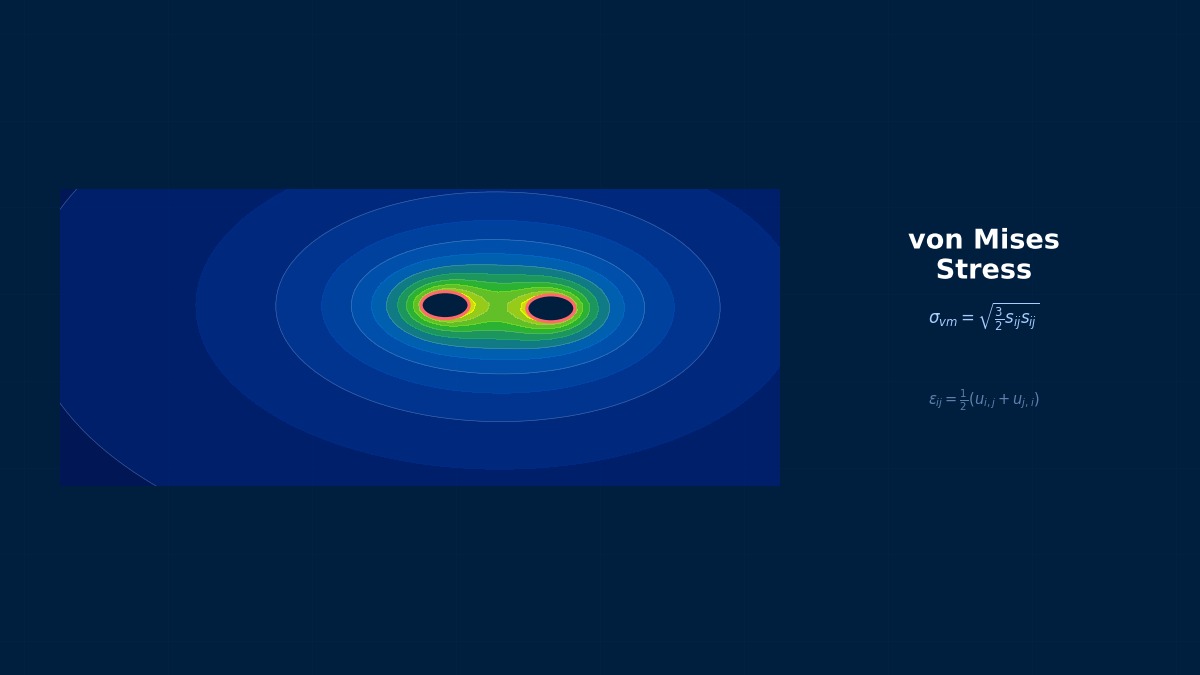
CAE visualization for shell kirchhoff love theory - technical simulation diagram
キルヒホッフ・ラブ薄肉シェル理論

Theory and Physics

Classical Theory of Thin Shells

🧑‍🎓

Professor, is Kirchhoff-Love shell theory the curved surface version of Kirchhoff plate theory?


🎓

Exactly. While Kirchhoff plates deal with bending of flat plates, Kirchhoff-Love shells deal with the coupling of bending and membrane forces in curved surfaces. Love (1888) extended Kirchhoff's assumptions to curved surfaces.


Fundamental Assumptions

🎓

Love's assumptions (First approximation theory):


1. The shell thickness $t$ is sufficiently thin compared to other dimensions (radius $R$, etc.)

2. Displacements are small compared to the plate thickness

3. Normal stress in the thickness direction $\sigma_z$ is negligible

4. Shear deformation in the thickness direction is negligible — same as Kirchhoff's assumption

5. Higher-order terms of $t/R$ are neglected


🧑‍🎓

Assumption 4 is the same as for Kirchhoff plates. Zero shear deformation.


🎓

Yes. The essential difference from plates (flat surfaces) is the coupling of membrane forces and bending due to curvature. In flat plates, membrane forces and bending are independent, but in shells, curvature causes them to couple. This is the source of complexity in shell theory.


Coupling of Membrane Forces and Bending

🧑‍🎓

Could you explain "membrane-bending coupling" a bit more?


🎓

Consider a spherical shell under pressure. Membrane theory predicts a uniform tensile stress of $\sigma = pR/(2t)$. However, if the shell has a hole or a change in thickness, membrane stresses alone cannot satisfy the compatibility conditions for deformation. Bending moments compensate for this shortfall.


🧑‍🎓

It's the same as "discontinuity stresses" in plates, right?


🎓

Exactly the same mechanism. Discontinuity stresses occurring at the junction of a pressure vessel's cylinder and head can be explained by this membrane-bending coupling due to curvature change in Kirchhoff-Love theory.


Implementation in FEM

🧑‍🎓

Are there FEM elements for Kirchhoff-Love shells?


🎓

For the same reason as Kirchhoff plates, implementation is difficult because $C^1$ continuity is required. In modern FEM, Mindlin-Reissner shells (including shear deformation) are mainstream.


🎓

However, IGA (Isogeometric Analysis) can directly discretize Kirchhoff-Love shells by utilizing the $C^1$ continuity of NURBS basis functions. This is why IGA shell element research is active.


Summary

🧑‍🎓

Let me organize the Kirchhoff-Love shell theory.


🎓

Key points:


  • Classical theory of thin shells ignoring shear deformation — Love (1888)
  • Coupling of membrane forces and bending — Shell curvature induces coupling
  • $C^1$ continuity required in FEM — Difficult to implement
  • Mindlin-Reissner shells are used as substitutes in practice — Converges to K-L for thin shells
  • IGA is reviving K-L shells — $C^1$ continuity of NURBS basis functions

🧑‍🎓

It's the same pattern as Kirchhoff plates. The theory is elegant but FEM implementation is difficult, so Mindlin-type elements took the lead. But IGA shows signs of revival.


🎓

Exactly. The gap between the depth of structural mechanics theory and the difficulty of FEM implementation is being bridged by the new paradigm of IGA.


Coffee Break Trivia

Assumptions of Kirchhoff-Love Theory

Kirchhoff-Love shell theory was formulated by Gustav Kirchhoff in 1850 as plate theory and extended to curved shells by Augustus Love in 1888. The main assumption is that "normals to the shell mid-surface remain normal after deformation (normals remain unchanged)," which allows shear deformation to be ignored. Its application is limited to thin-walled structures with a thickness/span ratio below about 1/20.

Physical Meaning of Each Term
  • Inertia term (mass term): $\rho \ddot{u}$, i.e., "mass × acceleration". Have you ever experienced being thrown forward when slamming on the brakes? That "feeling of being carried away" is precisely the inertia force. Heavier objects are harder to set in motion and harder to stop once moving. Buildings shake during earthquakes because the ground moves suddenly while the building's mass "gets left behind". In static analysis, this term is set to zero, assuming "forces are applied slowly enough that acceleration is negligible". It cannot be omitted for impact loads or vibration problems.
  • Stiffness term (elastic restoring force): $Ku$ or $\nabla \cdot \sigma$. When you stretch a spring, you feel a "force trying to return it", right? That's Hooke's law $F=kx$, the essence of the stiffness term. Now a question—an iron rod and a rubber band, which stretches more under the same force? Obviously the rubber band. This "resistance to stretching" is the Young's modulus $E$, which determines stiffness. A common misconception: "high stiffness ≠ strong". Stiffness is "resistance to deformation", strength is "resistance to failure"—different concepts.
  • External force term (load term): Body forces $f_b$ (gravity, etc.) and surface forces $f_s$ (pressure, contact forces, etc.). Think of it this way—the weight of a truck on a bridge is a "force acting on the entire volume" (body force), while the force of the tires pushing on the road surface is a "force acting only on the surface" (surface force). Wind pressure, water pressure, bolt tightening force... all are external forces. A common pitfall here: getting the load direction wrong. Intending "tension" but ending up with "compression"—sounds like a joke, but it actually happens when coordinate systems are rotated in 3D space.
  • Damping term: Rayleigh damping $C\dot{u} = (\alpha M + \beta K)\dot{u}$. Try plucking a guitar string. Does the sound continue forever? No, it gradually fades. That's because vibrational energy is converted to heat by air resistance and internal friction in the string. Car shock absorbers work on the same principle—intentionally absorbing vibrational energy for a smoother ride. What if damping were zero? Buildings would keep swaying forever after an earthquake. Since that doesn't happen in reality, setting appropriate damping is crucial.
Assumption Conditions and Applicability Limits
  • Continuum assumption: Treats material as a continuous medium, ignoring microscopic heterogeneity
  • Small deformation assumption (for linear analysis): Deformation is sufficiently small compared to initial dimensions, and stress-strain relationship is linear
  • Isotropic material (unless otherwise specified): Material properties are independent of direction (anisotropic materials require separate tensor definitions)
  • Quasi-static assumption (for static analysis): Ignores inertia and damping forces, considering only equilibrium between external and internal forces
  • Non-applicable cases: Large deformation/large rotation problems require geometric nonlinearity. Nonlinear material behavior like plasticity or creep requires constitutive law extensions
Dimensional Analysis and Unit Systems
VariableSI UnitNotes / Conversion Memo
Displacement $u$m (meter)When inputting in mm, unify loads and elastic modulus to MPa/N system
Stress $\sigma$Pa (Pascal) = N/m²MPa = 10⁶ Pa. Be careful of unit inconsistency when comparing with yield stress
Strain $\varepsilon$Dimensionless (m/m)Note the difference between engineering strain and logarithmic strain (for large deformation)
Elastic modulus $E$PaSteel: ~210 GPa, Aluminum: ~70 GPa. Note temperature dependence
Density $\rho$kg/m³In mm system: tonne/mm³ (= 10⁻⁹ tonne/mm³ for steel)
Force $F$N (Newton)Unified as N in mm system, N in m system

Numerical Methods and Implementation

Numerical Methods for K-L Shells

🧑‍🎓

Please tell me how to handle Kirchhoff-Love shells in FEM.


🎓

There are three approaches.


1. Substitution with Mindlin-Reissner Shell Elements

🎓

Most practical. Mindlin-type shell elements (S4R, CQUAD4, etc.) automatically converge to K-L shells in the thin limit. With shear locking countermeasures (MITC method, etc.), they work fine.


2. DKT Shell Elements

🎓

Discrete Kirchhoff Triangle (DKT) extends the plate theory DKT to shells. Nastran's CTRIA3 shell and Abaqus's STRI3/STRI65 belong to this family. High accuracy for thin plates only.


3. IGA Shell Elements

🎓

Isogeometric Analysis (IGA) directly discretizes K-L shells using the $C^1$ continuity of NURBS basis functions. No rotational degrees of freedom are needed, resulting in fewer DOFs.


🧑‍🎓

IGA shells have no rotational DOFs?


🎓

In K-L shells, rotation angles are determined by the derivative of deflection, so the independent variables are only the three displacements $(u, v, w)$. This is fewer than the 5 DOFs ($u, v, w, \theta_x, \theta_y$) or 6 DOFs (including drilling) of Mindlin shells. Reducing DOF count is a major advantage for large-scale problems.


Comparison of Methods

MethodContinuityDOF/NodeThin Plate AccuracyThick Plate Support
Mindlin-type$C^0$5–6○ (with locking countermeasures)
DKT Shell$C^0$ (discrete K-L)5–6×
IGA K-L Shell$C^1$ or higher3×
🧑‍🎓

IGA has the best DOF efficiency.


🎓

However, IGA implementation in commercial solvers is not yet widespread. Some IGA shells are implemented in LS-DYNA, but it is not standard in Abaqus/Nastran/Ansys. For now, Mindlin-type is the practical standard.


Summary

🧑‍🎓

Let me organize the numerical methods for K-L shells.


🎓

Key points:


  • Substitution with Mindlin-type shells is the practical standard — Automatically converges to K-L for thin shells
  • DKT shells are high-precision elements for thin plates only — STRI3/STRI65
  • IGA enables direct discretization of K-L shells — Efficient with 3 DOFs
  • Commercial implementation of IGA is still limited — A future main candidate

Coffee Break Trivia

C1 Continuity Requirement for KL Shells

In Kirchhoff-Love theory, second derivatives of displacement appear in the weak form, so finite elements must satisfy C1 continuity (continuity of displacement and its first derivative) between adjacent elements. Designing elements that meet this requirement is complex, and many researchers tackled it in the 1960s-70s. The Bogner-Fox-Schmit (BFS) rectangular element is a classic example of a C1 element, but its difficulty in handling arbitrary meshes led to Mindlin-Reissner shells (C0 continuity) becoming mainstream instead.

Linear Elements (1st-order elements)

Linear interpolation between nodes. Low computational cost but low stress accuracy. Beware of shear locking (mitigated by reduced integration or B-bar method).

Quadratic Elements (with mid-side nodes)

Can represent curved deformation. Stress accuracy improves significantly, but DOFs increase by about 2–3 times. Recommended when stress evaluation is important.

Full Integration vs Reduced Integration

Full Integration: Risk of over-constraint (locking). Reduced Integration: Risk of hourglass modes (zero-energy modes). Choose appropriately.

Adaptive Mesh

Automatic refinement based on error indicators (e.g., ZZ estimator). Efficiently improves accuracy in stress concentration areas. Includes h-method (element subdivision) and p-method (order increase).

Newton-Raphson Method

Standard method for nonlinear analysis. Updates tangent stiffness matrix each iteration. Quadratic convergence within convergence radius, but computationally expensive.

Modified Newton-Raphson Method

Updates tangent stiffness matrix using initial value or every few iterations. Lower cost per iteration but linear convergence speed.

Convergence Criteria

Force residual norm: $||R|| / ||F_{ext}|| < \epsilon$ (typically $\epsilon = 10^{-3}$ to $10^{-6}$). Displacement increment norm: $||\Delta u|| / ||u|| < \epsilon$. Energy norm: $\Delta u \cdot R < \epsilon$

Load Increment Method

Applies total load in small increments rather than all at once. The arc-length method (Riks method) can trace beyond limit points on the load-displacement curve.

Analogy for Direct vs Iterative Methods

Direct methods are like "solving simultaneous equations accurately with pen and paper"—reliable but too time-consuming for large problems. Iterative methods are like "repeatedly guessing to approach the correct answer"—starting with a rough estimate but improving accuracy with each iteration. When looking up a word in a dictionary, it's faster to jump to a likely section (iterative) than to search from the first page sequentially (direct).

関連シミュレーター

この分野のインタラクティブシミュレーターで理論を体感しよう

シミュレーター一覧

関連する分野

熱解析製造プロセス解析V&V・品質保証
この記事の評価
ご回答ありがとうございます!
参考に
なった
もっと
詳しく
誤りを
報告
参考になった
0
もっと詳しく
0
誤りを報告
0
Written by NovaSolver Contributors
Anonymous Engineers & AI — サイトマップ
About the Authors