Six-Node Triangular Element (TRIA6)
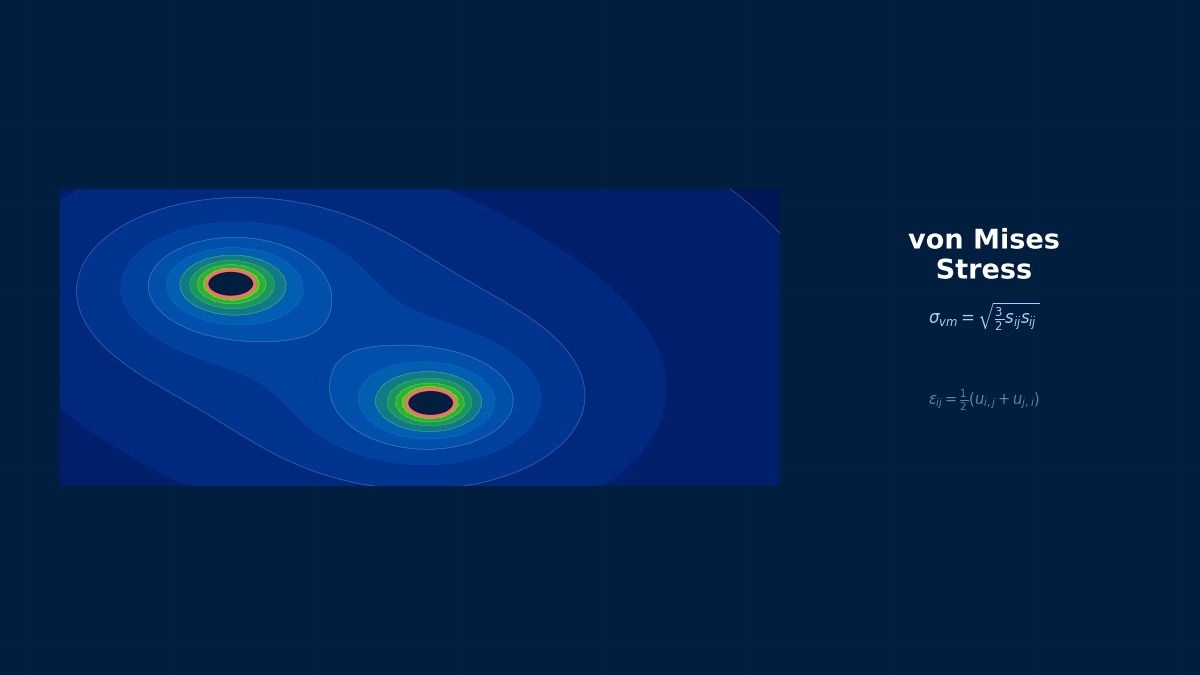
Six-Node Triangular Element (TRIA6): Theoretical Foundations
LST Element — The Superior Version of CST
Does the 6-node triangular element (TRIA6, LST) solve the problems of CST?
Yes. The LST (Linear Strain Triangle) is a quadratic triangular element where strain varies linearly within the element. It completely eliminates the constant strain problem of CST.
Shape Function
TRIA6 has three vertex nodes and three mid-side nodes. The shape functions are quadratic polynomials of the area coordinates $L_1, L_2, L_3$:
TRIA6 has three vertex nodes and three mid-side nodes. The shape functions are quadratic polynomials of the area coordinates $L_1, L_2, L_3$:
Vertex nodes:
Mid-side nodes:
It's the 2D version of TET10, right?
Exactly. TRIA6 = 2D version of TET10, CST = 2D version of TET4. It's the same relationship.
Accuracy
- Displacement: $O(h^3)$ (CST is $O(h^2)$)
- Stress: $O(h^2)$ (CST is $O(h)$)
Same convergence rate as Q8, right?
Yes. Since TRIA6 and Q8 are elements of the same order (quadratic), they have the same convergence rate. However, Q8 has slightly higher accuracy per element (8-term vs. 6-term polynomial).
TRIA6 vs. Q8
| Characteristic | TRIA6 | Q8 |
|---|---|---|
| Automatic Meshing | Easy | Somewhat Difficult |
| Accuracy per DOF | 70-80% of Q8 | Baseline |
| Curved Edge Handling | Has mid-side nodes | Has mid-side nodes |
| Sensitivity to Mesh Quality | More robust than Q8 | Sensitive to distortion |
| Adaptive Meshing | Easy | Somewhat Difficult |
TRIA6 is inferior to Q8 in accuracy efficiency but superior in ease of mesh generation. It's the same pattern as TET10 vs. HEX20, right?
Perfect understanding. The pattern "triangles/tetrahedra are easy for automatic meshing, quadrilaterals/hexahedra have higher accuracy" is common in both 2D and 3D.
Numerical Integration
| Integration | Points | Accuracy |
|---|---|---|
| 3-point Gauss (Full Integration) | 3 | Integrates quadratic polynomials exactly |
| 1-point Gauss | 1 | Insufficient accuracy (not used) |
| 7-point Gauss | 7 | Used for higher-order integration |
Usually, 3 points are sufficient, right?
Yes. 3-point full integration is standard for TRIA6. Shear locking does not occur (because it's a quadratic element). Volume locking is also usually not a problem. It's a very stable element.
Summary
Let me organize the theory of TRIA6.
Key Points:
- Quadratic Triangular Element (LST) — Superior version of CST. Strain varies linearly.
- 2D Version of TET10 — Inherits the advantage of automatic meshing.
- Same Convergence Rate as Q8 — However, Q8 has higher DOF efficiency.
- Robust to Mesh Quality — More stable than Q8 even with distorted shapes.
- 3-point Gauss Integration is Sufficient — No locking.
If CST is the "do not use" element, then TRIA6 is the "use with confidence" element, right?
Exactly. TRIA6 is the most reliable triangular element for 2D automatic mesh analysis.
TRIA6's Complete Quadratic Polynomial and Accuracy
The 6-node triangular element (TRIA6) has three vertex nodes and three mid-side nodes, using a complete quadratic polynomial (6 terms) for its shape functions. In area coordinates, the vertex shape functions are Li(2Li-1), and the mid-side ones are 4LiLj. At three times the computational cost of TRIA3 (linear), the stress error convergence rate for bending problems improves from h-squared to h-cubed. Records indicate that Browning, Abrahamson, and others first practically applied quadratic triangular elements to aircraft wing stress analysis in the late 1960s.
Computational Methods for the Six-Node Triangular Element (TRIA6)
TRIA6 Implementation
Please tell me the implementation considerations for TRIA6.
TRIA6 is more complex than CST but can be implemented standardly using numerical integration (3-point Gauss).
Element Names by Solver
| Variation | Nastran | Abaqus | Ansys |
|---|---|---|---|
| Standard | CTRIA6 | CPS6 (Plane Stress) | PLANE183 (degenerated) |
| Plane Strain | CTRIA6 + PLPLANE | CPE6 | PLANE183(degenerated,PE) |
| Axisymmetric | CTRIAX6 | CAX6 | PLANE183(degenerated,Axi) |
In Ansys, is TRIA6 not a dedicated element but a degenerated form of PLANE183?
Ansys's PLANE183 is an 8-node quadrilateral but is used degenerated into a 6-node triangle by placing mid-side nodes on three edges. However, internally, the correct TRIA6 formulation is used, not a degenerated CST.
Handling of Mid-Side Nodes
Similar to Q8/TET10, CAD curve snapping for mid-side nodes is important for TRIA6. It improves the approximation accuracy of curved boundaries.
Points to note:
- Mid-side nodes should be within 25% to 75% of the edge length.
- The Jacobian must be positive.
- Use finer mesh in areas with high curvature.
TRIA6 Mesh Quality
| Metric | Ideal Value | Acceptable Range |
|---|---|---|
| Aspect Ratio | 1.0 | < 5.0 |
| Minimum Angle | 60° | > 20° |
| Jacobian | Positive | Must be positive |
Are the quality requirements more lenient than for CST?
TRIA6 is more robust to element shape distortion than CST. The quadratic shape functions partially absorb distortion. However, accuracy degrades with extreme distortion like minimum angles below 10°.
Summary
Let me organize the numerical methods for TRIA6.
Key Points:
- 3-point Gauss Integration is Standard — Full integration, no locking.
- CAD Snapping for Mid-Side Nodes — Same caution as Q8, TET10.
- Robust to Shape Distortion — More stable than CST.
- Dramatic Accuracy Improvement from CST→TRIA6 Conversion — Effect of linear→quadratic.
3-Point Gauss Integration for TRIA6
TRIA6 typically uses 3-point or 7-point Gauss integration. The integration points for the 3-point scheme are placed at equal distances from the triangle's centroid (e.g., L1=L2=1/6, L3=2/3) and can integrate polynomials up to 5th order exactly. The 7-point scheme is a high-precision version proposed by Strang-Fix (1973), capable of fully integrating polynomials up to 7th order. Since the 3-point integration points become superconvergence points for stress sampling, the Zienkiewicz-Zhu method, which extrapolates stresses from these points to obtain nodal stresses, is widely used.
Experience the theory firsthand with the interactive simulator for this field
All Simulators