8-Node Quadrilateral Element (QUAD8)
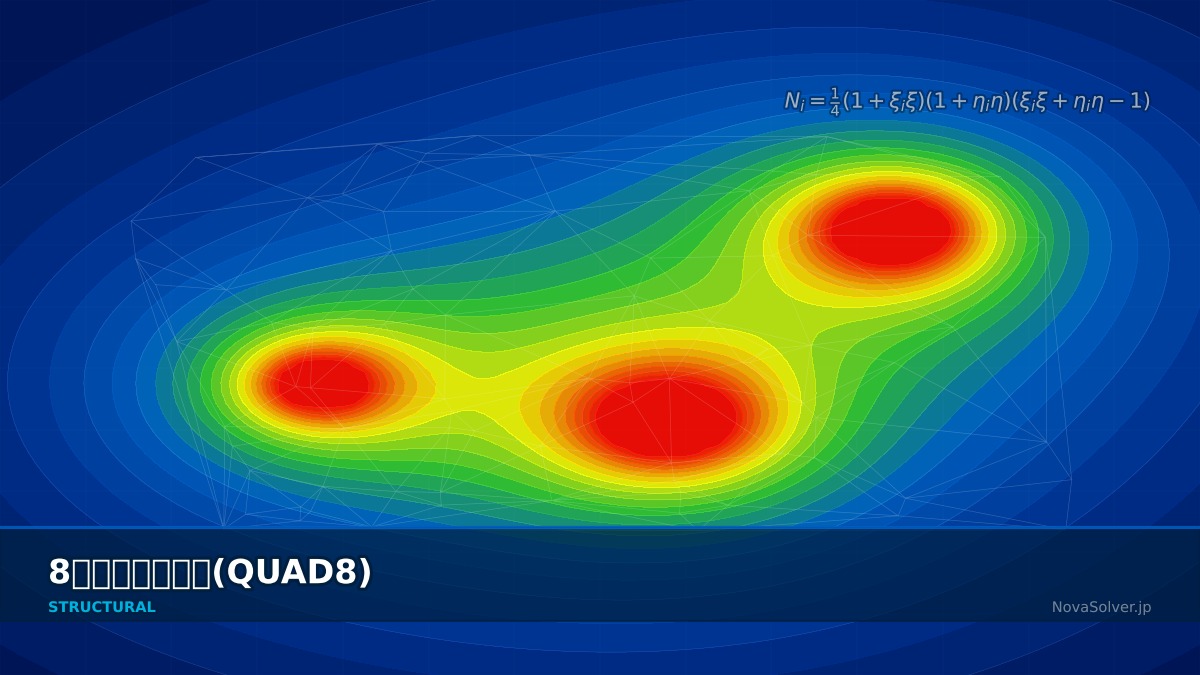
8-Node Quadrilateral Element (QUAD8): Theoretical Foundations
Q8 Element — Second-Order Accurate 2D Element
Professor, is Q8 an upgraded version of Q4?
Yes. It's an 8-node quadratic element that adds 4 mid-side nodes at the midpoint of each edge to Q4's 4 vertices. It's the 2D version of HEX20.
Shape Functions
Q8 shape functions are Serendipity-type quadratic polynomials:
Vertex Nodes:
Mid-Side Nodes (e.g., $\xi_i = 0$):
So it's Q4's bilinear form plus $\xi^2, \eta^2$ terms. That's why it can accurately represent bending.
Exactly. The "lack of $\xi^2, \eta^2$ terms" which was the cause of shear locking in Q4 is resolved in Q8. Shear locking does not occur in Q8.
Q8 Accuracy
- Displacement: $O(h^3)$ (Q4 is $O(h^2)$)
- Stress: $O(h^2)$ (Q4 is $O(h)$)
Stress convergence is one order faster. Where Q4 needs 100 elements, Q8 can achieve comparable accuracy with 25 elements.
Curved Edge Advantage
The mid-side nodes in Q8 can represent curves, right?
By snapping the mid-side nodes to CAD surfaces, edges can become quadratic curves. The approximation accuracy for circular holes or curved boundaries is significantly higher than Q4 (straight edges).
Is Q8 more advantageous for stress concentration evaluation?
Overwhelmingly so. Comparing stress concentration at a circular hole ($K_t = 3.0$) between Q4 and Q8, Q8 is 5-10% more accurate with the same number of elements. The gap widens further with coarser meshes.
Integration Scheme
| Integration | Gauss Points | Characteristics |
|---|---|---|
| Full Integration (3×3) | 9 | Highest accuracy. No locking |
| Reduced Integration (2×2) | 4 | Shear locking not needed but conventionally used. One hourglass mode |
If Q8 doesn't have shear locking, why use reduced integration?
Reduced integration Q8 (CPS8R, etc.) is strong against volumetric locking. More robust than full integration for problems where $\nu \to 0.5$. Also, computational cost is 4/9 that of full integration.
Practical Recommendation:
- Linear Elasticity ($\nu < 0.45$) → CPS8 (Full Integration) or CPS8R (Reduced Integration) are both OK
- Incompressible Materials ($\nu > 0.45$) → CPS8R (Reduced Integration) is recommended
Summary
Let me organize the theory of Q8.
Key Points:
- 8-node Serendipity-type quadratic element — Upgraded version of Q4
- No shear locking — Because it has $\xi^2, \eta^2$ terms
- Accurately approximates surfaces with curved edges — Advantageous for stress concentration evaluation
- Half the DOF of Q4 for equivalent accuracy — Efficient
- Standard for precise 2D FEM analysis — When in doubt, use Q8
Now I understand the reason stated on the Q4 page that "Q8 is more efficient."
Q4 is the "element for learning the basics," Q8 is the "element for practical use." Understanding both and then using Q8 is best.
Serendipity Shape Functions of the Q8 Element
The 8-node quadrilateral element (Q8) belongs to the Serendipity family and was systematized in 1966 by Ergatoudis, Irons, and Zienkiewicz during research at Lancaster University. The eight shape functions corresponding to the 4 vertex nodes and 4 mid-side nodes contain complete quadratic polynomials and possess high-accuracy characteristics where the error in pure bending problems generally converges in proportion to the cube of the element size h.
Computational Methods for 8-Node Quadrilateral Element (QUAD8)
Q8 Implementation Details
Please explain the numerical integration and handling in solvers for Q8.
Q8 is a quadratic element, so the B matrix is a first-order polynomial. $B^T D B$ is quadratic, requiring 3×3 (9-point) Gauss integration for exact integration. Reduced integration approximates it with 2×2 (4 points).
Element Names by Solver
| Variation | Nastran | Abaqus | Ansys |
|---|---|---|---|
| Full Integration | CQUAD8 | CPS8 | PLANE183(full) |
| Reduced Integration | — | CPS8R | PLANE183(red.) |
| Hybrid | — | CPE8H, CPE8RH | — |
Does Nastran's CQUAD8 only have full integration?
Nastran's CQUAD8 internally uses optimized integration. While it doesn't have the same level of refinement as Q4's CQUAD4, its basic accuracy as a quadratic element is high. There is no explicit reduced integration option, but it rarely causes practical problems.
Mid-Side Node Considerations
What should we be careful about when handling mid-side nodes?
Like TET10 and HEX20, Q8 also requires:
- Snap mid-side nodes to CAD curves — Improves approximation accuracy for arcs, etc.
- Do not deviate significantly from the edge midpoint — Keep within 25%–75% of the edge length
- Check that the Jacobian does not become negative — Element degeneration due to incorrect mid-side node placement
Q9 (Lagrange-type) Element
Is there also a Q9 element?
Q9 is a 9-node Lagrange-type quadratic element that adds an element center node to Q8. It contains the $\xi^2\eta^2$ term, making it a complete quadratic polynomial.
The practical difference between Q8 and Q9 is small. Q9 has an extra center node, increasing DOF, but the accuracy improvement is marginal. Nastran's CQUAD9 and Abaqus's CPS9 are available in some solvers, but Q8 is sufficient for most cases.
Mesh Convergence Demonstration
Can you show the difference in mesh convergence between Q4 and Q8 numerically?
Maximum stress in the Kirsch problem (infinite plate with a circular hole, uniaxial tension, $K_t = 3.0$):
| Mesh | Q4 (CPS4I) | Q8 (CPS8R) | Theoretical Value |
|---|---|---|---|
| Coarse (8 elements around hole) | 2.65 (-12%) | 2.91 (-3%) | 3.00 |
| Medium (16 elements around hole) | 2.88 (-4%) | 2.98 (-0.7%) | 3.00 |
| Fine (32 elements around hole) | 2.96 (-1.3%) | 3.00 (0%) | 3.00 |