Geometric stiffening effect (spin stiffening)
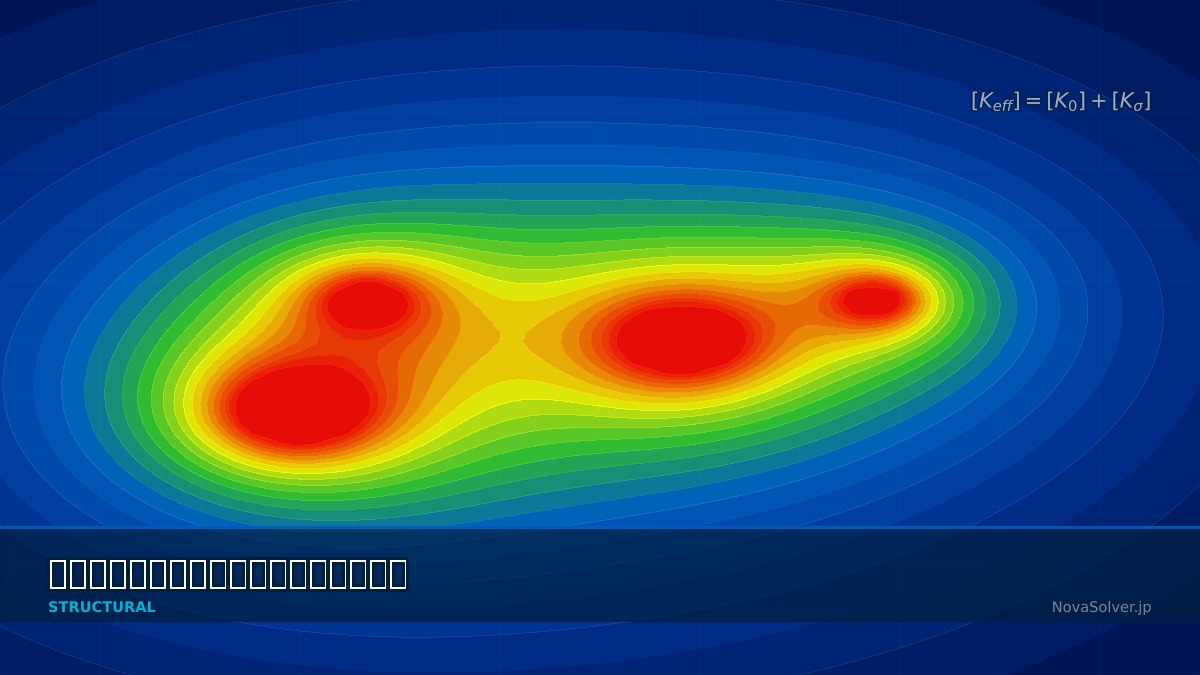
Theory and Physics
Geometric Stiffening Effect
Professor, what is the geometric stiffening effect?
The effect where initial stress changes the stiffness of a structure. Tensile stress increases stiffness (stiffening), compressive stress decreases stiffness (softening).
- $[K_\sigma] > 0$ (Tension) → Effective stiffness increases. Natural frequency rises.
- $[K_\sigma] < 0$ (Compression) → Effective stiffness decreases. Buckling occurs when $[K_{eff}] = 0$.
Application Examples
Summary
"Stress Stiffening" of a Rotating Disk
A rotating thin disk (like a CD or rotor) experiences an increase in bending stiffness due to in-plane tensile stress from centrifugal force, raising its natural frequency (stress stiffening). This effect originated from Griffith's concept of the stress stiffness matrix in the 1920s and is formulated in FEM as [Kσ]=∫[G]ᵀ[σ][G]dV. The Campbell diagram, showing the rise of turbine blade natural frequency with rotational speed, visualizes this effect.
Physical Meaning of Each Term
- Inertia Term (Mass Term): $\rho \ddot{u}$, meaning "mass × acceleration". Have you ever experienced being thrown forward during sudden braking? That "feeling of being carried away" is precisely the inertial force. Heavier objects are harder to start moving and harder to stop once moving. Buildings shake during earthquakes because the ground moves suddenly while the building's mass "gets left behind". In static analysis, this term is set to zero, assuming "forces are applied slowly enough to ignore acceleration". It cannot be omitted in impact loads or vibration problems.
- Stiffness Term (Elastic Restoring Force): $Ku$ or $\nabla \cdot \sigma$. When you stretch a spring, you feel a "force trying to return it", right? That's Hooke's law $F=kx$, the essence of the stiffness term. Now a question—if you pull an iron rod and a rubber band with the same force, which stretches more? Obviously the rubber band. This "resistance to stretching" is the Young's modulus $E$, which determines stiffness. A common misconception: "High stiffness ≠ strong". Stiffness is "resistance to deformation", strength is "resistance to failure"—they are different concepts.
- External Force Term (Load Term): Body force $f_b$ (e.g., gravity) and surface force $f_s$ (pressure, contact force). Think of it this way—the weight of a truck on a bridge is a "force acting on the entire volume" (body force), while the force of the tires pushing on the road is a "force acting only on the surface" (surface force). Wind pressure, water pressure, bolt tightening force... all are external forces. A common pitfall here: getting the load direction wrong. Intending "tension" but ending up with "compression"—sounds like a joke, but it actually happens when coordinate systems rotate in 3D space.
- Damping Term: Rayleigh damping $C\dot{u} = (\alpha M + \beta K)\dot{u}$. Try plucking a guitar string. Does the sound continue forever? No, it gradually fades. That's because vibration energy is converted to heat by air resistance and internal friction in the string. Car shock absorbers work on the same principle—they intentionally absorb vibration energy to improve ride comfort. What if damping were zero? Buildings would keep swaying forever after an earthquake. Since that doesn't happen in reality, setting appropriate damping is crucial.
Assumptions and Applicability Limits
- Continuum assumption: Treats material as a continuous medium, ignoring microscopic heterogeneity.
- Small deformation assumption (for linear analysis): Deformation is sufficiently small compared to initial dimensions, and stress-strain relationship is linear.
- Isotropic material (unless specified otherwise): Material properties are independent of direction (anisotropic materials require separate tensor definitions).
- Quasi-static assumption (for static analysis): Ignores inertial and damping forces, considering only equilibrium between external and internal forces.
- Non-applicable cases: Large deformation/large rotation problems require geometric nonlinearity. Nonlinear material behavior like plasticity or creep requires constitutive law extensions.
Dimensional Analysis and Unit Systems
| Variable | SI Unit | Notes / Conversion Memo |
|---|---|---|
| Displacement $u$ | m (meter) | When inputting in mm, unify loads and elastic modulus to MPa/N system. |
| Stress $\sigma$ | Pa (Pascal) = N/m² | MPa = 10⁶ Pa. Be careful of unit inconsistency when comparing with yield stress. |
| Strain $\varepsilon$ | Dimensionless (m/m) | Note the distinction between engineering strain and logarithmic strain (for large deformation). |
| Elastic Modulus $E$ | Pa | Steel: ~210 GPa, Aluminum: ~70 GPa. Note temperature dependence. |
| Density $\rho$ | kg/m³ | In mm system: tonne/mm³ (= 10⁻⁹ tonne/mm³ for steel). |
| Force $F$ | N (Newton) | Unify as N in mm system, N in m system. |
Numerical Methods and Implementation
FEM Implementation
1. Obtain stress distribution from static analysis.
2. Construct $[K_\sigma]$ from stress.
3. Use $[K_0] + [K_\sigma]$ as the global stiffness matrix.
- Ansys: PSTRES, ON (Watch out for forgetting this setting).
- Nastran: SOL 105/103 with load → automatic calculation.
- Abaqus: Static → Buckle/Frequency → automatic calculation.
Summary
Calculation and Assembly of the Geometric Stiffness Matrix
The geometric stiffness matrix Kσ is calculated using the shape function derivative matrix [G] under the initial stress state. The calculation procedure has three steps: ① Obtain prestress from linear static analysis, ② Assemble Kσ, ③ Solve the eigenvalue problem (K+Kσ)φ=ω²Mφ. ANSYS's PSTRES,ON command automates this, inheriting stress results from the previous analysis, adding Kσ, and solving for eigenvalues.
Linear Elements (1st-order Elements)
Linear interpolation between nodes. Low computational cost but low stress accuracy. Beware of shear locking (mitigated by reduced integration or B-bar method).
Quadratic Elements (with Mid-side Nodes)
Can represent curved deformation. Stress accuracy improves significantly, but degrees of freedom increase by about 2-3 times. Recommended when stress evaluation is important.
Full Integration vs Reduced Integration
Full Integration: Risk of over-constraint (locking). Reduced Integration: Risk of hourglass modes (zero-energy modes). Choose appropriately for the situation.
Adaptive Mesh
Automatic refinement based on error indicators (e.g., ZZ estimator). Efficiently improves accuracy in stress concentration areas. Includes h-method (element subdivision) and p-method (order increase).
Newton-Raphson Method
Standard method for nonlinear analysis. Updates the tangent stiffness matrix each iteration. Achieves quadratic convergence within the convergence radius, but computational cost is high.
Modified Newton-Raphson Method
Updates the tangent stiffness matrix using the initial value or every few iterations. Cost per iteration is low, but convergence speed is linear.
Convergence Criteria
Force residual norm: $||R|| / ||F_{ext}|| < \epsilon$ (typically $\epsilon = 10^{-3}$ to $10^{-6}$). Displacement increment norm: $||\Delta u|| / ||u|| < \epsilon$. Energy norm: $\Delta u \cdot R < \epsilon$.
Load Increment Method
Applies the full load in small increments rather than all at once. The arc-length method (Riks method) can track beyond limit points on the load-displacement curve.
Analogy: Direct Method vs Iterative Method
The direct method is like "solving simultaneous equations accurately with pen and paper"—reliable but takes too long for large-scale problems. The iterative method is like "repeatedly guessing to approach the correct answer"—starts with a rough answer but improves accuracy with each iteration. It's the same principle as looking up a word in a dictionary: opening to an estimated page and adjusting forward/backward (iterative) is more efficient than searching sequentially from the first page (direct).
Relationship Between Mesh Order and Accuracy
1st-order elements are like "approximating a curve with a ruler"—represented by straight line segments, so accuracy is limited. 2nd-order elements are like a "flexible curve"—can represent curved changes, dramatically improving accuracy even at the same mesh density. However, computational cost per element increases, so judge based on total cost-effectiveness.
Practical Guide
Practical Checklist
Stress Stiffening Effect on Aircraft Wings
An aircraft wing in flight experiences increased out-of-plane bending stiffness due to tensile stress from lift, raising its natural frequency by about 5-15% compared to when stationary on the ground. Boeing has incorporated wing stress stiffening into flutter analysis since the 1960s; for the B747 wing design, the in-flight natural frequency was calculated with a 10% increase over ground values for safety margin. This "flutter analysis considering stiffness increase" became an FAA type certification requirement.
Analogy for Analysis Flow
The analysis flow is actually very similar to cooking. First, buy ingredients (prepare CAD model), do the prep work (mesh generation), apply heat (solver execution), and finally plate it (visualization in post-processing). Here's an important question—in cooking, which step is most prone to failure? Actually, it's the "prep work". If mesh quality is poor, results will be a mess no matter how excellent the solver is.
Pitfalls Beginners Often Fall Into
Are you checking mesh convergence? Do you think "the calculation ran = the result is correct"? This is actually the most common trap for CAE beginners. The solver will always return "some answer" for the given mesh. But if the mesh is too coarse, that answer can be far from reality. Confirm that results stabilize across at least three levels of mesh density—neglecting this leads to the dangerous assumption that "the computer gave the answer, so it must be correct".
Thinking About Boundary Conditions
Setting boundary conditions is like "writing the problem statement" for an exam. If the problem statement is wrong? No matter how accurately you calculate, the answer will be wrong. "Is this surface truly fully fixed?" "Is this load truly uniformly distributed?"—Correctly modeling real-world constraint conditions is often the most critical step in the entire analysis.
Software Comparison
Tools
Supported by all solvers. For Ansys, don't forget the PSTRES, ON setting.
Differences in Stress Stiffening Implementation Among Solver Vendors
Implementation of geometric stiffness (stress stiffening) differs by solver. Nastran can add initial stress stiffness to linear analysis with `PARAM,KGGINIT,YES`, but ABAQUS automatically considers it in `*STATIC` nonlinear steps, while ANSYS requires the `PSTRES,ON` command. There is a documented case where a wind turbine blade (over 60m long) had its natural frequency calculated 8% lower due to a missed setting.
The Three Most Important Questions for Selection
- "What are you solving?": Does the required physical model/element type for geometric stiffening effects (spin stiffening) have support? For example, in fluids, the presence of LES support; in structures, the capability for contact/large deformation makes a difference.
- "Who will use it?": For beginner teams, tools with rich GUIs are suitable; for experienced users, flexible script-driven tools are better. Similar to the difference between automatic (GUI) and manual (script) transmission cars.
- "How far will it expand?": Selection considering future analysis scale expansion (HPC support), deployment to other departments, and integration with other tools leads to long-term cost reduction.
Advanced Technology
Advanced Research
Discovery of Geometric Stiffness: Stress Stiffening Phenomenon in Rotor Blades
The geometric stiffening effect became apparent in the 1950s during Sikorsky UH-1 helicopter development as a discrepancy between measurements and analysis. It was found that centrifugal force at 2,900 rpm raised blade natural frequency by 20% due to stress stiffening, leading to the implementation of the delta stiffness matrix in MSC Nastran. In current ANSYS, it is automatically considered via the PSTRESS element option.
Troubleshooting
Troubles
Underestimation of Natural Frequency Due to Overlooking Stress Stiffening
When FEM natural frequency is lower than measured values for structures with large prestress, the most common cause is forgetting to consider stress stiffening. Especially in tension membrane structures, tension cables, and high-speed rotating bodies, stiffness increase from prestress is dominant; ignoring this can lead to natural frequency predictions being 20-50% too low. First, check the tensile stress level generated in static analysis; if tensile prestress exceeds 1% of yield stress, always perform analysis including stress stiffness.
When You Think "The Analysis Doesn't Match"
- First, take a deep breath—Panicking and randomly changing settings makes the problem more complex.
- Create a minimal reproducible case—Reproduce the geometric stiffening effect (spin stiffening) problem in its simplest form. "Subtractive debugging" is most efficient.
- Change one thing and re-run—Making multiple changes simultaneously makes it unclear what worked. The principle of "controlled experiment", same as in science.
- Return to physics—If the calculation result is non-physical, like "objects floating against gravity", suspect a fundamental error in the input data.
Related Topics
なった
詳しく
報告