Prestress Modal Analysis
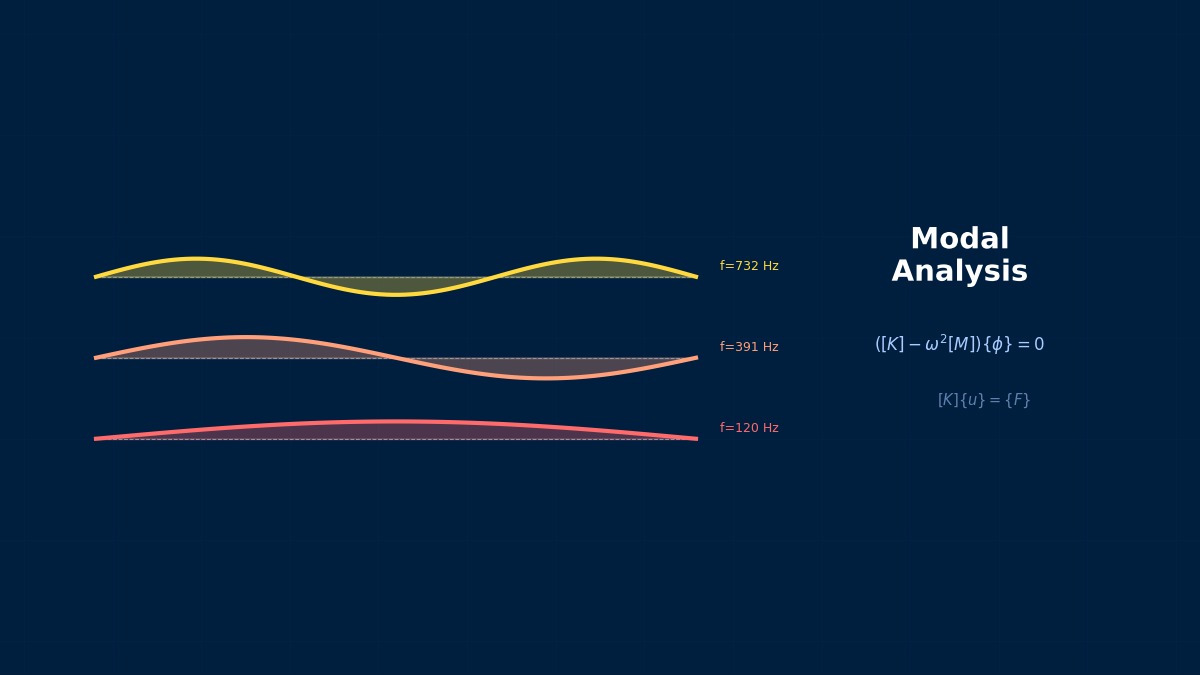
Prestress Modal: Theoretical Foundations
What is Prestressed Modal Analysis?
Professor, what is "prestressed modal analysis"?
It's natural frequency analysis in the presence of initial stress (prestress). When a structure is under tensile or compressive forces, its natural frequencies change. It's the same principle as a string's pitch rising when tightened.
Like a guitar string. Increasing the tension raises the vibration frequency.
Exactly. Conversely, compressive forces lower the vibration frequency. As compressive force approaches the critical buckling load, the frequency approaches zero. Frequency zero = buckling.
Governing Equation
Eigenvalue problem including prestress:
$[K_\sigma]$ is the geometric stiffness matrix (stress stiffness), same as in buckling analysis.
Buckling is $([K_0] + \lambda [K_\sigma])\{\phi\} = \{0\}$, and vibration is $([K_0] + [K_\sigma] - \omega^2 [M])\{\phi\} = \{0\}$. $[K_\sigma]$ is common!
Perfect observation. Buckling and vibration share the same geometric stiffness matrix. Tensile prestress makes $[K_\sigma] > 0$, increasing overall stiffness and raising frequency. Compressive prestress makes $[K_\sigma] < 0$, decreasing overall stiffness and lowering frequency.
Application Examples
| Structure | Type of Prestress | Effect on Frequency |
|---|---|---|
| String / Cable | Tension | Frequency increases with tension |
| Rotating Disk | Centrifugal Force (Tension) | Frequency increases with rotation speed |
| Turbine Blade | Centrifugal Force | Frequency changes with rotation |
| Compression Column | Axial Compression | Frequency decreases with compression |
| Prestressed Concrete Beam | Tension (PC Steel) | Frequency slightly increases with tension |
| Membrane Structure (Tent) | In-plane Tension | Frequency increases with tension |
So centrifugal prestress is important for rotating body vibrations.
In turbine blades and rotating disks, centrifugal force creates tensile prestress, raising the frequency. This is called spin softening/hardening. Since frequency changes with each rotation speed, it's necessary to evaluate natural frequencies at each speed.
FEM Procedure
1. Static Analysis (Preload) — Determine initial stress (compression, tension, centrifugal, etc.)
2. Geometric Stiffness Matrix Formation — Calculate $[K_\sigma]$ from the static analysis stress
3. Eigenvalue Analysis — Use $[K_0] + [K_\sigma]$ as stiffness to find natural frequencies
That's almost the same procedure as buckling analysis.
Summary
Let me organize prestressed modal analysis.
Key points:
- Initial stress changes natural frequency — Increases with tension, decreases with compression
- $[K_0] + [K_\sigma] - \omega^2 [M] = 0$ — Eigenvalue problem with added geometric stiffness
- Buckling and vibration share the same $[K_\sigma]$ — Frequency becomes zero at buckling point
- Centrifugal prestress is important for rotating bodies — Spin softening/hardening
- Two-step process: static analysis → eigenvalue analysis — Same procedure as buckling analysis
The relationship "frequency becomes zero at buckling point" is profound. Vibration and buckling are connected by a single theory.
It's one of the most beautiful relationships in structural mechanics. VCT (Vibration Correlation Technique) utilizes this relationship to non-destructively predict buckling load from changes in frequency.
High Pitch of a Taut String and Vibration Frequency of a Compressed Spring
Applying tension to a string instrument's string raises its natural frequency. Conversely, applying compressive load lowers the natural frequency, reaching zero at the buckling load (Pcr). This relationship is expressed as f²=f₀²(1-P/Pcr), allowing the compressive load P (prestress amount difficult to measure) to be inversely calculated from the measured natural frequency. This principle is actually used for tension management in bridge cables.
Computational Methods for Prestress Modal
Solver Settings
Please teach me the settings for prestressed modal analysis.
Nastran
```
SOL 103
CEND
SUBCASE 1
LOAD = 100 $ Preload
METHOD = 10 $ Eigenvalue Analysis
SPC = 1
```
Setting a load in SOL 103 automatically makes it a prestressed modal analysis.
Abaqus
```
*STEP
*STATIC
*CLOAD
...
*END STEP
*STEP
*FREQUENCY
20, ,
*END STEP
```
Place a Frequency step after the Static step. Stress from the previous step is automatically reflected in the geometric stiffness.
Ansys
```
/SOLU
ANTYPE, STATIC
PSTRES, ON ! Activate stress stiffness
SOLVE
FINISH
/SOLU
ANTYPE, MODAL
MODOPT, LANB, 20
SOLVE
```
In Ansys, PSTRES, ON is mandatory, right? Same as for buckling.
Forgetting PSTRES, ON means stress stiffness isn't calculated, resulting in "normal" natural frequencies with zero prestress effect. Same pitfall as buckling.
Types of Preload
| Preload | Setting Method | Example |
|---|---|---|
| Axial Force | Concentrated load or distributed load | Tension cable, compression column |
| Centrifugal Force | RFORCE (Nastran), *DLOAD CENTRIFUGAL (Abaqus) | Rotating body |
| Temperature | TEMP load | Frequency change due to thermal stress |
| Internal Pressure | PLOAD4 / *DLOAD P | Vibration of pressurized vessels |
There's also prestress from temperature?
When a constrained structure undergoes temperature change, thermal stress occurs, affecting frequency. In steel beams during fire, temperature rise generates axial compressive force, leading to frequency decrease → buckling.
Summary
Let me organize the numerical methods for prestressed modal analysis.