Fourier's Law
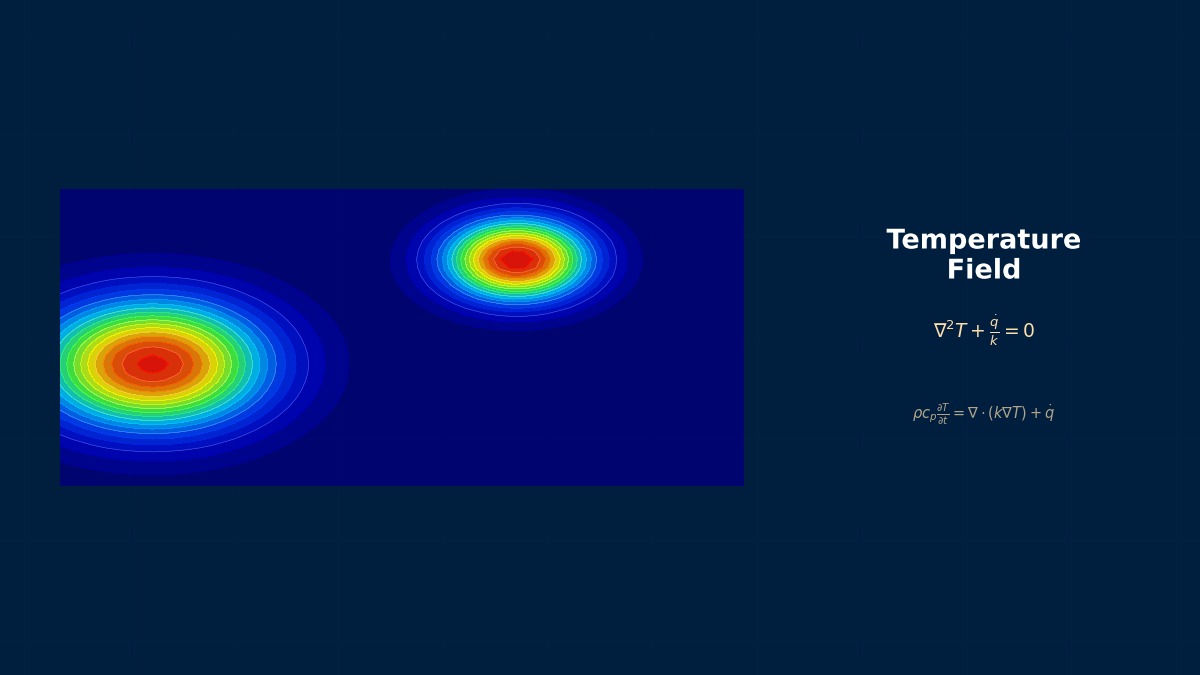
Fourier's Law: Theoretical Foundations
What is Fourier's Law?
Professor, I heard that Fourier's Law is the very foundation of heat transfer analysis. Why is it so important?
Fourier's Law is a mathematical expression of the natural phenomenon that "heat flows where there is a temperature gradient." It was formulated by Joseph Fourier in his 1822 book 'The Analytical Theory of Heat.' All heat conduction analysis starts from here.
It's amazing that a 200-year-old law is still in active use today.
Yes, just as Newtonian mechanics begins with F=ma, heat transfer engineering begins with Fourier's Law. In vector form, it is written as follows.
Governing Equation
The basic form of Fourier's Law is the relationship between the heat flux vector $\mathbf{q}$ and the temperature gradient.
Here, $k$ is the thermal conductivity [W/(m K)], and $\nabla T$ is the temperature gradient [K/m]. The minus sign reflects the second law of thermodynamics: "heat flows from the high-temperature side to the low-temperature side."
It becomes much simpler in one dimension, right?
Correct. In the one-dimensional case, the partial derivative becomes an ordinary derivative.
Combining this with the energy conservation law yields the steady-state heat conduction equation.
$\dot{q}_v$ is the internal heat generation per unit volume [W/m³]. If k is constant, it simplifies further to $k \frac{d^2T}{dx^2} + \dot{q}_v = 0$.
Does that mean the temperature distribution becomes linear when there is no internal heat generation?
Exactly. For a flat plate with surface temperatures $T_1$ and $T_2$, the distribution becomes linear: $T(x) = T_1 + (T_2 - T_1)\frac{x}{L}$. This is a basic case often used for verifying analytical solutions.
Extension to 3D
For general 3D problems, it is written in tensor form to account for anisotropic materials.
For isotropic materials, $k_{ij} = k \delta_{ij}$, which reduces to Laplace's equation $\nabla^2 T = 0$ (no generation) or Poisson's equation $\nabla^2 T + \frac{\dot{q}_v}{k} = 0$ (with generation).
For composite materials like CFRP, k is completely different in the fiber direction versus the transverse direction, right?
Correct. For CFRP, the thermal conductivity along the fiber direction is about 5-10 W/(m K), while in the transverse direction it's about 0.5-1 W/(m K). It cannot be handled correctly without the tensor form.
Boundary Conditions
There are three types of boundary conditions.
| Type | Name | Equation | Physical Meaning |
|---|---|---|---|
| 1st Kind | Dirichlet | $T = T_s$ | Specify surface temperature |
| 2nd Kind | Neumann | $-k \frac{\partial T}{\partial n} = q_s$ | Specify heat flux |
| 3rd Kind | Robin | $-k \frac{\partial T}{\partial n} = h(T - T_\infty)$ | Convective Heat Transfer |
So, an adiabatic condition is a Neumann condition with $q_s = 0$, right?
Correct. In practice, the 3rd kind boundary condition is used most frequently. The estimation of the convection heat transfer coefficient $h$ greatly influences the accuracy of the results.
The Year Fourier's Law Was Born
Joseph Fourier proposed q = −k∇T in his 1822 book 'The Analytical Theory of Heat.' This equation is the starting point of heat transfer engineering and is still used unchanged as the basic governing equation in modern FEA solvers, even after more than 200 years.
Computational Methods for Fourier's Law
Discretization by the Finite Element Method
How do you solve Fourier's Law on a computer?
We start from the weak form (Galerkin method) of the steady-state heat conduction problem. The temperature field $T$ is approximated using shape functions $N_i$.
Applying integration by parts to the weak form yields the element-level equation.
Here, $K^e_{ij} = \int_{\Omega_e} k \nabla N_i \cdot \nabla N_j \, d\Omega$ is the element thermal conductivity matrix, and $f^e_i = \int_{\Omega_e} \dot{q}_v N_i \, d\Omega + \int_{\Gamma_e} q_s N_i \, d\Gamma$ is the element thermal load vector.
It looks similar in form to the stiffness matrix in structural analysis.
Good observation. It has the same mathematical structure as $[K]\{u\}=\{F\}$ in structural analysis. However, in thermal analysis, the unknown is the scalar temperature, so there is only one degree of freedom per node. This makes the problem size much smaller than in structural analysis.
Finite Difference Method / Finite Volume Method
The Finite Difference Method (FDM) is also often used for steady-state heat conduction. Discretizing with central differences yields, in 1D:
The Finite Volume Method (FVM) places temperature at cell centers and conserves heat flux at cell interfaces. CFD solvers (Ansys Fluent, STAR-CCM+) are FVM-based, so in conjugate heat transfer analysis, the solid side is also automatically discretized using FVM.
Does the accuracy change depending on the method?
FEM is strong for complex geometries and can achieve high accuracy with higher-order elements. FVM strictly satisfies conservation laws, making it suitable for fluid-solid coupling. FDM is easy to implement but limited to structured grids. Choosing the right method is important.
Matrix Solution Methods
The assembled global equation $[K]\{T\}=\{f\}$ is linear for steady-state heat conduction, so it can be solved in a single step.
| Solver | Type | Characteristics | Recommended Scale |
|---|---|---|---|
| Cholesky Decomposition | Direct | Optimal for symmetric positive definite, accurate | ~500k DOF |
| PCG Method | Iterative | Good memory efficiency | 500k – 10M DOF |
| AMG Preconditioner + CG | Iterative | Strong for large-scale problems | 10M DOF and above |
What happens when there is temperature-dependent thermal conductivity?
It becomes a nonlinear problem requiring iterative calculation. The $k(T)$ is updated sequentially using the Newton-Raphson method. The convergence criterion is typically a residual norm around $10^{-6}$, but sometimes a temperature change of $10^{-3}$ K is used as a benchmark.
Thermal Conductivity Measurement Methods
The Flash Method (Laser Flash Method), based on ASTM E1461 standard, can measure a wide range from 0.1 to 2000 W/m·K with ±3% accuracy. Netzsch's LFA467 apparatus is used worldwide as a standard machine that can simultaneously obtain thermal diffusivity, specific heat, and thermal conductivity in a single test.
Try the interactive simulators in this field to experience the theory
All Simulators