Kiln Thermal Analysis
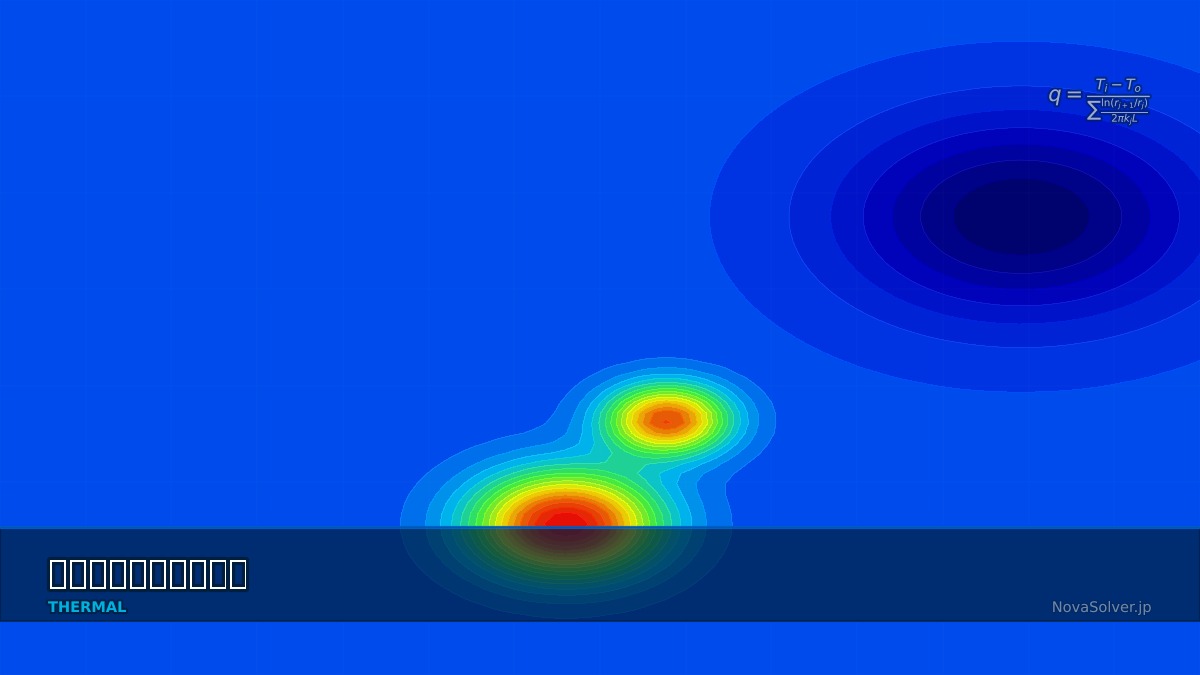
Theory: heat through the kiln wall
Overview
On our cement plant's rotary kiln, the shell is hot in just one area. What's happening?
The kiln interior is protected by refractory brick, and in the burning zone the hot face exceeds 1400 °C. Shell temperature outside is set mostly by brick thickness and the clinker layer stuck to the brick (coating). A local hot spot suggests coating has fallen off there, the brick has thinned, or brick has dropped out. Computing wall heat transfer lets you infer the interior condition from shell temperature — and since heat loss drives fuel use, it matters for kiln energy efficiency too.
Wall heat balance
The sum of layer resistances from hot face to shell (coating, brick, steel) sets the heat flux through the wall; shell temperature settles where this balances convection and radiation from the shell exterior.
The invention of the rotating kiln
Until the 19th century, cement raw materials were burned in vertical shaft kilns loaded in batches, limiting output. In the 1880s Ransome in England devised the rotating cylindrical kiln, and once made practical in the US in the early 20th century, it allowed continuous feed and mass production. Kilns over 100 m long were built, but suspension preheaters using exhaust heat to preheat raw meal later shortened kilns and cut fuel use greatly. Today shell-temperature scanners serve as eyes into the kiln.
Worked example: the burning-zone wall
Burning zone of a 4.5 m diameter kiln: hot face 1400 °C, basic brick (2.5 W/mK), 30 mm steel shell. The exterior loses heat to 20 °C surroundings by convection (15 W/m²K) and radiation (emissivity 0.85):
| Wall condition | Shell | Heat flux | Loss per metre |
|---|---|---|---|
| Brick 220 mm | 350 °C | 11.8 kW/m² | 167 kW/m |
| Coating 150 mm + brick 220 mm | 207 °C | 5.0 kW/m² | 71 kW/m |
| Brick worn to 100 mm | 485 °C | 22.5 kW/m² | 318 kW/m |
| Brick worn to 60 mm | 578 °C | 33.3 kW/m² | 471 kW/m |
With or without coating, heat loss differs by more than half.
Coating conducts heat less well than brick, so it acts as insulation. Over a 20 m burning zone, heat loss is 3.35 MW without coating and 1.41 MW with it — about 96,000 GJ versus 41,000 GJ a year. Conversely, brick worn to 100 mm puts the shell at 485 °C, and near 600 °C the shell glows red and risks deforming. At a 300 °C shell, radiation is 54% of exterior loss, so ignoring it overestimates shell temperature. Inferring the interior from scanner readings needs a calculation with radiation and convection done properly.
Analysis workflow
- Solve combustion, gas flow and material-bed temperature along the kiln for the hot-face distribution.
- From layer resistances (coating, brick, shell) find shell temperature and heat loss.
- Include both convection (rotation and wind) and radiation on the shell exterior.
- Compare with scanner readings to infer remaining brick and coating condition.
- Check thermal deformation of shell and tyres (riding rings) from the temperature field.
“The red band on the scanner”
One day a kiln's shell scanner showed a red band of high temperature. Compared with wall heat-transfer calculations, the reading corresponded to brick worn below half or major coating loss. Adjusting combustion to shift the flame slightly rebuilt the coating and the temperature fell — but it rose again weeks later, and at the scheduled shutdown the brick was indeed locally thin. Linking shell-temperature changes to calculations makes shutdown planning easier.
Common mistakes
Mistakes and fixes
| Mistake | Effect | Fix |
|---|---|---|
| Ignoring shell radiation | Shell temperature overestimated | Include radiation |
| Ignoring coating | Heat loss overestimated | Calculate per condition |
| Constant brick conductivity | Profile off | Use temperature dependence |
| Watching average shell temperature | Local wear missed | Circumferential and axial maps |
| Ignoring thermal deformation | Brick loosening | Check shell and tyre deformation |
I'd like to try related calculations.
Try the furnace efficiency calculator, blackbody radiation simulator and radiation network simulator. Related processes include industrial furnace simulation, drying processes and glass forming.
Related Topics
Experience the theory firsthand with the interactive simulator for this field
All Simulators