Welding Heat Simulation
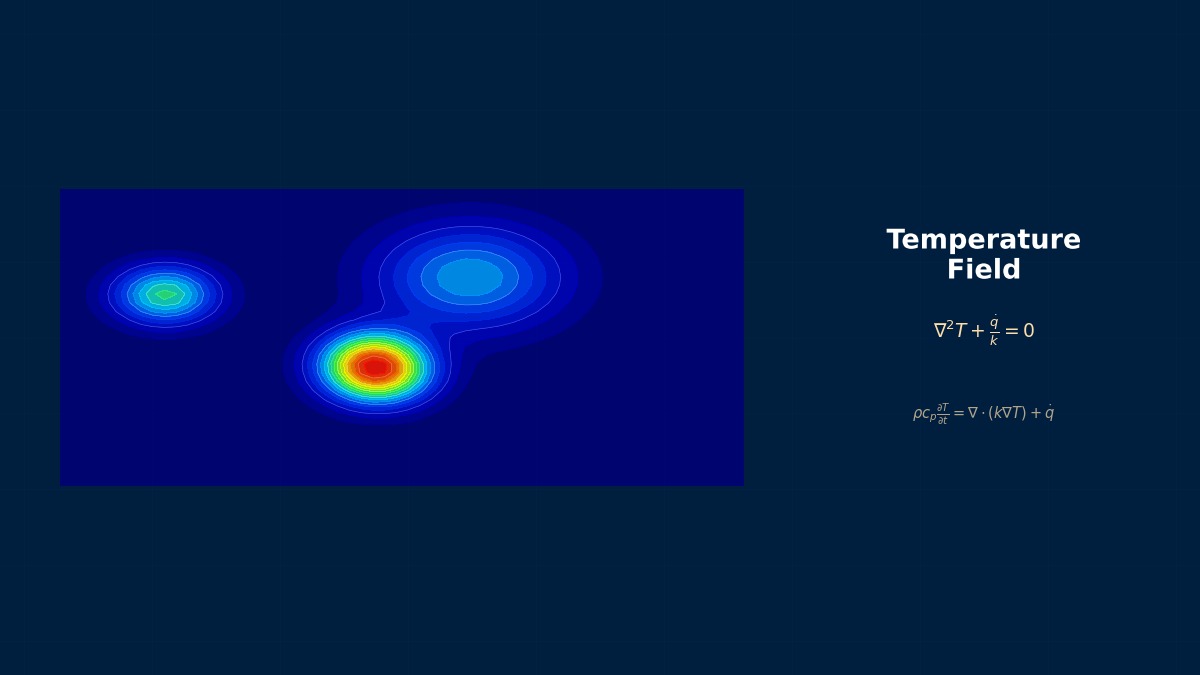
Theory: a moving heat source and cooling time
Overview
What should a welding thermal analysis look at first — the whole temperature field?
In steel welding, the most important thing is how fast the weld cools. Steel transforms between 800 and 500 °C, so if the cooling time t8/5 is too short, hard brittle structures form and crack readily. t8/5 is set mainly by heat input, thickness and preheat. The analytical solution for a moving point source (Rosenthal) gives thick- and thin-plate cases, and practice also uses experimentally corrected formulas. Let's calculate with both.
Heat input and cooling time
$Q$ is heat input per unit length, $\eta$ thermal efficiency (about 0.8 for MAG), $T_0$ preheat (initial) temperature and $d$ thickness. Thick plate (3D flow) scales with heat input; thin plate (2D) with heat input squared over thickness squared. SEW 088 uses experimentally corrected coefficients.
Rosenthal's moving source
Rosenthal first solved welding heat flow theoretically in the 1930s and 40s, showing that in coordinates moving with the torch the temperature field becomes time-independent. His solution remains the basis for estimating weld pool size and cooling rates. The German steel industry compiled measured cooling times into the SEW 088 guideline, spreading the use of t8/5 to control welding conditions.
Worked example: MAG welding (1.12 kJ/mm)
28 V, 250 A, 5 mm/s, efficiency 0.8. Rosenthal properties: conductivity 28 W/mK, volumetric heat capacity 4.8 MJ/m³K (representative for 500–800 °C).
Thickness and preheat
| Preheat | Thickness | SEW 088 | Rosenthal |
|---|---|---|---|
| 20 °C | 10 mm | 14.3 s (thin) | 20.0 s (2D) |
| 20 °C | 20 mm | 5.9 s (thick) | 5.1 s (3D) |
| 20 °C | 40 mm | 5.9 s (thick) | 5.1 s (3D) |
| 150 °C | 10 mm | 26.6 s (thin) | 43.1 s (2D) |
| 150 °C | 20 mm | 8.8 s (thick) | 8.4 s (3D) |
The SEW 088 thick/thin transition is 15.5 mm at 20 °C preheat and 17.4 mm at 150 °C.
Effect of heat input (thick plate, no preheat)
| Heat input | SEW 088 | Rosenthal |
|---|---|---|
| 0.60 kJ/mm | 3.2 s | 2.7 s |
| 1.12 kJ/mm | 5.9 s | 5.1 s |
| 2.00 kJ/mm | 10.6 s | 9.1 s |
For thick plate Rosenthal and SEW differ by about 15%, but for thin plate by 40%.
Rosenthal assumes constant properties and no heat loss from the plate surfaces. In thick plate heat spreads mainly into the plate, so these assumptions hold fairly well. In thin plate heat can escape only in-plane, so surface losses and property variation matter relatively more, and the thickness-squared dependence magnifies small differences. Practice therefore uses experimentally corrected formulas such as SEW, with Rosenthal for trends. Either way, thinner plate and higher preheat mean slower cooling: at 150 °C preheat, 10 mm plate gives 26.6 s, over four times the thick plate without preheat.
Analysis tips
- Compute heat input including thermal efficiency (it differs by process).
- Check whether thickness falls in the thick or thin regime before choosing the formula.
- Compare with the recommended t8/5 range for the steel and adjust preheat or heat input.
- For detailed analysis use FEM with temperature-dependent properties, latent heat and surface losses.
- In multi-pass welds, treat heat from previous passes (interpass temperature) as the initial temperature.
“Cracks only on winter sites”
On a steel-structure site using the same procedure year-round, weld cracks appeared only in winter work. In winter the steel was near 0 °C, shortening t8/5 and hardening the HAZ, while humid air added hydrogen. Adding preheat temperatures and ambient-dependent controls to the procedure, warming the steel before welding, eliminated the cracks. t8/5 is sensitive to the steel's initial temperature and varies with the season.
Common mistakes
Mistakes and fixes
| Mistake | Effect | Fix |
|---|---|---|
| No thermal efficiency | Heat input overrated | Process efficiency |
| Thick-plate formula for thin plate | t8/5 underestimated | Use transition thickness |
| Fixed 20 °C initial | Winter cracking missed | Actual steel temperature |
| Constant properties | Large thin-plate error | Temperature-dependent data |
| Ignoring interpass temperature | Multi-pass errors | Include previous passes |
I'd like to learn related topics.
Related pages include additive manufacturing thermal analysis, quench heat treatment, welding distortion, thermal stress analysis and casting thermal analysis.