Monte Carlo Radiation Analysis
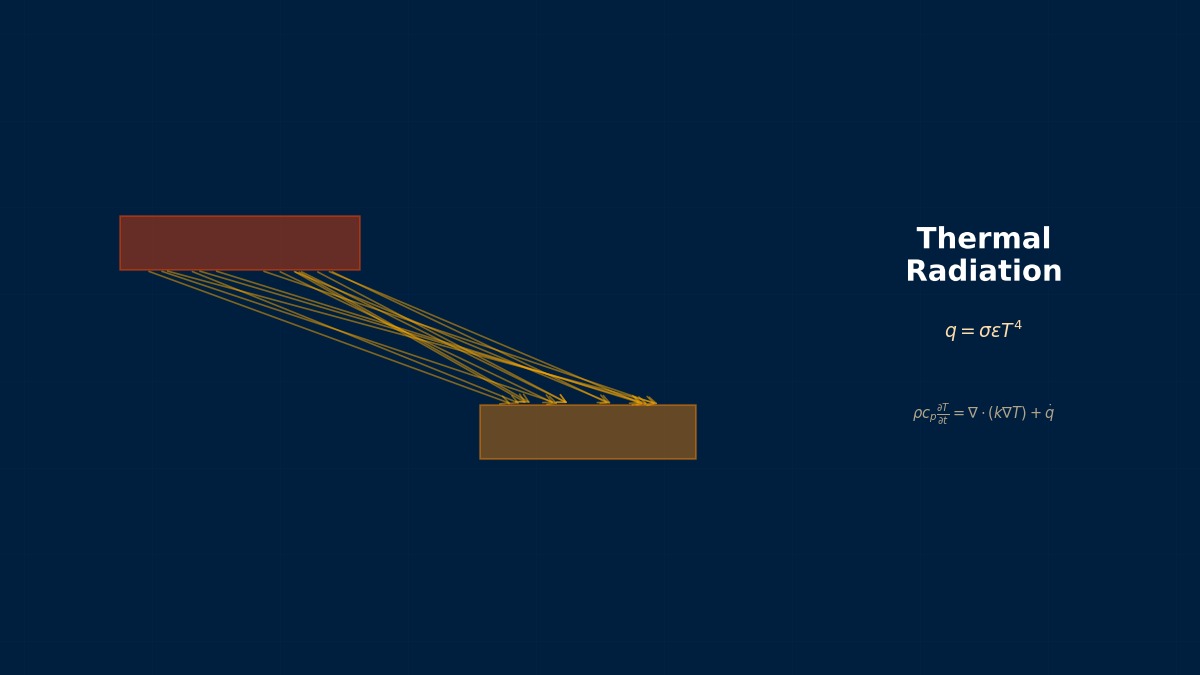
Theory: counting rays to compute radiation
Overview
Monte Carlo uses random numbers. Can that give accurate answers?
With enough rays, yes — but error shrinks only with the square root of ray count, so accuracy gets expensive. In exchange, complex shapes, wavelength- or direction-dependent properties, and absorbing or scattering gases are all handled by the same ray-following procedure. Let's check how well Monte Carlo matches exact solutions — the view factor between two disks and transmissivity through an absorbing layer — and how it changes with ray count.
View factor and statistical error
Points on surface 1 are chosen uniformly and directions cosine-distributed to match diffuse emission ($R$ uniform random in 0–1). The fraction hitting surface 2 is the view factor. Hit-or-miss is binomial, so scatter is $\sqrt{F(1-F)/N}$.
An absorbing layer
$s$ is the distance to absorption, sampled from an exponential distribution with absorption coefficient κ. Diffuse light includes oblique rays with longer paths, so it transmits less than a collimated beam.
From Los Alamos to thermal radiation
The Monte Carlo method was devised in the 1940s at Los Alamos by Ulam, von Neumann and others to compute neutron transport, named after Monaco's casino district. Howell and others applied it to thermal radiation in the 1960s, for furnaces and spacecraft of complex shape. Today film computer graphics compute lighting with the same ray-tracing idea.
Worked examples
Example 1: view factor between facing disks
Two coaxial disks of radius 1, spacing 1; exact value 0.38197. Ten runs with different random seeds for each ray count.
| Rays | Mean | Std dev | Theoretical std |
|---|---|---|---|
| 100 | 0.3710 | 0.0671 | 0.0486 |
| 1,000 | 0.3876 | 0.0122 | 0.0154 |
| 10,000 | 0.3829 | 0.0038 | 0.0049 |
| 100,000 | 0.3820 | 0.0012 | 0.0015 |
| 1,000,000 | 0.3819 | 0.0006 | 0.0005 |
Example 2: transmissivity of an absorbing layer
| Optical thickness κL | Collimated MC | exp(−κL) | Diffuse MC | 2E₃(κL) |
|---|---|---|---|---|
| 0.1 | 0.9045 | 0.9048 | 0.8323 | 0.8326 |
| 1 | 0.3678 | 0.3679 | 0.2185 | 0.2194 |
| 3 | 0.0503 | 0.0498 | 0.0180 | 0.0179 |
Each with 200,000 rays.
It takes a million rays just to settle the fourth decimal place. That's a lot.
That's Monte Carlo's weakness: a tenfold error cut needs 100 times the rays. But however complex the shape or numerous the surfaces, the error decreases the same way. Compared with methods whose view-factor matrix grows rapidly with surface count, Monte Carlo gains as problems get harder. In practice, set ray count from required accuracy (say 1% in heat flux) and confirm results settle as it doubles and quadruples. Variance reduction (importance sampling, reciprocity) improves accuracy for the same ray count.
Analysis tips
- First verify the code on simple shapes with exact solutions.
- Double ray count and confirm scatter falls as 1/√N.
- Check results with reciprocity A₁F₁₂ = A₂F₂₁ and summation ΣF = 1.
- Small or rarely hit surfaces have large error; allocate rays preferentially.
- Record RNG quality and seeds for reproducibility.
“A small sensor's temperature fluctuated”
In a furnace radiation analysis, a small wall-mounted temperature sensor's computed temperature varied by tens of kelvins from run to run. Its area was tiny compared with the furnace, so very few rays hit it. Importance sampling — firing more rays toward the sensor with correspondingly lower weights — cut the scatter to a few kelvins for the same run time. With Monte Carlo, check that enough rays reach the locations of interest.
Common mistakes
Mistakes and fixes
| Mistake | Effect | Fix |
|---|---|---|
| Uniform directions | Not diffuse emission | Use cosine weighting |
| Too few rays | Noisy results | Size by 1/√N |
| Rays miss small surfaces | Local error | Importance sampling |
| No reciprocity check | Bugs missed | Check sums and reciprocity |
| Unfixed seeds | Not reproducible | Record seeds |
I'd like to learn related topics.
Related pages include view factors, radiosity method, participating media, gray-body exchange and Planck's law.
Related Topics
Experience the theory firsthand with the interactive simulator for this field
All Simulators