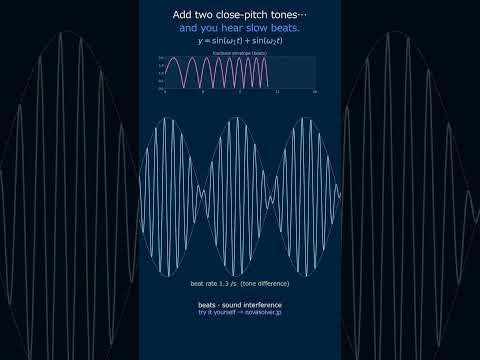
Acoustic Beats Simulator — Two-Tone Interference and Beat Frequency
Quick answer The beat frequency of two tones is f_beat = |f₁ − f₂| with period T_b = 1/f_beat. For equal amplitudes the sum is y(t) = 2A·cos(2π·f_avg·t)·cos(2π·f_b·t), where f_avg = (f₁+f₂)/2. Example: f₁ = 440 Hz and f₂ = 444 Hz beat at 4.0 Hz (period 250 ms).
Add two sine tones whose frequencies f1 and f2 differ slightly and a slow loudness pulsation appears at |f1 - f2| Hz, the classic beat phenomenon. This tool also exposes the amplitudes A1, A2 and shows the composite waveform, spectrum, beat frequency, average frequency, beat period and maximum composite amplitude in real time. Use it to study piano tuning, heterodyne receivers and close natural modes in structural vibrations.
Parameters
Frequency 1 f1
Hz
Frequency 2 f2
Hz
Amplitude 1 A1
—
Amplitude 2 A2
—
Defaults: f1 = 440 Hz (A4 reference pitch), f2 = 444 Hz (4 Hz mistune), A1 = A2 = 0.5. The sweep moves f2 from 440 to 2000 Hz and back, so you can watch the beat vanish at f1 = f2 and accelerate as the spread widens.
Results
—
Beat frequency
—
Average frequency
—
Beat period
—
Max composite amplitude
Composite waveform y(t) (0 to 1000 ms)
Blue = composite y(t)=A1*cos(2*pi*f1*t)+A2*cos(2*pi*f2*t). Orange dashed = amplitude envelope. Yellow dot = constructive maximum (A_max). Red dot = destructive minimum (A_min). One envelope cycle equals one audible beat.
Frequency spectrum
X axis = frequency [Hz], Y axis = amplitude. Blue and pink spikes = f1 and f2. Yellow dashed line = average frequency f_avg = (f1+f2)/2. Orange arrow = frequency difference |f1 - f2|, source of the beat.
Theory & Key Formulas
The sum of two sine tones can be split into a fast carrier and a slow envelope by the sum-to-product identity.
$f_{\mathrm{avg}} = (f_{1}+f_{2})/2$ is the perceived pitch, $f_{b} = |f_{1}-f_{2}|/2$ is the half-difference inside the cosine envelope. The constructive maximum amplitude is $A_{1}+A_{2}$ and the destructive minimum is $|A_{1}-A_{2}|$. With f1 = 440 Hz, f2 = 444 Hz and A1 = A2 = 0.5 the tool reports beat frequency 4.0 Hz, average frequency 442 Hz, beat period 250 ms and maximum composite amplitude 1.00.
What is the Acoustic Beats Simulator?
🙋
With the defaults f1 = 440 Hz, f2 = 444 Hz and amplitudes 0.5 each I get a beat frequency of 4 Hz and an average frequency of 442 Hz. What does that actually sound like?
🎓
Nice catch. Your ear hears one tone roughly at 442 Hz, slightly above A4, while its loudness pulses four times per second in a steady wow-wow-wow-wow pattern. That is the beat. Look at the waveform card and you can see two layers, the fast inner oscillation at about 442 Hz and a slow outer envelope that wraps the whole signal at 4 Hz. One envelope cycle equals one beat, which is why the beat period is 250 ms. Slide f2 toward 440 and the beat slows down until it disappears completely.
🙋
The spectrum only shows two spikes at f1 and f2. Why do I hear a 4 Hz beat that is not even a peak in the spectrum?
🎓
Sharp question. Physically the signal contains only 440 and 444 Hz, so there really is no spectral line at 4 Hz. The cochlea, however, responds non-linearly to instantaneous pressure, and that picks up the slow amplitude modulation of the envelope as a perceived rhythm. Mathematically the sum-to-product identity rewrites the two cosines as a fast carrier multiplied by a slow envelope; the linear superposition still has only two frequencies, but the ear perceives a single pitch with a slow loudness wobble.
🙋
When I drop A2 from 0.5 to 0.2 the beat becomes shallower and never goes silent. What is going on?
🎓
The envelope minimum is the explanation. With equal amplitudes the beat troughs reach exactly zero (perfect destructive interference, A_min = 0). When A1 differs from A2, the minimum is fixed at |A1 - A2|, so even at the trough some signal remains. With A1 = 0.5 and A2 = 0.2 the minimum is 0.3, and the modulation index m = 2*min(A1, A2)/(A1 + A2) drops to 0.57. Real instruments and loudspeakers almost never produce equal amplitudes, which is why beats in the wild usually sound like a vibrato wobble rather than a clean pulse.
🙋
I have heard piano tuners say "turn the peg until the beats vanish". Can I reproduce that with the tool?
🎓
Yes, exactly. Set f1 = 440 as the reference and treat f2 as the string. As you walk f2 from 444 to 442 to 441 to 440, the beat frequency drops to 2, then 1, then 0 Hz, while the beat period grows to 500, 1000 and finally infinity ms. The string is in tune the moment the beat period becomes infinite. Professional tuners can stretch beats well below half a beat per second, and in this tool you will see the envelope flatten into a pure straight line the instant f2 hits 440.
Physical Model and Key Equations
The sum of two cosines can be split into a fast carrier and a slow envelope by the sum-to-product identity.
where $f_{\mathrm{avg}}=(f_{1}+f_{2})/2$ is the fast inner pitch heard by the ear and $f_{b}=|f_{1}-f_{2}|/2$ is the half-difference inside the cosine envelope. Because the perceived loudness modulation tracks the absolute value of the envelope, the audible beat frequency is $f_{\mathrm{beat}}=|f_{1}-f_{2}|$ Hz and the beat period is $T_{b}=1/|f_{1}-f_{2}|$. The constructive maximum amplitude is $A_{\max}=A_{1}+A_{2}$ and the destructive minimum is $A_{\min}=|A_{1}-A_{2}|$.
For unequal amplitudes the envelope is $\sqrt{A_{1}^{2}+A_{2}^{2}+2 A_{1} A_{2}\cos(2\pi(f_{1}-f_{2})t)}$. It oscillates between the maximum $A_{1}+A_{2}$ and the minimum $|A_{1}-A_{2}|$ at the beat period. The waveform card draws this generalised envelope as the orange dashed curve.
Real-World Applications
Instrument tuning: Piano tuners and guitarists adjust strings until the beats stop. They sound a 440 Hz reference together with the string and count the beats per second; one beat per second between two notes implies a 1 Hz mismatch. This basic technique lets a tuner reach 0.5 Hz accuracy without absolute pitch. Set f1 = 440, f2 = 441 in the tool and the beat period reads 1000 ms, exactly the case a professional tuner describes as "one beat per second".
Heterodyne receivers (radio, radar, GPS): Mixing an incoming high-frequency signal (for example 1 GHz) with a local oscillator at 999.9 MHz produces a 100 kHz intermediate-frequency beat that is much easier to amplify and filter than the original. This deliberate use of $f_{b} = |f_{1} - f_{2}|$ underlies AM and FM radios, televisions, radars and GPS receivers. Try f1 = 440, f2 = 400 in the tool and the beat at 40 Hz makes the principle obvious.
Mechanical vibration diagnosis: Twin-shaft fans, twin-engine aircraft and clusters of motors rarely run at exactly the same speed, so the difference in shaft frequencies appears as a beat in the radiated noise. Two motors at 50 Hz and 50.5 Hz on a single chassis create a 0.5 Hz wobble that passengers find unpleasant. Designers solve it with synchronised speed control or active noise cancellation, and CAE engineers predict it by resolving the two close peaks in an FFT of the simulated time response.
Acoustics teaching and psychoacoustics: Beats are the textbook example of how the ear extracts a frequency that is not actually present in the spectrum. By exposing the waveform, the envelope and the spectrum in parallel, this tool lets students explore the question "where does the third frequency come from" as the joint outcome of the sum-to-product identity and cochlear non-linearity, an essential first step into psychoacoustics and music theory.
Common Misconceptions and Caveats
The most common confusion is to identify the beat frequency with $|f_{1}-f_{2}|/2$. The cosine envelope inside the sum-to-product identity does oscillate at that half-difference, but the ear perceives loudness modulation at the rate of $|\cos|$, which is twice as fast. The audible beat frequency is therefore $|f_{1}-f_{2}|$, exactly the value the tool reports as "Beat frequency". Keep this distinction between the mathematical envelope and the perceived rhythm in mind when reading textbooks.
A second pitfall is the assumption that beats are always audible. Once $|f_{1}-f_{2}|$ exceeds roughly 20 Hz the ear can no longer follow the pulses as a rhythm and instead hears a rough timbre, and beyond 30 Hz the two tones are perceived as a separate dyad inside the same critical band. Audible beats really live in the 0.5 to 15 Hz window. In the tool, setting f2 to 470 Hz still produces beats mathematically, but in real life the result is heard as a chord, not as a wobble.
A third surprise is that the beat speed does not depend on amplitude at all. The beat period $T_{b}=1/|f_{1}-f_{2}|$ is set by the frequency difference alone; the amplitude ratio only changes the depth (modulation index). Drop A2 from 0.5 to 0.1 in the tool and the beat period stays at 250 ms, while the envelope range shrinks to roughly [0.4, 0.6]. So if a tuner thinks the beats have disappeared because the string is quiet, they have actually only become shallower.
Frequently Asked Questions
For two sine tones with equal amplitudes the sum becomes y(t) = 2A * cos(2*pi*f_avg*t) * cos(2*pi*f_b*t) by the sum-to-product identity, where f_avg = (f1 + f2)/2 and f_b = |f1 - f2|/2. The fast inner cosine is heard as the average pitch, while the slow outer cosine is the amplitude envelope. The ear perceives loudness modulation at the period of the absolute value of the envelope, giving an audible beat frequency of |f1 - f2| Hz. With the defaults f1 = 440 Hz, f2 = 444 Hz the tool reports a beat frequency of 4.0 Hz and a beat period of 250 ms.
Two tones at exactly the same frequency overlap perfectly and the beats vanish (f_b = 0, the envelope is flat). Any small mismatch produces a beat at |f1 - f2| Hz that is easy to count with a clock or a metronome. A reference tone at 440 Hz against a string with two beats per second tells the tuner that the string is at 442 Hz or 438 Hz; halve that to one beat every two seconds and the tuning is essentially correct. The ear is poor at absolute pitch but excellent at counting slow beats, which is why every pre-electronic tuner used this method. Move f2 toward 440 Hz in the tool and the beat period grows to 1, 5, 10 seconds and finally to infinity when the two tones lock.
With equal amplitudes the envelope minimum is zero and the beat goes silent at every trough (perfect destructive interference). When A1 differs from A2 the minimum is |A1 - A2|, so the trough never reaches silence and the beat depth (modulation index) is shallower. The maximum is always A1 + A2, the minimum is |A1 - A2|, and the modulation index can be written as 2*min(A1, A2)/(A1 + A2). Drop A2 from 0.50 to 0.20 in the tool and the maximum becomes 0.70 while the minimum is 0.30, a clearly shallower beat. Real instruments and loudspeakers rarely produce equal amplitudes, so the asymmetric beat is heard as a vibrato-like wobble.
Problem cases: twin-engine aircraft, paired pumps and multi-fan installations whose shafts run at slightly different speeds generate a low-frequency pressure pulsation (a few Hz) that passengers and operators perceive as an annoying wobble; designers fight it with synchronised speed control or active noise cancellation. Useful cases: heterodyne receivers in radio, radar and GPS deliberately mix a high-frequency input with a local oscillator to produce a much lower intermediate-frequency beat that is easier to amplify and demodulate. In CAE, two close natural modes of a structure show up as beats in the time-domain response, so an FFT that resolves the two peaks predicts where beats can occur. This tool gives the underlying physics in an interactive form.
Set frequency f₁ (Hz) using the first slider; typical range 440–880 Hz for audible tones.
Set frequency f₂ (Hz) using the second slider; detuning by 5–10 Hz creates perceptible beats in speech and music synthesis.
Adjust amplitude A₁ and A₂ (arbitrary units, 0–1) to control individual tone levels in the composite waveform.
Observe real-time waveform display; beat frequency equals |f₁−f₂|, and beat period = 1 / beat frequency.
Worked Example
Two piano strings tuned nominally to A₄: f₁ = 440 Hz, f₂ = 445 Hz, both A₁ = A₂ = 0.8 units. Beat frequency = |440−445| = 5 Hz; beat period = 0.2 seconds; average frequency = 442.5 Hz. The composite waveform exhibits amplitude modulation with envelope peaks every 0.2 s, creating audible wobble used in tuning procedures. Maximum composite amplitude ≈ 1.6 units (A₁ + A₂).
Practical Notes
Voice recording: male fundamental ~120 Hz, female ~220 Hz; beat rates below 15 Hz sound like roughness, above 30 Hz merge into a single pitch with timbre.