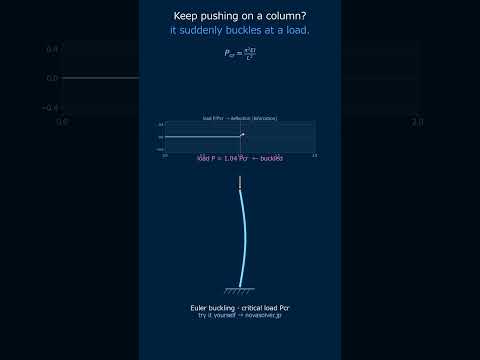
Column Buckling Calculator — Euler Load, Johnson Formula & Safety Factor
Set end conditions, cross-section, material, and length to instantly compute critical buckling load Pcr. The calculator automatically applies Euler's or Johnson's formula based on the slenderness ratio, and plots Pcr vs L and σcr vs λ curves.
Parameters
End Condition
Material
Cross-section
Diameter d (mm)
mm
Side length b (mm)
mm
Height h (mm)
mm
Flange width bf (mm)
mm
Web thickness tw (mm)
mm
Flange thickness tf (mm)
mm
Column length L (mm)
mm
Design load P (kN)
kN
Animation
Preset (end conditions)
Results
—
Pcr (kN)
—
Effective length factor K
—
Slenderness λ = KL/r
—
Buckling stress σcr (MPa)
—
Safety factor FS
—
Formula used
Critical Load Pcr vs Column Length L
Buckling load Pcr vs column length L
Buckling stress σcr vs slenderness ratio λ(with operating point)
$\lambda_c = \pi\sqrt{2E/\sigma_y}$: transition slenderness ratio $\lambda \gt \lambda_c$: Euler formula $\lambda \le \lambda_c$: Johnson formula
What is Column Buckling?
🙋
What exactly is buckling? Is it just the column bending because it's too weak?
🎓
Basically, it's a sudden, catastrophic failure under compression, but not from crushing. It's an instability. For instance, a long, thin ruler will suddenly bow sideways under an axial load long before the material itself would crush. Try selecting different "End Conditions" in the simulator above—you'll see the critical load change dramatically because how the ends are held changes how easily it can buckle.
🙋
Wait, really? So there are two different formulas, Euler and Johnson. Which one do I use?
🎓
Great question! It depends on how "slender" the column is. Euler's formula is for long, slender columns that fail elastically. Johnson's is for shorter, "intermediate" columns where material yielding starts to play a role. The simulator does this switch automatically for you. A common case is the piston rod in an engine—it's not extremely long, so Johnson's formula is often more accurate.
🙋
So the cross-section shape matters a lot, right? How does the simulator know which direction it might buckle?
🎓
Exactly! It always calculates using the minimum moment of inertia (I). A column buckles in the direction where it has the least bending stiffness. Try changing the cross-section from "Solid Circle" to "Rectangle" and adjust the side lengths 'b' and 'h' separately. You'll see the critical load drop significantly if you make one side much thinner, because 'I' becomes much smaller in that direction.
Physical Model & Key Equations
The primary model is Euler's Buckling Formula, which calculates the critical load for a perfectly straight, elastic column. The key is the effective length (KL), which accounts for end conditions.
$$P_{cr}= \frac{\pi^2 E I_{min}}{(KL)^2}$$
Pcr: Critical buckling load (N). E: Young's Modulus (Pa), from the selected material. Imin: Minimum area moment of inertia (m⁴) of the cross-section. K: Effective length factor (e.g., 1.0 for pinned-pinned). L: Actual column length (m).
For intermediate columns, the Johnson Parabolic Formula accounts for the interaction between elastic buckling and material yield strength. It's used when the slenderness ratio (KL/r) is below a transition point.
$$P_{cr}= A \sigma_y \left[1 - \frac{\sigma_y}{4\pi^2 E}\left(\frac{KL}{r}\right)^2\right]$$
A: Cross-sectional area (m²). σy: Material yield strength (Pa). r: Radius of gyration, where $r = \sqrt{I/A}$. The term (KL/r) is the slenderness ratio, the fundamental measure of a column's susceptibility to buckling.
Frequently Asked Questions
It switches automatically based on the slenderness ratio (λ = KL/r). If λ is greater than or equal to the critical slenderness ratio, Euler's formula is applied; if it is less, Johnson's formula is applied. This allows for proper evaluation of both elastic buckling in long columns and plastic collapse in short columns.
Select it according to the end conditions. Common values are: both ends pinned (K=1.0), both ends fixed (K=0.5), one end fixed and the other free (K=2.0), and one end fixed and the other pinned (K=0.7). Choose the value that best matches the actual support condition.
In the Pcr vs L graph, an inverse relationship between column length and buckling load can be observed. In the σcr vs λ graph, it is immediately clear that as the slenderness ratio decreases, the stress approaches the yield stress in the Johnson region, and as it increases, the strength drops sharply in the Euler region.
Divide the calculated Pcr by the safety factor to obtain the allowable buckling load. A typical safety factor is between 2 and 3, but it should be adjusted according to the application or standard. By entering the safety factor in the tool, the allowable load is automatically displayed and can be used as a design reference.
Real-World Applications
Structural Engineering & Building Design: Calculating the safe load for steel columns in building frames is a direct application. Engineers must ensure columns supporting floors and roofs have a high enough critical buckling load with a significant safety factor, especially under dynamic loads like wind or earthquakes.
Aerospace & Aircraft Design: Aircraft struts, landing gear, and internal fuselage supports are designed to be as light as possible while resisting buckling. Using high-strength alloys and optimizing cross-sections (like I-beams) are crucial, and tools like this help validate preliminary designs.
Industrial Machinery & Hydraulics: The piston rods in hydraulic cylinders are classic intermediate columns. They are subject to high compressive forces during extension. Using Johnson's formula with the correct end conditions (often pinned-pinned) ensures the rod won't buckle during operation.
Scaffolding & Temporary Structures: The uprights in scaffolding are essentially long columns. Their safety depends heavily on the end conditions—whether they are firmly fixed to the base and braced laterally. This calculator highlights why proper bracing (reducing 'K' or 'L') is so critical on a construction site.
Common Misconceptions and Points to Caution
Let's go over some common pitfalls you might encounter when starting out with buckling calculations. First is "Idealization of End Conditions". While tools let you select neat conditions like "both ends pinned" or "one end fixed", real-world structures almost always have ambiguous supports like "semi-fixed". For example, can a column base fixed with bolts be considered "perfectly fixed"? In reality, there's some rotational play, so the practical wisdom is to err on the side of safety and calculate it as a "pin" support.
Next is "Overlooking the Direction of the Moment of Inertia". Shapes like H-beams or square tubes have completely different strengths depending on the bending direction. Even if you set a square tube with "side length b=50mm", the tool uses the moment of inertia (I) about its principal axis (strong direction). In actual design, you must consider which direction the load is coming from and always check for buckling about the weak axis. For instance, for structures like racking uprights that could be loaded from any direction, it's a golden rule to verify using the weak axis values.
Finally, there's "How to Use the Safety Factor". Setting a safety factor of 2 in the tool means the allowable load is half the calculated critical load. Caution here! That safety factor is meant to cover both uncertainties in the calculation model (end conditions, load eccentricity, etc.) and material variability. For example, if you're using parts with large manufacturing tolerances, you need to factor in a larger safety margin. Don't just trust the output blindly; a professional's intuition lies in always questioning, "What risks are not baked into this number?"
Enter column diameter or width (val-d, val-b) and height/length (val-h) in millimeters. For I-beams, input flange width (val-bf).
Select end condition via sliders (sl-d, sl-b, sl-h, sl-bf): pinned-pinned K=1.0, fixed-free K=2.0, fixed-pinned K=0.7, fixed-fixed K=0.5.
The calculator computes slenderness ratio λ=KL/r, selects Euler formula (long columns, λ>π√(E/Fy)) or Johnson formula (intermediate, λ≤π√(E/Fy)), outputs critical buckling load P_cr in kN and safety factor FS against design load.
Worked Example
Steel column (E=200 GPa, Fy=250 MPa) with circular section: diameter 100 mm, height 3000 mm, fixed-pinned ends (K=0.7). Radius of gyration r=25 mm. Slenderness λ=(0.7×3000)/25=84. Transition value π√(E/Fy)≈88, so λ<88 triggers Johnson formula. Johnson stress σ=Fy[1−(Fy×λ²)/(4π²E)]≈198 MPa. Critical load P_cr=(198×π×0.025²)=0.31 MN=310 kN. Under 250 kN service load, FS=310/250=1.24.
Practical Notes
Slenderness λ>200 indicates very flexible columns; validate support conditions and consider bracing or increased section size.
Johnson formula dominates for compact built-up columns in buildings (λ typically 40–100); Euler dominates for long pin-ended struts (λ>120).
Safety factors FS<1.5 on buckling loads require peer review; material variability and residual stress reduce real capacity by 10–20%.
Rectangular hollow sections (RHS) with width val-b and thickness val-bf offer superior buckling resistance versus solid bars of equal weight.
🎬 Watch it in motion
Euler Buckling | a slender column snaps sideways at once #Shorts
Why does a column suddenly snap? Euler buckling #Shorts