Heat Exchanger CFD Analysis
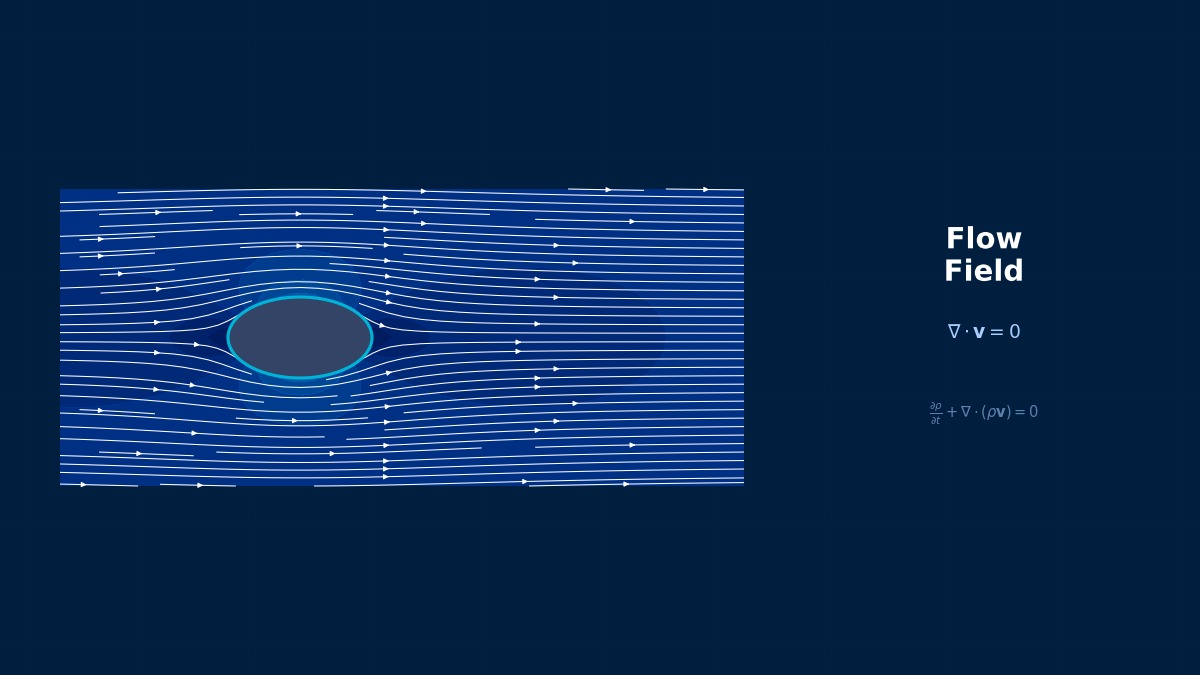
Heat Exchanger CFD: Theoretical Foundations
Overview
Teacher! What is the purpose of performing CFD analysis on heat exchangers? Are manual calculation methods like the NTU method or LMTD method insufficient?
Manual calculation methods (LMTD, ε-NTU) are effective for estimating overall performance, but local phenomena such as flow maldistribution in tube bundles, dead zones around baffles, and temperature distribution non-uniformity cannot be evaluated without CFD.
Governing Equations
Please tell me the fundamental equations for heat exchanger CFD.
Solve flow and heat transfer in a coupled manner. It's Navier-Stokes + the energy equation.
The fundamental equations for overall performance evaluation are the LMTD method and the ε-NTU method.
$U$ is the overall heat transfer coefficient, and $A$ is the heat transfer area, right? In CFD, do we back-calculate these from the simulation results?
Yes. Calculate $Q$ from the inlet/outlet temperatures obtained by CFD, then back-calculate $U$ from that and compare it with the design value.
Heat Exchanger Type-Specific Modeling
Does the analysis method differ between shell & tube and plate type?
They differ significantly. For shell & tube, the flow outside the tubes is complex and the influence of baffles is large. For plate type, the flow and heat transfer inside the channels are dominant.
| Type | CFD Model | Main Evaluation Items |
|---|---|---|
| Shell & Tube | Tube Bank + Baffle | Shell-side flow maldistribution, dead zones |
| Plate Type | Periodic model of one channel | Heat transfer enhancement effect of corrugated plates |
| Fin-tube (Air Conditioning) | Periodic model of one row | Fin Efficiency, Condensation |
| Double Pipe | Full 3D | Flow pattern (counterflow/parallel flow) |
Shell & Tube Porous Media Approach
Modeling every single tube in a shell & tube type is tough, right?
Meshing hundreds to thousands of tubes individually is unrealistic. In practice, the tube bundle is modeled as a porous media + distributed resistance.
The pressure drop in a tube bank is expressed by correlation formulas corresponding to the tube arrangement. For in-line arrangement:
$N_r$ is the number of tube rows, $\chi$ is the arrangement correction factor, and $f$ is the friction coefficient, right? $V_{max}$ is the velocity at the minimum cross-section.
The correlation by Zukauskas (1972) is widely used. This is converted into porous media resistance parameters and input into the CFD.
Practical Considerations
What should I be especially careful about in heat exchanger CFD?
- Temperature dependence of fluid properties (viscosity is greatly affected by temperature)
- Wall heat transfer and conjugate heat transfer between fluid and solid
- Modeling of leakage gaps in baffles (gap between tube and baffle hole)
- Entry effects in tube bundles (heat transfer coefficient is high in the first few rows)
Establishment of Heat Exchanger Theory—The Birth of LMTD and ε-NTU Methods (1940s)
The "LMTD (Logarithmic Mean Temperature Difference) method" and "ε-NTU (Effectiveness-Number of Transfer Units) method," still used today as thermal design theories for heat exchangers, were systematized in the 1940s by Mason (1954) and Kays & London (1964), among others. In particular, Kays & London's classic book "Compact Heat Exchangers" compiled experimental data for St (Stanton number) and f (friction factor) for hundreds of types of heat sink/fin geometries, becoming the bible for compact heat exchanger design. These experimental correlations are still used today, 50 years later, to check the validity of CFD results. If the Nu and f calculated by CFD deviate by more than 20% from the Kays-London correlations, it's a sign that there is a problem with the mesh or boundary conditions.
Computational Methods for Heat Exchanger CFD
Details of Numerical Methods
Please tell me the specific setup methods for heat exchanger CFD.
Let me explain the settings according to the modeling approach.
Approach 1: Full Geometry (Small Scale / Detailed Evaluation)
The approach of meshing each tube individually, right?
For double pipe or small heat exchangers with 20 tubes or less, full geometry is possible. Mesh the tube wall as a solid domain and couple the fluid and solid using Conjugate Heat Transfer (CHT).
Setup Procedure:
1. Define fluid domains (inside tube, outside tube) and solid domain (tube wall) separately
2. Set Coupled Wall condition at fluid-solid interfaces
3. Turbulence Model: Realizable k-ε + Enhanced Wall Treatment (outside tube)
4. Energy Equation: ON
5. Property Values: Temperature dependent (especially viscosity)
| Parameter | Tube Side | Shell Side |
|---|---|---|
| Turbulence Model | Realizable k-ε | SST k-ω (if there is flow separation at baffles) |
| y+ | ≈ 1 | ≈ 1 to 30 |
| Mesh | O-grid + prism layers | Tetrahedral + prism layers |
Approach 2: Porous Media Model (Large Scale / Overall Evaluation)
The method of treating the tube bundle as a porous body, right?
Use Fluent's Heat Exchanger Model (Macro Model). Treat the shell side as a porous media, and calculate tube bundle resistance and heat transfer with a sub-model.
Required Input Data:
- Tube outer diameter, tube pitch, tube arrangement pattern (in-line, staggered)
- Tube-side flow rate and inlet temperature
- Shell-side heat transfer correlation (Zukauskas, Kern, Bell-Delaware, etc.)
- Number of baffles, spacing, cut ratio
Can we directly input the Bell-Delaware method parameters?
Fluent's Heat Exchanger Model internally calculates correction factors based on the Bell-Delaware method. The user only needs to specify the baffle geometry.
Conjugate Heat Transfer (CHT) Settings
What should I be careful about in CHT calculations?
- Match the mesh at fluid-solid interfaces (non-conformal is possible but accuracy decreases)
- At least 3 layers of mesh in the solid (in the tube wall thickness direction)
- For high thermal conductivity materials like copper or aluminum, temperature gradients within the solid are small, so a coarse solid mesh is acceptable
- For stainless steel, wall temperature distribution is important, so use a finer solid mesh
| Material | Thermal Conductivity [W/(m K)] | Solid Mesh |
|---|---|---|
| Copper | 385 | Coarse is acceptable (3 layers) |
| Aluminum | 205 | Coarse is acceptable (3 layers) |
| Stainless Steel | 16 | Somewhat fine (5-8 layers) |
| Titanium | 22 | Somewhat fine (5-8 layers) |
Convergence Criterion
What should I look at for convergence criteria in heat exchanger CFD?
In addition to residuals, confirm that the following physical quantity monitors have reached a steady state.
- Outlet temperatures for tube side and shell side
- Heat exchange rate Q (inlet enthalpy - outlet enthalpy)
- Difference between tube-side and shell-side Q within 1% (energy balance)
If the Q for the tube side and shell side don't match, it means energy isn't conserved, right?
Exactly. Energy balan...
Related Topics
Related SimulatorsExperience the theory firsthand with the interactive simulator for this field
All Simulators
Rate this articleThank you for your feedback!HelpfulMore detailsReport error
What should I look at for convergence criteria in heat exchanger CFD?
In addition to residuals, confirm that the following physical quantity monitors have reached a steady state.
- Outlet temperatures for tube side and shell side
- Heat exchange rate Q (inlet enthalpy - outlet enthalpy)
- Difference between tube-side and shell-side Q within 1% (energy balance)
If the Q for the tube side and shell side don't match, it means energy isn't conserved, right?
Exactly. Energy balan...
Related Topics
Experience the theory firsthand with the interactive simulator for this field
All Simulators