Mechanical Joining of Composite Materials
Category: 構造解析 | Integrated 2026-04-06
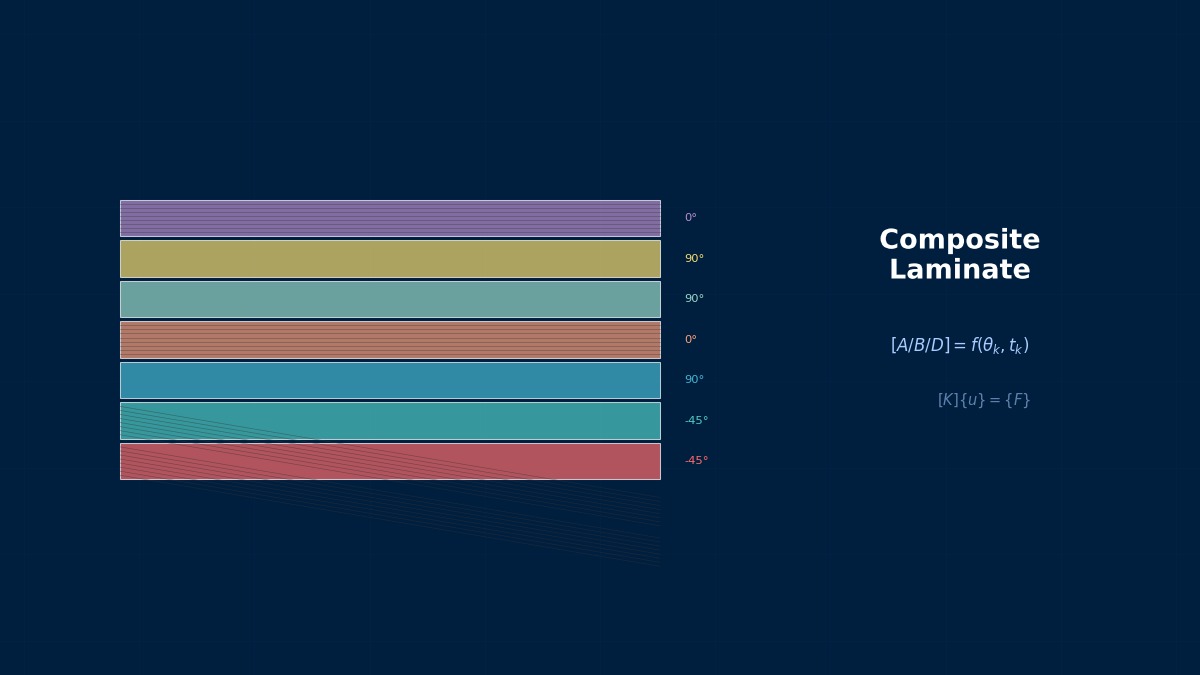
CAE visualization for composite joint theory - technical simulation diagram
複合材料の機械的接合

Theory and Physics

Bolted Joints in Composite Materials

🧑‍🎓

Professor, how is bolting composite materials different from metals?


🎓

They are fundamentally different. Metals yield around the bolt hole, allowing stress redistribution, but composite materials fail in a brittle manner. Since load redistribution through yielding cannot be expected, stress concentration at the bolt hole directly leads to failure.


Failure Modes of Bolted Joints in Composites

🎓

Four primary failure modes:


ModeCharacteristicsRisk Level
Bearing FailureCrushing around the bolt holeDesirable (Progressive)
Net-Tension FailureTensile fracture at the bolt hole cross-sectionDangerous (Sudden)
Shear-Out FailureShear splitting from the bolt hole to the edgeDangerous (Sudden)
Cleavage FailureSplitting longitudinally from the bolt holeDangerous (Sudden)
🧑‍🎓

Bearing failure is "desirable"?


🎓

Bearing failure involves progressive crushing around the hole, so it does not lead to sudden collapse. In design, dimensions are determined so that bearing failure occurs first. Net-tension and shear-out failures are sudden and should be avoided.


Design Parameters

🎓

Joint dimensional parameters:


  • $e/d$ — Edge distance/Bolt diameter ratio. $e/d \geq 3$ to avoid shear-out
  • $w/d$ — Plate width/Bolt diameter ratio. $w/d \geq 5$ to avoid net-tension
  • $t/d$ — Plate thickness/Bolt diameter ratio. $t/d \leq 1$ to ensure bearing strength

🧑‍🎓

Is $e/d \geq 3$ the same rule as for metals?


🎓

Metals are sufficient with $e/d \geq 2$, but composites are brittle, so $e/d \geq 3$ is required. It also depends on the layup configuration; if the layup is not well-balanced like $[0/\pm45/90]$, an even larger $e/d$ is needed.


Modeling in FEM

🎓

Level 1 (Simple): Represent bolt with spring elements

Level 2 (Intermediate): Beam elements + contact surfaces

Level 3 (Detailed): Solid elements for bolt + hole + Pretension + Contact + PDA


🧑‍🎓

Level 3 seems very complex.


🎓

Level 3 FEM simulates the bearing failure process (hole crushing → matrix cracking → fiber kinking → final failure). Often performed using Abaqus Hashin + CZM.


Summary

🧑‍🎓

Let me organize the theory of bolted joints in composites.


🎓

Key points:


  • Composites exhibit brittle failure — No load redistribution through yielding
  • Four failure modes — Bearing (progressive), Net-tension/Shear-out/Cleavage (sudden)
  • Design for bearing failure to occur first — $e/d \geq 3, w/d \geq 5$
  • Reproduce bearing failure with Level 3 FEM — Hashin + CZM + Contact
  • Layup configuration greatly influences joint strength — Well-balanced layup is essential

Coffee Break Yomoyama Talk

Non-Uniform Load Distribution in Composite Joints

In bolted composite joints, load concentrates on the end bolts, causing "Load sharing imbalance." According to Hart-Smith's analysis (1980s), in a three-bolt shear joint, the end bolts carry 45-55% of the total load. This non-uniformity varies with the in-plane elastic modulus of the laminate and the joint geometry. Detailed load distribution calculations via FEM can determine the optimal configuration.

Physical Meaning of Each Term
  • Inertia Term (Mass Term): $\rho \ddot{u}$, i.e., "mass × acceleration". Have you ever experienced being thrown forward during sudden braking? That "feeling of being carried away" is precisely the inertial force. Heavier objects are harder to set in motion and harder to stop once moving. Buildings shake during earthquakes because the ground moves suddenly while the building's mass "gets left behind." In static analysis, this term is set to zero, assuming "forces are applied slowly enough to ignore acceleration." It cannot be omitted for impact loads or vibration problems.
  • Stiffness Term (Elastic Restoring Force): $Ku$ or $\nabla \cdot \sigma$. When you stretch a spring, you feel a "force trying to return," right? That's Hooke's law $F=kx$, the essence of the stiffness term. So, a question—if you pull an iron rod and a rubber band with the same force, which stretches more? Obviously, the rubber band. This "resistance to stretching" is the Young's modulus $E$, which determines stiffness. A common misconception: "High stiffness = strong" is incorrect. Stiffness is "resistance to deformation," strength is "resistance to failure"—they are different concepts.
  • External Force Term (Load Term): Body forces $f_b$ (e.g., gravity) and surface forces $f_s$ (pressure, contact forces). Think of it this way—the weight of a truck on a bridge is a "force acting on the entire volume" (body force), while the force of the tires pushing on the road is a "force acting only on the surface" (surface force). Wind pressure, water pressure, bolt tightening force... all are external forces. A common mistake here: getting the load direction wrong. Intending "tension" but applying "compression"—sounds like a joke, but it actually happens when coordinate systems are rotated in 3D space.
  • Damping Term: Rayleigh damping $C\dot{u} = (\alpha M + \beta K)\dot{u}$. Try plucking a guitar string. Does the sound continue forever? No, it gradually fades. That's because vibrational energy is converted to heat by air resistance and internal friction in the string. Car shock absorbers work on the same principle—they intentionally absorb vibrational energy for a smoother ride. What if damping were zero? Buildings would keep swaying forever after an earthquake. Since that doesn't happen in reality, setting appropriate damping is crucial.
Assumptions and Applicability Limits
  • Continuum assumption: Treat material as a continuous medium, ignoring microscopic heterogeneity
  • Small deformation assumption (for linear analysis): Deformation is sufficiently small compared to initial dimensions, and stress-strain relationship is linear
  • Isotropic material (unless specified otherwise): Material properties are direction-independent (anisotropic materials require separate tensor definitions)
  • Quasi-static assumption (for static analysis): Ignore inertial and damping forces, consider only equilibrium between external and internal forces
  • Non-applicable cases: Large deformation/large rotation problems require geometric nonlinearity. Nonlinear material behavior like plasticity or creep requires constitutive law extensions
Dimensional Analysis and Unit Systems
VariableSI UnitNotes / Conversion Memo
Displacement $u$m (meter)When inputting in mm, unify loads and elastic modulus to MPa/N system
Stress $\sigma$Pa (Pascal) = N/m²MPa = 10⁶ Pa. Be careful of unit inconsistency when comparing with yield stress
Strain $\varepsilon$Dimensionless (m/m)Note the distinction between engineering strain and logarithmic strain (for large deformations)
Elastic Modulus $E$PaSteel: ~210 GPa, Aluminum: ~70 GPa. Note temperature dependence
Density $\rho$kg/m³In mm system: tonne/mm³ (= 10⁻⁹ tonne/mm³ for steel)
Force $F$N (Newton)Unify as N in mm system, N in m system

Numerical Methods and Implementation

Detailed FEM Model for Bolted Joints

🧑‍🎓

Please explain the detailed FEM model for bolted joints in composites.


Model Configuration

  • Plate: Solid elements (C3D8I or SC8R). Define layup by layers
  • Bolt: Solid elements or rigid body (depending on analysis purpose)
  • Bolt-hole contact: Contact with friction. Also consider clearance
  • Plate-plate contact: Friction at the clamping surface. Clamping from pretension
  • Damage model: Hashin (in-plane damage) + CZM (Delamination)
🧑‍🎓

Do you include clearance too?


🎓

Bolt hole clearance (gap between bolt diameter and hole) affects bearing load distribution. Results differ between precision-fit holes (interference fit) and standard holes (0.1~0.3 mm clearance).


Mesh Requirements

🎓
  • Around hole: Element size 0.5~1 mm
  • Through thickness: Minimum 1 element per layer (solid) or layered shell
  • Bolt: Can be coarse (or even rigid)

  • Solver Settings

    🎓

    Abaqus setting example (bearing failure simulation):


    ```

    *STEP, NLGEOM=YES, INC=1000

    *STATIC

    0.01, 1.0, 1e-10, 0.02

    *CONTACT

    ...

    *DAMAGE INITIATION, CRITERION=HASHIN

    ...

    *DAMAGE EVOLUTION, TYPE=ENERGY

    ...

    ```


    🧑‍🎓

    Nonlinear static analysis (Contact + damage). Seems computationally heavy.


    🎓

    A full model for a single-bolt joint has several hundred thousand DOF. Computation time ranges from several hours to days. Multi-bolt joints are even larger.


    Summary

    🧑‍🎓

    Let me organize the numerical methods for bolted joints in composites.


    🎓

    Key points:


    • Solid elements + Contact + PDA — Standard configuration for detailed models
    • Modeling clearance — Affects bearing load distribution
    • Mesh around hole: 0.5~1 mm — Captures damage localization
    • High computational cost — Several hours for one bolt
    • Abaqus Hashin + CZM is standard — Reproduces bearing failure

    Coffee Break Yomoyama Talk

    FEM Evaluation of Stress Concentration Around CFRP Bolt Holes

    Strength evaluation of composite bolted joints uses the Point Stress Criterion (PSC) or Average Stress Criterion (ASC). PSC compares the stress at a point a characteristic material distance D₀ away from the hole edge with the material strength to predict failure. D₀ is typically around 1.5~3.5mm for CFRP T300/5208. Calibrating this parameter from experiments and inputting it into FEM can achieve bolt hole strength prediction accuracy within ±10%.

    Linear Elements (1st Order Elements)

    Linear interpolation between nodes. Low computational cost but low stress accuracy. Beware of shear locking (mitigated with reduced integration or B-bar method).

    Quadratic Elements (with Midside Nodes)

    Can represent curved deformation. Stress accuracy improves significantly, but DOFs increase by about 2-3 times. Recommended when stress evaluation is critical.

    Full Integration vs Reduced Integration

    Full Integration: Risk of over-constraint (Locking). Reduced Integration: Risk of hourglass modes (zero-energy modes). Choose appropriately.

    Adaptive Mesh

    Automatic refinement based on error indicators (e.g., ZZ estimator). Efficiently improves accuracy in stress concentration areas. Includes h-method (element subdivision) and p-method (order increase).

    Newton-Raphson Method

    Standard method for nonlinear analysis. Updates tangent stiffness matrix every iteration. Quadratic convergence within convergence radius, but computationally expensive.

    Modified Newton-Raphson Method

    Updates tangent stiffness matrix using initial value or every few iterations. Cost per iteration is low, but convergence is linear.

    関連シミュレーター

    この分野のインタラクティブシミュレーターで理論を体感しよう

    シミュレーター一覧

    関連する分野

    この記事の評価
    ご回答ありがとうございます!
    参考に
    なった
    もっと
    詳しく
    誤りを
    報告
    参考になった
    0
    もっと詳しく
    0
    誤りを報告
    0
    Written by NovaSolver Contributors
    Anonymous Engineers & AI — サイトマップ