20節点六面体要素(HEX20)

Category: 構造解析 | Integrated 2026-04-06
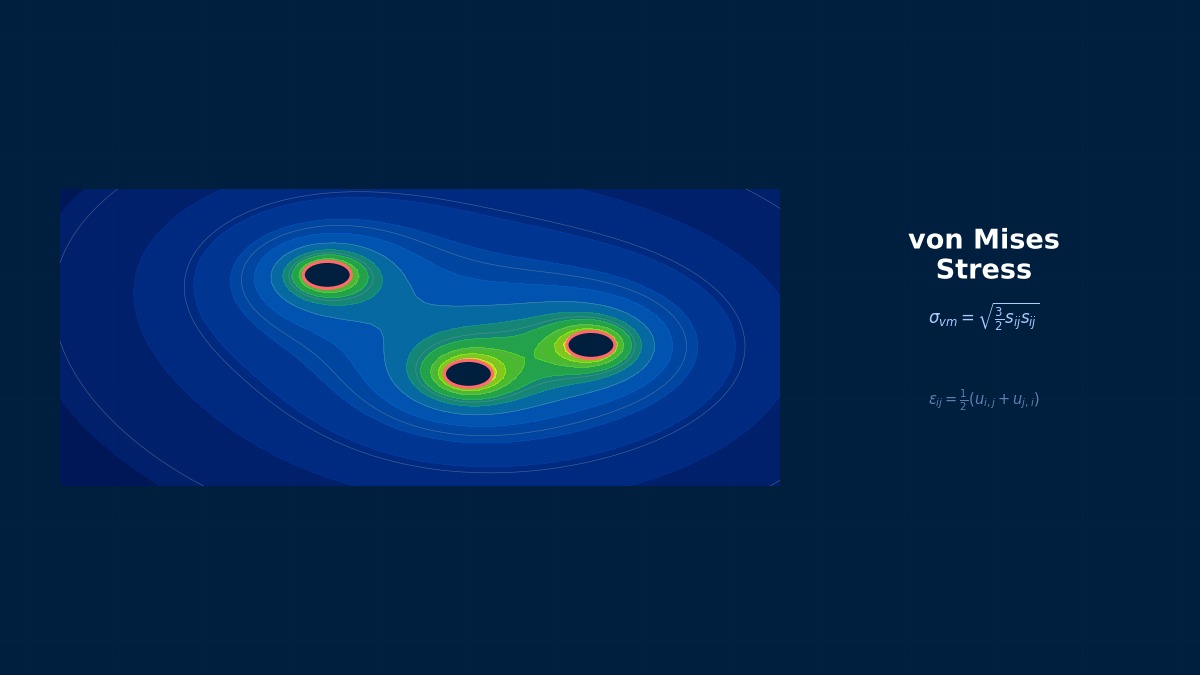
CAE visualization for hex20 element theory - technical simulation diagram
20節点六面体要素(HEX20)

Theory and Physics

HEX20 — The Highest Accuracy 3D Element

🧑‍🎓

Is HEX20 the most accurate 3D element in FEM?


🎓

It can be said to be the most accurate among practical elements. It is a 20-node quadratic hexahedral element, with 3 degrees of freedom per node, totaling 60 DOF. It has 2.5 times the DOF of HEX8 (24 DOF), but its accuracy is orders of magnitude higher.


Shape Functions

🎓

HEX20 has 8 vertex nodes and 12 edge mid-point nodes. The shape functions are of the serendipity type:


Vertex nodes:

$$ N_i = \frac{1}{8}(1+\xi_i\xi)(1+\eta_i\eta)(1+\zeta_i\zeta)(\xi_i\xi+\eta_i\eta+\zeta_i\zeta-2) $$

Edge mid-point nodes (e.g., $\xi_i = 0$):

$$ N_i = \frac{1}{4}(1-\xi^2)(1+\eta_i\eta)(1+\zeta_i\zeta) $$

🧑‍🎓

What is the Serendipity type? Is it different from the Lagrange type?


🎓

The Lagrange type (27-node HEX) has nodes on faces and inside, while the Serendipity type (20-node HEX) has mid-side nodes only on edges, with no nodes at face centers or inside. The Serendipity type has nearly equivalent accuracy to the Lagrange type with fewer DOF, making it overwhelmingly more common in practice.


Accuracy of HEX20

🧑‍🎓

How accurate is HEX20?


🎓

Comparison with TET10:


Accuracy for the same DOF countHEX20TET10
DisplacementVery HighHigh
StressVery HighHigh
Efficiency (Accuracy per DOF)Highest50–70% of HEX20
  • Displacement: $O(h^4)$ (HEX20) vs. $O(h^3)$ (TET10)
  • Stress: $O(h^3)$ (HEX20) vs. $O(h^2)$ (TET10)

🧑‍🎓

HEX20 converges one order faster. It achieves comparable accuracy even with a mesh twice as coarse...


🎓

Therefore, for geometries where HEX meshing is possible, HEX20 is the most efficient. The problem is the effort required for mesh generation. This trade-off between "accuracy efficiency vs. mesh generation cost" is the essence of choosing between HEX20 and TET10.


Integration Scheme

🎓

Integration for HEX20:


IntegrationGauss PointsCharacteristics
Full Integration (3×3×3)27Highest accuracy. Low risk of locking
Reduced Integration (2×2×2)8Avoids shear locking. Hourglassing is 1 mode
🧑‍🎓

Reduced integration for HEX20 is 2×2×2 = 8 points? That's the same number as full integration for HEX8.


🎓

Yes. Reduced integration for HEX20 (C3D20R) uses the same 8 integration points as full integration for HEX8, but delivers far higher accuracy. C3D20R is considered one of the most efficient elements in 3D FEM.


🧑‍🎓

Does C3D20R have hourglassing issues?


🎓

Reduced integration for HEX20 has only one hourglass mode. This is extremely few compared to the 12 modes of HEX8R, posing almost no problem in practice. However, caution is needed for single-element patch tests.


When to Use HEX20

🧑‍🎓

In what situations should HEX20 be used?


🎓
  • When highest accuracy is required — Benchmark verification, precise stress evaluation
  • When stress distribution through thickness is important — Stress classification in pressure vessels
  • For precise evaluation of contact problems — Pressure distribution on contact surfaces
  • For geometries where mesh generation is easy — Revolved bodies, extruded bodies

  • 🧑‍🎓

    Conversely, in what situations is HEX20 disadvantageous?


    🎓
    • Complex geometries — Automatic HEX meshing is difficult. TET10 is more practical
    • Large deformation analysis — HEX20 is sensitive to distortion (mid-side nodes are prone to movement)
    • Explicit analysis — High DOF count leads to smaller stable time increments. HEX8R is more efficient

    • Summary

      🧑‍🎓

      Let me organize the theory of HEX20.


      🎓

      Key points:


      • 20 nodes, Serendipity type, quadratic hexahedron — Highest accuracy among practical 3D elements
      • C3D20R (reduced integration) is highly recommended — 8 integration points for maximum efficiency
      • Fast convergence — One order faster than TET10
      • Mesh generation is a challenge — Automatic HEX is difficult. Suitable for sweep/mapped meshing
      • Not suitable for large deformation or explicit analysis — HEX8R or TET10 are more stable

      🧑‍🎓

      So HEX20 is "the best element if you can create it," right?


      🎓

      Exactly. There is a wall of mesh generation between "the highest accuracy" and "if you can create it." For engineers who can overcome this wall, HEX20 is the most powerful weapon.


      Coffee Break Trivia

      Theoretical Superiority of Quadratic Hexahedral Elements

      The 20-node hexahedral element (Serendipity element) is a masterpiece of isoparametric formulation proposed by Ergatoudis et al. in 1966. Its shape functions, which include complete quadratic polynomials, provide nearly 8 times the stress accuracy within an element compared to linear elements. Adopted in structural analysis for space agencies since NASA's Apollo program in the 1970s, it was once called the "gold standard element."

      Physical Meaning of Each Term
      • Inertia term (mass term): $\rho \ddot{u}$, meaning "mass × acceleration". Have you ever experienced being thrown forward when slamming on the brakes? That "feeling of being carried away" is precisely the inertial force. Heavier objects are harder to set in motion and harder to stop once moving. Buildings shake during earthquakes because the ground moves suddenly while the building's mass "gets left behind". In static analysis, this term is set to zero, based on the assumption that "forces are applied slowly enough that acceleration can be ignored". It absolutely cannot be omitted for impact loads or vibration problems.
      • Stiffness term (elastic restoring force): $Ku$ or $\nabla \cdot \sigma$. When you pull a spring, you feel a "force trying to return it", right? That is Hooke's law $F=kx$, the essence of the stiffness term. Now a question — an iron rod and a rubber band, which stretches more under the same force? Obviously the rubber. This "resistance to stretching" is the Young's modulus $E$, which determines stiffness. A common misconception: "High stiffness ≠ strong". Stiffness is "resistance to deformation", strength is "resistance to failure" — they are different concepts.
      • External force term (load term): Body forces $f_b$ (e.g., gravity) and surface forces $f_s$ (e.g., pressure, contact forces). Think of it this way — the weight of a truck on a bridge is a "force acting on the entire volume" (body force), while the force of the tires pushing on the road surface is a "force acting only on the surface" (surface force). Wind pressure, water pressure, bolt tightening force... all are external forces. A common mistake here: getting the load direction wrong. Intending "tension" but ending up with "compression" — it sounds like a joke, but it actually happens when coordinate systems are rotated in 3D space.
      • Damping term: Rayleigh damping $C\dot{u} = (\alpha M + \beta K)\dot{u}$. Try plucking a guitar string. Does the sound continue forever? No, it gradually fades. That's because the vibration energy is converted to heat by air resistance and internal friction in the string. Car shock absorbers work on the same principle — they deliberately absorb vibration energy to improve ride comfort. What if damping were zero? Buildings would continue shaking forever after an earthquake. Since that doesn't happen in reality, setting appropriate damping is important.
      Assumptions and Applicability Limits
      • Continuum assumption: Treats material as a continuous medium, ignoring microscopic heterogeneity
      • Small deformation assumption (for linear analysis): Deformation is sufficiently small compared to initial dimensions, and the stress-strain relationship is linear
      • Isotropic material (unless otherwise specified): Material properties are independent of direction (anisotropic materials require separate tensor definitions)
      • Quasi-static assumption (for static analysis): Ignores inertial and damping forces, considering only the balance between external and internal forces
      • Non-applicable cases: For large deformation/large rotation problems, geometric nonlinearity is required. For plasticity, creep, and other nonlinear material behaviors, constitutive law extensions are needed
      Dimensional Analysis and Unit Systems
      VariableSI UnitNotes / Conversion Memo
      Displacement $u$m (meter)When inputting in mm, unify loads and elastic modulus to MPa/N system
      Stress $\sigma$Pa (Pascal) = N/m²MPa = 10⁶ Pa. Be careful of unit inconsistency when comparing with yield stress
      Strain $\varepsilon$Dimensionless (m/m)Note the distinction between engineering strain and logarithmic strain (for large deformation)
      Elastic modulus $E$PaSteel: ~210 GPa, Aluminum: ~70 GPa. Note temperature dependence
      Density $\rho$kg/m³In mm system: tonne/mm³ (= 10⁻⁹ tonne/mm³ for steel)
      Force $F$N (Newton)Unify as N in mm system, N in m system

      Numerical Methods and Implementation

      C3D20R — The Most Efficient 3D Element

      🧑‍🎓

      Please explain why C3D20R (Abaqus's HEX20 reduced integration) is considered "the most efficient".


      🎓

      There are three reasons:


      1. Highest accuracy/DOF ratio — 2–3 times more accurate than TET10 for the same DOF count

      2. No shear locking — Avoided by reduced integration

      3. Minimal volumetric locking — No problem up to about $\nu = 0.49$


      🧑‍🎓

      So C3D20R (reduced integration) is recommended over C3D20 (full integration).


      🎓

      C3D20 uses 27 integration points, resulting in high computational cost, and can show signs of volumetric locking for materials with high $\nu$. C3D20R uses 8 integration points, is faster to compute, and has less locking. In practice, C3D20R is overwhelmingly more common.


      Element Names by Solver

      VariationAbaqusNastranAnsys
      Full IntegrationC3D20CHEXA(20)SOLID186(full)
      Reduced IntegrationC3D20RSOLID186(red.)
      HybridC3D20H, C3D20RHu-P formulation
      🧑‍🎓

      Does Nastran's CHEXA(20) not have a reduced integration option?


      🎓

      Nastran's CHEXA(20) uses 2×2×2 (reduced) integration by default. There is an option to switch to full integration, but the default is reduced. So, Nastran's CHEXA(20) ≈ Abaqus's C3D20R.


      Handling of Mid-Side Nodes

      🧑‍🎓

      HEX20's mid-side nodes are at the midpoints of edges, but for curved surfaces, they should be snapped to the CAD, right?


      Related Topics

      関連シミュレーター

      この分野のインタラクティブシミュレーターで理論を体感しよう

      シミュレーター一覧

      関連する分野

      この記事の評価
      ご回答ありがとうございます!
      参考に
      なった
      もっと
      詳しく
      誤りを
      報告
      参考になった
      0
      もっと詳しく
      0
      誤りを報告
      0
      Written by NovaSolver Contributors
      Anonymous Engineers & AI — サイトマップ