Modeling of Latent Heat Effects
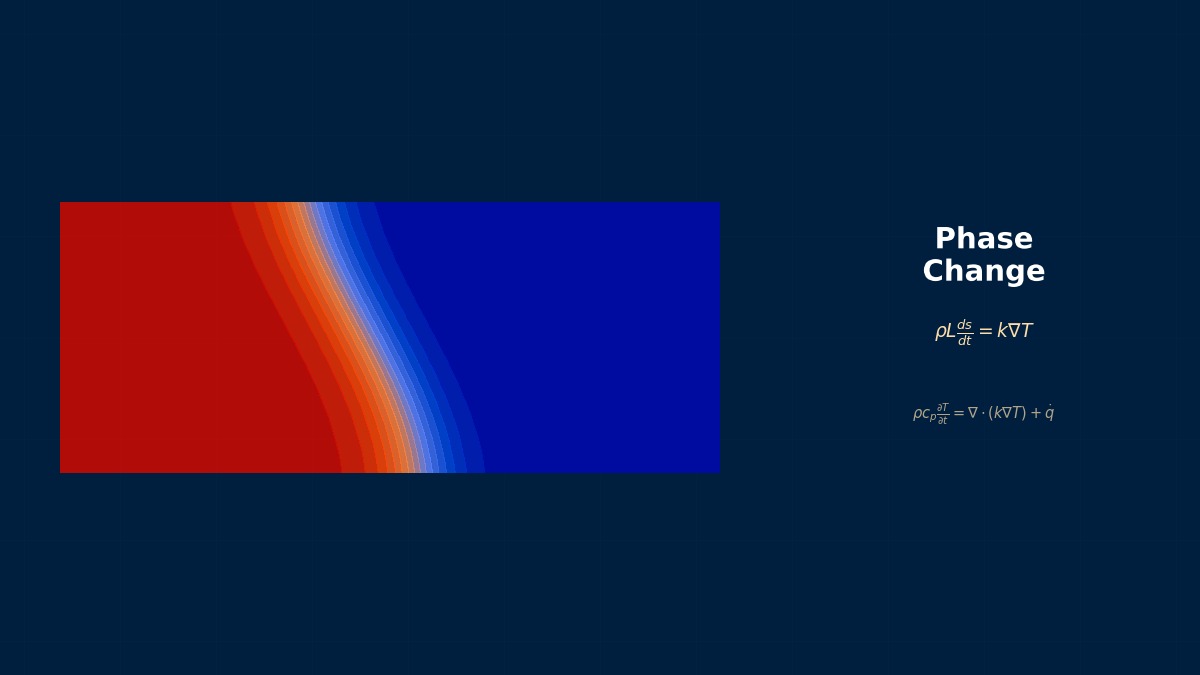
Theory: heat that flows without changing temperature
Overview
In a thermal analysis of a heat-storage material, results change a lot with time step once the melting point is crossed. Is my latent-heat setup wrong?
Probably how latent heat is entered. When water freezes it stays at 0 °C while releasing 334 kJ per kg — about as much heat as cooling water by 80 K. Ordinary thermal solvers, with temperature as the unknown, struggle with heat flowing at constant temperature, so they approximate it with a specific-heat peak around the melting point. If a time step jumps over that peak, latent heat drops out of the calculation.
Apparent-heat-capacity method
Latent heat $L$ is spread as specific heat over a range $\Delta T_m$ below the melting point $T_m$. Natural for alloys that solidify over a range, artificial for pure substances. A narrower range is more realistic, but a step that jumps across it omits the latent heat.
Enthalpy method
$H$ is enthalpy per unit mass and $f_l$ liquid fraction. Solving for heat content as the conserved variable means latent heat is not lost even if a step crosses the melting point. The kinked temperature–enthalpy relation needs iteration, but the latent heat is preserved.
Exact solution for verification (Stefan problem)
$s$ is frozen-layer thickness, $\alpha$ solid thermal diffusivity and $Ste$ the Stefan number (sensible to latent heat ratio). This exact solution for one-sided freezing from a constant-temperature wall is the benchmark for checking latent-heat handling.
A problem that began with Arctic sea ice
The Stefan problem is named after the Austrian physicist Stefan, who around 1889 analysed how fast polar sea ice thickens; expedition records had already shown ice thickness growing with the square root of time. Problems in which the boundary itself moves as an unknown are mathematically awkward, and the same form appears in freezing, casting, welding, crystal growth and even food freezing. The enthalpy method, which avoids tracking the boundary, spread as a computational approach in the 1970s.
Worked example: freezing water
Example 1: exact solution
Water at 0 °C freezing from a −10 °C wall (ice conductivity 2.2 W/(m·K), specific heat 2,100 J/(kg·K), latent heat 334 kJ/kg). The Stefan number is a small 0.063, so latent heat dominates.
| Time | Ice thickness (exact) | Quasi-steady estimate |
|---|---|---|
| 1 h | 22.5 mm | 22.7 mm |
| 6 h | 55.1 mm | 55.7 mm |
| 24 h | 110.3 mm | 111.4 mm |
Thickness grows with the square root of time, so going from 6 to 24 hours only doubles it. With a small Stefan number, the quasi-steady estimate treating the ice temperature profile as linear is within about 1%.
Example 2: comparing the two methods
The same problem solved in 1D with a 1 mm grid and an implicit scheme, comparing ice thickness after 6 hours (exact 55.1 mm). Apparent heat capacity was evaluated at each step's starting temperature.
| Time step | Enthalpy | Apparent cp, 2 K range | 0.5 K range | 0.1 K range |
|---|---|---|---|---|
| 10 s | 54.6 mm | 53.8 mm | 54.4 mm | 54.4 mm |
| 60 s | 54.6 mm | 53.6 mm | 53.8 mm | 52.9 mm |
| 600 s | 54.6 mm | 52.3 mm | 48.4 mm | 42.4 mm |
Narrowing the range to be more realistic actually makes things worse with a large step.
Right. With a 0.1 K range, a grid point's temperature sweeps straight through it in 600 s, never properly sitting on the latent-heat peak. When the latent-heat bookkeeping goes wrong, whether the error comes out thick or thin depends on the implementation and how heat capacity is evaluated; here it came out thin. Either way, results that change with time step are the telltale sign of skipped latent heat. The enthalpy method stays at 54.6 mm even with a 60-fold larger step. If you use apparent heat capacity, check that the temperature change per step is well below the range.
How to approach the analysis
Checks
- Confirm how the software handles latent heat (apparent heat capacity or enthalpy).
- Set grid and time step against an exact solution such as the Stefan problem.
- Halve the time step and confirm results don't change.
- Check the global energy balance: heat in = change in sensible + latent heat.
Cautions
- Alloy freezing range: alloys solidify over a range; take liquid fraction versus temperature from material data.
- Supercooling: water and PCMs may stay liquid below the melting point, then rebound in temperature once freezing starts.
- Volume change and convection: expansion on freezing and natural convection in the liquid need separate modelling where relevant.
“The PCM stores less heat than expected”
An analysis of a PCM cool box predicted longer holding time than the experiment. The latent-heat peak had been spread over a wide temperature range, so latent heat acted at temperatures where the material had not yet begun to melt. Too narrow a range, conversely, gets skipped by the time step. Reading how much heat is absorbed at each temperature from differential scanning calorimetry (DSC) data and entering that shape directly is the reliable approach. When comparing with experiments, compare cumulative absorbed heat, not just temperature, to see the cause.
Common mistakes
Mistakes and fixes
| Mistake | Effect | Fix |
|---|---|---|
| Narrow range with large steps | Latent heat skipped | Widen range or use enthalpy |
| No time-step sensitivity check | Error goes unnoticed | Halve and compare |
| Overly wide range | Premature melting | Enter DSC shape |
| Not checking energy balance | Missing latent heat undetected | Compare cumulative heat |
| Ignoring supercooling | Wrong freezing onset | Check experimentally, model if needed |
I'd like to try melting and freezing calculations myself.
Try the PCM melting simulator for PCM melting and the freeze-drying tool for freeze-drying. For details see the Stefan problem, the mushy zone, melting and solidification, phase-change materials and casting solidification.
Related Topics
Experience the theory firsthand with the interactive simulator for this field
All Simulators