Melting and Solidification Simulation
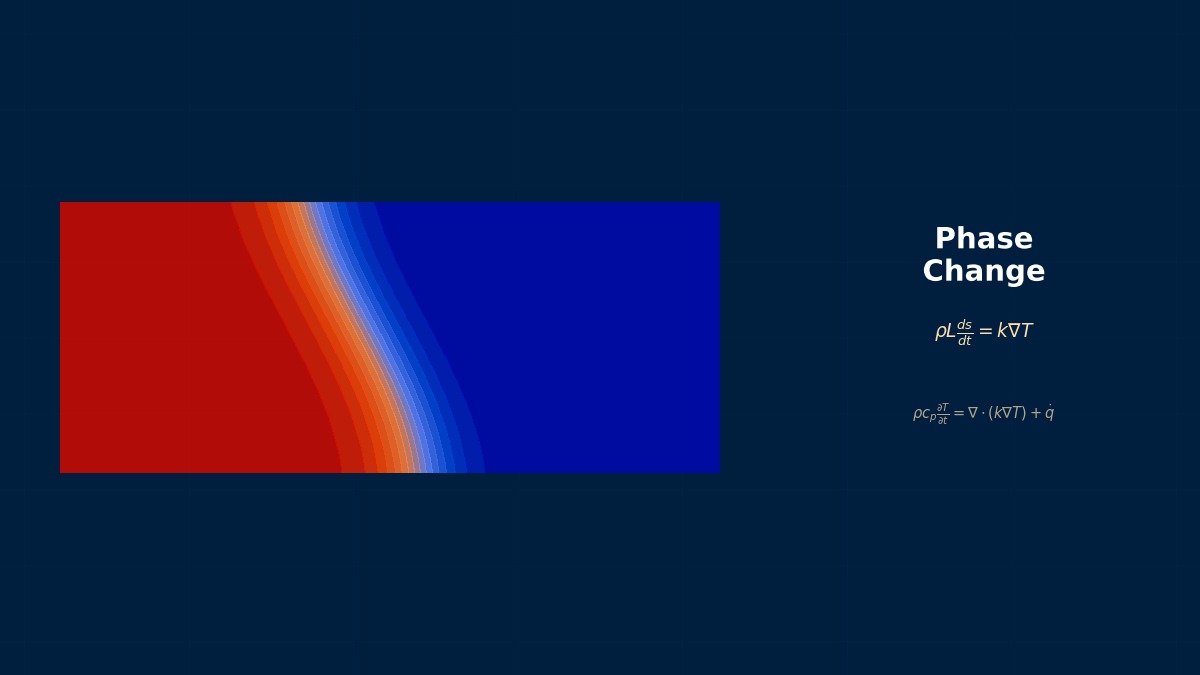
Theory: a moving interface and latent heat
Overview
How does melting/solidification differ from ordinary heat conduction?
Latent heat is absorbed or released at the solid–liquid boundary. At the melting point large amounts of heat flow without changing temperature, so the interface advances only as fast as that heat is removed. Its position is part of the answer, so the mesh can't be fitted to it. The enthalpy method computes each cell's energy (enthalpy) and derives liquid fraction and temperature from it, avoiding explicit interface tracking and extending directly to multiple dimensions. The standard check is the Stefan problem, which has an exact solution.
Neumann solution (one-phase Stefan problem)
The liquid is at the melting point and the wall held ΔT below it. c and α are the solid's specific heat and diffusivity, L latent heat. For small St, λ ≈ √(St/2) (quasi-steady approximation).
Enthalpy method
f_l is liquid fraction. For a pure substance it jumps from 0 to 1 at the melting point; for alloys it changes over a temperature range, forming the mushy zone.
From the thickness of Arctic ice
In 1889 Stefan formulated heat conduction with a moving interface while studying how fast polar sea ice thickens. Neumann is said to have presented the exact solution earlier in lectures, and it is now called the Neumann solution. Growth of the solid layer with the square root of time applies to sea ice, welding, casting and thermal storage alike, and it remains the first verification problem for numerical methods.
Worked examples
Example 1: time for the solid layer to grow
| Material | Wall undercooling | St | λ | 10 mm | 50 mm | 100 mm |
|---|---|---|---|---|---|---|
| Water (ice) | 10 K | 0.063 | 0.176 | 711 s | 4.9 h | 19.7 h |
| Aluminium | 300 K | 0.76 | 0.554 | 1.0 s | 26 s | 105 s |
| Paraffin (PCM) | 10 K | 0.10 | 0.220 | 57 min | 23.9 h | 95.6 h |
Ten times thicker takes 100 times longer. Aluminium's diffusivity is about 70 times ice's and its undercooling larger, so it is orders of magnitude faster (real moulds slow it through their own thermal resistance).
Example 2: verifying the enthalpy method (ice, 400 cells)
| Front position | Enthalpy method | Neumann | Difference |
|---|---|---|---|
| 10 mm | 710 s | 711 s | −0.1% |
| 50 mm | 17,762 s | 17,764 s | 0.0% |
Example 3: quasi-steady approximation error
| Material | St | λ error | Time to 100 mm (exact / approx.) |
|---|---|---|---|
| Water (ice) | 0.063 | +1.0% | 71,056 / 69,609 s |
| Paraffin | 0.10 | +1.6% | 344,302 / 333,333 s |
| Aluminium | 0.76 | +11.0% | 105 / 85 s |
So simple approximations fail when the Stefan number is large.
Right. The quasi-steady approximation assumes a linear temperature profile in the solid. With large latent heat and a slow interface, the solid's temperature settles first and it works well. At large Stefan numbers the sensible heat to cool the solid matters, the profile departs from linear, and the approximation predicts solidification too fast — 19% short for aluminium cooled 300 K. In casting that means underestimating solidification time and mispredicting shrinkage porosity. Numerical methods like the enthalpy method include this automatically, but grid and time step should be checked once against exact solutions like these.
Simulation workflow
- Compute the Stefan number to see whether latent or sensible heat dominates.
- Give liquid fraction over a narrow band for pure substances, solidus to liquidus for alloys.
- Where liquid convection matters, include flow resistance in the mushy zone.
- Verify grid and time step against exact solutions such as Neumann's.
- Choose models handling volume change (shrinkage) or undercooling if important.
“The storage tank only half melted”
A paraffin thermal store designed to melt fully overnight (10 hours) only half melted in practice. The design had used one enlarged conductivity for paraffin that included liquid convection. In reality the melt convected above the heat-transfer tubes but barely moved below them, where heat crossed at the solid's 0.24 W/mK. Melting 50 mm by conduction alone takes about 24 hours, roughly matching measurements. Adding fins to shorten conduction distances solved it.
Common mistakes
Mistakes and fixes
| Mistake | Effect | Fix |
|---|---|---|
| Quasi-steady at large St | Time underestimated | Neumann or numerics |
| Liquid-fraction band too narrow | Temperature oscillates | Spread over a few cells |
| Convection as uniform conductivity | Top–bottom difference missed | Solve the flow |
| Coarse grid | Front advances in steps | Check vs exact |
| Ignoring mould resistance | Solidification too fast | Include interface conductance |
I'd like to learn related topics.
Related pages include the Stefan problem, the enthalpy method, the mushy zone, phase-change materials (PCM) and casting solidification.
Related Topics
Experience the theory firsthand with the interactive simulator for this field
All Simulators