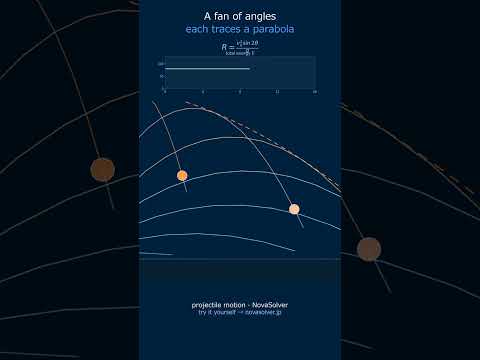
Freely set initial velocity, launch angle, height, and gravity to render ballistic trajectories in real time. Also simulate Moon, Mars, and Jupiter gravity environments.
Parameters
Presets
Initial velocity v₀
m/s
Launch angle θ
°
Launch height h
m
GravityAcceleration g
m/s²
Moon: 1.62 / Mars: 3.72 / Jupiter: 24.8
Air resistance
Drag coefficient Cd·A/m
Results
—
Range R [m]
—
Maximum Height H [m]
—
Flight time T [s]
—
Landing speed [m/s]
Visualization
Theory & Key Formulas
Decompose into horizontal and vertical components and solve analytically:
Maximum height: $t_{max}= \dfrac{v_0\sin\theta}{g}$, $H = h_0 + \dfrac{v_0^2\sin^2\theta}{2g}$
Landing time: $y(t_{land})=0$ Solve to get $R = v_0\cos\theta \cdot t_{land}$
With air resistance (linear drag): $m\ddot{\mathbf{r}}= m\mathbf{g}- k\mathbf{v}$, integrated numerically with RK4.
What is Projectile Motion?
🙋
What exactly is "projectile motion"? Is it just the path a thrown ball takes?
🎓
Basically, yes! It's the motion of any object launched into the air, subject only to gravity and air resistance. The key is that after launch, the only force (initially) is gravity pulling it down. In this simulator, you control the launch with the Initial velocity v₀ and Launch angle θ sliders. Try setting a high angle and see how the path changes.
🙋
Wait, really? So if I'm on the Moon, the ball would go much farther because gravity is weaker. How does the simulator show that?
🎓
Exactly right! That's the power of the GravityAcceleration g parameter. The preset buttons for Earth, Moon, and Mars instantly change this value. For instance, set the same velocity and angle on Earth and then click "Moon". You'll see the trajectory becomes a much wider arc because the downward pull is only about 1/6th as strong.
🙋
What about the "Air resistance" checkbox? In real life, a baseball is affected by air, right?
🎓
A great observation! In a perfect vacuum, the equations are simple. But in reality, air drag slows the projectile down, shortening its range. Turn on "Air resistance" in the simulator and increase the Drag coefficient Cd·A/m. You'll see the path is no longer a perfect parabola—it becomes asymmetrical and falls short. This is a crucial factor in CAE for accurate simulations, like calculating a rocket's trajectory.
Physical Model & Key Equations
The core idea is to split the motion into independent horizontal (x) and vertical (y) components. Without air resistance, the horizontal velocity is constant, while the vertical motion is under constant gravitational acceleration.
Where:
$v_0$ = Initial velocity (m/s)
$\theta$ = Launch angle (degrees)
$h_0$ = Launch height (m)
$g$ = Gravitational acceleration (m/s²)
$t$ = Time (s)
These are the equations plotted as the "Analytical Solution" in the simulator.
With air resistance, the motion becomes more complex. A drag force, proportional to the square of the velocity, acts opposite to the direction of motion. This requires numerical simulation (like the "Simulation" path in the tool), which is standard in engineering software.
$$F_d = \frac{1}{2} \rho C_d A v^2$$
Where:
$F_d$ = Drag force (N)
$\rho$ = Air density (kg/m³)
$C_d$ = Drag coefficient
$A$ = Cross-sectional area (m²)
$v$ = Velocity (m/s)
In the simulator, $\rho$, $C_d$, and $A$ are combined with mass $m$ into the single parameter Cd·A/m that you adjust. This is the same format used in professional tools like LS-DYNA for impact analysis.
Real-World Applications
Shell and Rocket Trajectory Analysis: Military and aerospace engineers use these exact simulations to predict where artillery shells will land or to plan rocket ascent paths. Adjusting for different planetary gravities (like Mars) is essential for space mission planning.
Sports Science and Equipment Design: Analyzing the flight of a baseball, golf ball, or javelin helps athletes optimize their launch angle and velocity. Equipment manufacturers use air resistance models to design dimples on golf balls or the surface texture of soccer balls for optimal flight.
Drop Velocity Calculation for Impact Tests: In automotive safety testing, engineers need to know the exact speed at which a crash test dummy or component will hit the ground if dropped from a specific height. This simulator's equations provide the foundational physics for those calculations.
Preliminary Spacecraft Re-entry Trajectory Design: While re-entry is extremely complex, the basic principles of ballistic motion under gravity (with immense drag!) start here. Simulating different drag coefficients helps model the initial re-entry corridor to ensure the spacecraft doesn't bounce off or burn up in the atmosphere.
Common Misunderstandings and Points to Note
When you start using this simulator, there are several pitfalls that beginners in physics often fall into. First is the "confusion between the direction and magnitude of initial velocity". The tool lets you set "Initial Velocity" and "Angle" separately, but these are essentially just separating the components of a vector. For example, an initial velocity of 10 m/s at 60 degrees and 20 m/s at 30 degrees both result in a horizontal initial velocity component of approximately 8.66 m/s. Since the range alone can sometimes yield similar results, get into the habit of considering both parameters together.
Second, the real-world meaning of the "Air Resistance Coefficient" value. The value you set here is, strictly speaking, the coefficient assuming a resistance proportional to velocity, whereas real air resistance is often proportional to the square of the velocity. In other words, understand that this tool's air resistance model is a simplified version. For instance, the value differs by orders of magnitude between a baseball (coefficient ~0.1–0.2) and a parachute (coefficient >1.0). So, a good tip when trying to replicate a real phenomenon is to start by looking up approximate coefficient values in literature.
Finally, the interpretation of cases where "Launch Height" is negative. You can set the height to a negative value for scenarios like throwing from a valley floor below ground level. However, the calculated "Range R" is then the horizontal distance from the launch point. If the landing point is higher than the launch point, the actual "effective range" will be shorter than the calculated value, so you need to cross-reference it with a topographic map. In practical applications, overlooking this often leads to planning errors.
Enter initial velocity v0 in m/s (typical range 10–100 m/s for ballistic applications)
Set launch angle theta in degrees (0–90°; 45° maximizes range on level ground)
Input initial height h0 in meters above ground level
Select gravitational acceleration: Earth (9.81 m/s²), Moon (1.62 m/s²), or Mars (3.71 m/s²)
Click Simulate to compute trajectory; observe real-time path and landing parameters
Toggle air resistance if modeling atmospheric drag (applies only on Earth)
Worked Example
Artillery scenario: Initial velocity v0 = 120 m/s, launch angle θ = 35°, h0 = 50 m (elevated platform), g = 9.81 m/s² (Earth). Simulator outputs Range R = 1,487 m, Maximum Height H = 298 m above ground, Flight Time T = 19.8 s, Landing Speed = 127 m/s. With air resistance enabled (drag coefficient typical for shells), range reduces to approximately 1,240 m due to atmospheric friction during 19.8 second flight.