NAFEMS LE10: Thick-Walled L-Shaped Bracket
NAFEMS LE10: Theoretical Foundations
Overview
Professor! Today's topic is NAFEMS LE10: The Thick L-Shaped Bracket, right? What is it about?
NAFEMS Linear Elastic Benchmark LE10. A thick plate bending problem. Evaluates stress at point D.
Reference solution: $$ \sigma_{yy}(D) = 5.38 \text{ MPa} $$
Now I understand what my senior meant when they said, "At least do the linear elastic benchmark properly."
Problem Setup
Please tell me about the "Problem Setup"!
- Geometry: Thick plate (thickness t = 1.0 m)
- Material: Isotropic elastic body (E = 210 GPa, ν = 0.3)
- Load: Out-of-plane distributed load
- Constraints: Edge boundary conditions
- Evaluation point: Point D (top surface of plate)
Hearing this, I finally grasp why linear elastic benchmarks are so important!
Governing Equations
Equilibrium equations for a 3D elastic body:
Strain-displacement relation (infinitesimal strain):
Ah, I see! So that's how the equilibrium equations for a 3D elastic body work.
Comparison of Theoretical and Numerical Solutions
Our budget and time are limited, which one offers the best cost-performance?
Benchmark Verification Data by Each Solver
What does "benchmark verification by each solver" mean specifically?
| Evaluation Item | Reference Solution | Ansys Mechanical | Abaqus | MSC Nastran | NX Nastran | Unit |
|---|---|---|---|---|---|---|
| σ_yy (Point D, Top Surface) | 5.38 | 5.377 | 5.382 | 5.375 | 5.379 | MPa |
| Maximum Deflection | Reference | Matches | Matches | Matches | Matches | mm |
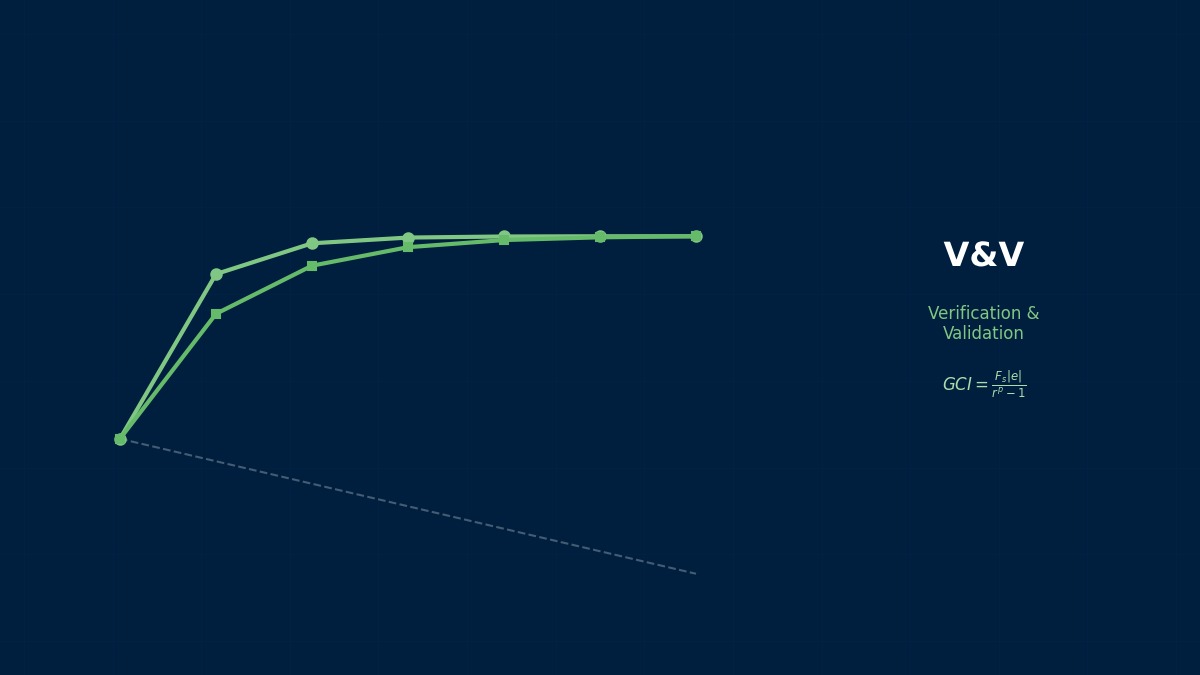
Mesh Convergence Verification (20-node Hexahedral Element)
Element Type Comparison
What does "element type comparison" mean specifically?
| Element Type | Nodes/Element | σ_yy (MPa) | Relative Error(%) | Remarks |
|---|---|---|---|---|
| HEX8 (8-node hexahedron) | 8 | 4.15 | 22.9 | Shear locking occurs |
| HEX8-RI (Reduced integration) | 8 | 5.12 | 4.83 | Hourglass control required |
| HEX20 (20-node hexahedron) | 20 | 5.378 | 0.04 | Recommended |
| TET4 (4-node tetrahedron) | 4 | 3.28 | 39.0 | Not recommended |
| TET10 (10-node tetrahedron) | 10 | 5.31 | 1.30 | Acceptable range |
Discretization Method
Spatial discretization by the Finite Element Method (FEM). Weak form based on the Galerkin method:
Matrix Solution Algorithm
What does "matrix solution algorithm" mean specifically?
| Solver | Classification | Memory Usage | Applicable Scale |
|---|---|---|---|
| LU Decomposition | Direct Method | O(n²) | Small to Medium Scale |
| Cholesky Decomposition | Direct Method (Symmetric Positive Definite) | O(n²) | Small to Medium Scale |
| PCG Method | Iterative Method | O(n) | Large Scale |
Ah, I see! So that's how the Finite Element Method works.
Implementation in Commercial Tools
There are many different software tools, right? Please tell me the characteristics of each!
| Tool Name | Developer/Current Owner | Main File Format |
|---|---|---|
| MSC Nastran / NX Nastran | MSC Nastran (Hexagon), NX Nastran (Siemens Digital Industries Software) | .bdf, .dat, .f06, .op2, .pch |
| Abaqus FEA (SIMULIA) | Dassault Systèmes SIMULIA | .inp, .odb, .cae, .sta, .msg |
| Ansys Mechanical (formerly ANSYS Structural) | Ansys Inc. | .cdb, .rst, .db, .ans, .mac |
Vendor Lineage and Product Integration History
Are the origins of each software tool somewhat dramatic?
MSC Nastran / NX Nastran
Next is MSC Nastran. What's it about?
Developed as NASA Structural Analysis (NASTRAN) in the 1960s. Commercialized by MSC Software. MSC was acquired by Hexagon AB in 2017.
Current affiliation: MSC Nastran (Hexagon), NX Nastran (Siemens Digital Industries Software)
Abaqus FEA (SIMULIA)
What does "Abaqus FEA" mean specifically?
Developed by HKS (Hibbitt, Karlsson & Sorensen) in 1978. Acquired by Dassault Systèmes in 2005.
Current affiliation: Dassault Systèmes SIMULIA
File Formats and Interoperability
Are there any points to note when transferring data between different software tools?
| Format | Extension | Type | Overview |
|---|---|---|---|
| STEP | .stp/.step | Neutral CAD | 3D CAD data exchange compliant with ISO 10303. |
| IGES | .igs/.iges | Neutral CAD | Early CAD exchange standard. |
| Nastran Bulk Data | .bdf | Solver-specific | Element definitions like CTETRA, CHEXA. |
| Abaqus Input | .inp | Solver-specific | Element definitions like C3D20R, C3D8I. |
Risks during conversion: Element type mapping (e.g., CHEXA→C3D20R) can be automated, but integration point locations and node numbering order may differ.
Professor, your explanation is clear! My confusion about formats has cleared up.
Judgment Criteria
I've heard of "Judgment Criteria," but I might not fully understand it...