Water Hammer Analysis
Theory: stopped water becomes a pressure wave
Overview
In our plant piping, stopping the pump makes a loud bang and the pipes shake. What's happening?
That's water hammer. When flowing water stops suddenly, it is compressed at the stopping point, creating a high-pressure region that travels along the pipe at close to the speed of sound, reflects at the ends and shuttles back and forth. Water is nearly incompressible, so a small velocity change produces a large pressure. The wave speed depends not only on water's stiffness but also on how much the pipe expands, so pipe material matters too.
Pressure-wave speed
$K$ is water's bulk modulus (about 2.2 GPa), $\rho$ density, $D$ internal diameter, $e$ wall thickness and $E$ the pipe's Young's modulus. In stiff pipes the wave speed approaches the speed of sound in water (about 1,480 m/s); in flexible pipes the wall expands, absorbing pressure and slowing the wave.
The Joukowsky equation
The pressure change for a velocity change $\Delta v$. $T_r$ is the round-trip time of the wave along pipe length $L$; closing faster than this counts as sudden closure and produces the full Joukowsky pressure. When flow decelerates, pressure rises upstream and falls downstream, sometimes low enough for water to vaporise (column separation).
An equation born of burst Moscow water mains
In the late 19th century Moscow's water system suffered unexplained pipe bursts. In 1897–98 Joukowsky, better known as an aerodynamics pioneer, ran valve-closure experiments on pipes hundreds of metres long and showed that the pressure rise is proportional to the velocity change times the wave speed, reaching its maximum when closure is faster than the round trip. Allievi in Italy developed the theory around the same time. The first formula used in piping design today came from a water-works failure investigation more than a century ago.
Worked examples
Example 1: effect of pipe material
A 200 mm bore, 1,000 m pipe with 2 m/s flow stopped suddenly:
| Pipe | Wave speed | Pressure rise | Round trip 2L/a | Hoop stress |
|---|---|---|---|---|
| Steel, 6 mm wall | 1,270 m/s | 2.53 MPa (259 m head) | 1.57 s | 42 MPa |
| PVC, 10 mm wall | 375 m/s | 0.75 MPa (76 m) | 5.33 s | 7 MPa |
| PE, 18 mm wall | 294 m/s | 0.59 MPa (60 m) | 6.79 s | 3 MPa |
Steel is stronger, yet its pressure rise is over four times higher.
Stiff pipes give pressure nowhere to go. PVC and PE bulge, slowing the wave and lowering pressure. But plastic pipes also have lower allowable stress and weaken with temperature, so relative to their strength they aren't necessarily safer. And 2.5 MPa is 260 m of head — often several times normal operating pressure. Setting design pressure from operating pressure alone can end with a burst pipe.
Example 2: effect of slower closure
| Closure time | Steel (2L/a = 1.57 s) |
|---|---|
| ≤ 1.57 s (sudden) | 2.53 MPa |
| 5 s | 0.80 MPa |
| 10 s | 0.40 MPa |
| 30 s | 0.13 MPa |
Closing slower than the round trip lets reflected low-pressure waves return and cancel before the valve is shut, so the rise falls roughly in inverse proportion to closure time. This estimate assumes flow decreases uniformly; real valves cut flow sharply near full closure, so the final part of the stroke should be slowed.
Example 3: entrained air
Just 0.1% air by volume at atmospheric pressure drops the mixture's wave speed from about 1,480 m/s to about 310 m/s, and 1% to about 100 m/s (ignoring pipe flexibility). A little air changes water-hammer estimates dramatically and lengthens round-trip times. Conversely, trapped air pockets can compress and rebound, spiking pressure, so air handling is a major source of analysis uncertainty.
How to approach the analysis
Methods
- Method of characteristics (MOC): treats pipelines in 1D and tracks wave propagation directly; the standard for network-wide water-hammer analysis.
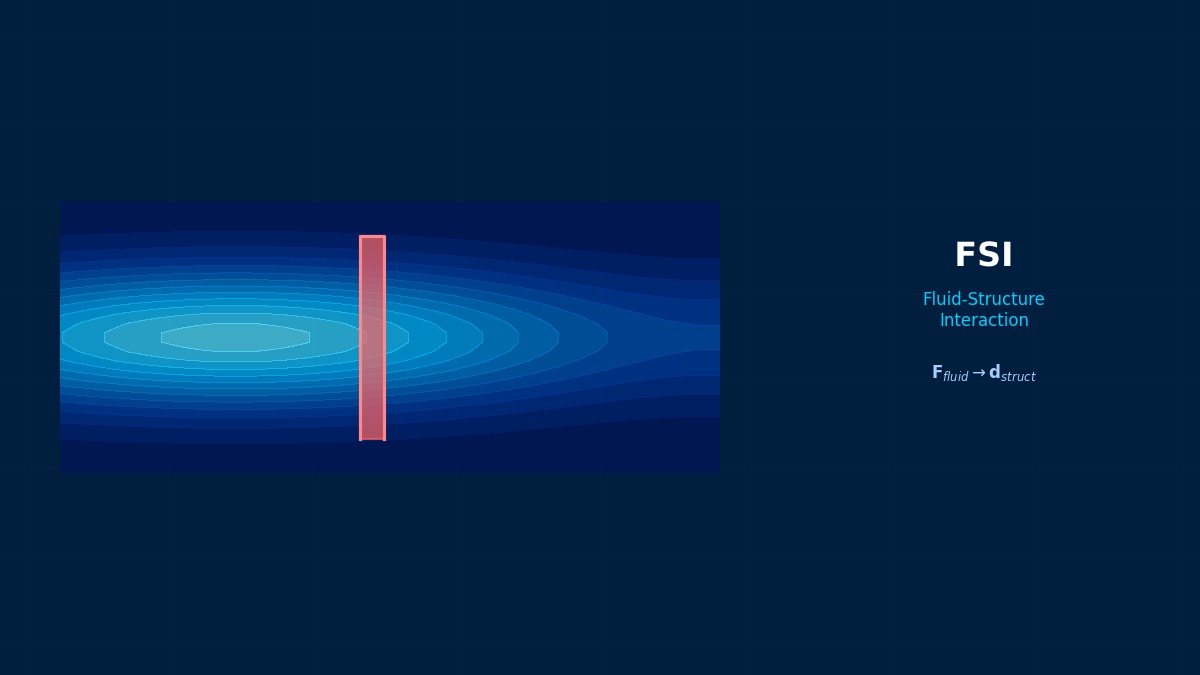
- Fluid–structure coupling: at bends and valves the wave pushes the pipe, whose vibration feeds back into the flow; lightly supported piping needs coupled analysis.
- 3D CFD: only for detailed flow around valves or pumps; unsuitable for whole pipelines.
What to check
- Compute round-trip time from length and wave speed and compare with valve and pump-trip times.
- Check maximum pressure against design pressure and minimum pressure against vapour pressure.
- Compute forces at bends and valve supports and check the supports.
- Always include the worst case, such as pump trip on power failure.
“The pipe only fails in power cuts”
Normal operation is fine, yet pipe supports come loose or valves break only in power failures. On a power cut the pump stops at once and check valves slam shut, giving far more abrupt velocity changes than any operating procedure. Pressure also drops right after the pump, the water column separates and then rejoins with a large pressure spike. Measures such as adding pump inertia (flywheels), choosing check-valve closing speed or fitting air vessels should be verified by analysing the power-failure case.
Common mistakes
Mistakes and fixes
| Mistake | Effect | Fix |
|---|---|---|
| Designing for operating pressure only | Burst from water hammer | Check the maximum with Joukowsky |
| Using sound speed in water | Overestimate for flexible pipes | Include pipe elasticity |
| Ignoring pump trip | Worst case missed | Analyse the power-failure case |
| Not checking low pressure | Column separation and rejoin | Compare minimum with vapour pressure |
| Ignoring air | Wrong pressure and period | Check sensitivity to air content |
I'd like to calculate water-hammer pressure myself.
Try the water hammer simulator for pressure waves, the surge tank oscillation tool for surge tanks, and the pipe flow calculator and pump system curve tool for pipelines and pumps. For fluid–structure coupling see sloshing and structures, tube-bundle vibration and hydroelasticity.