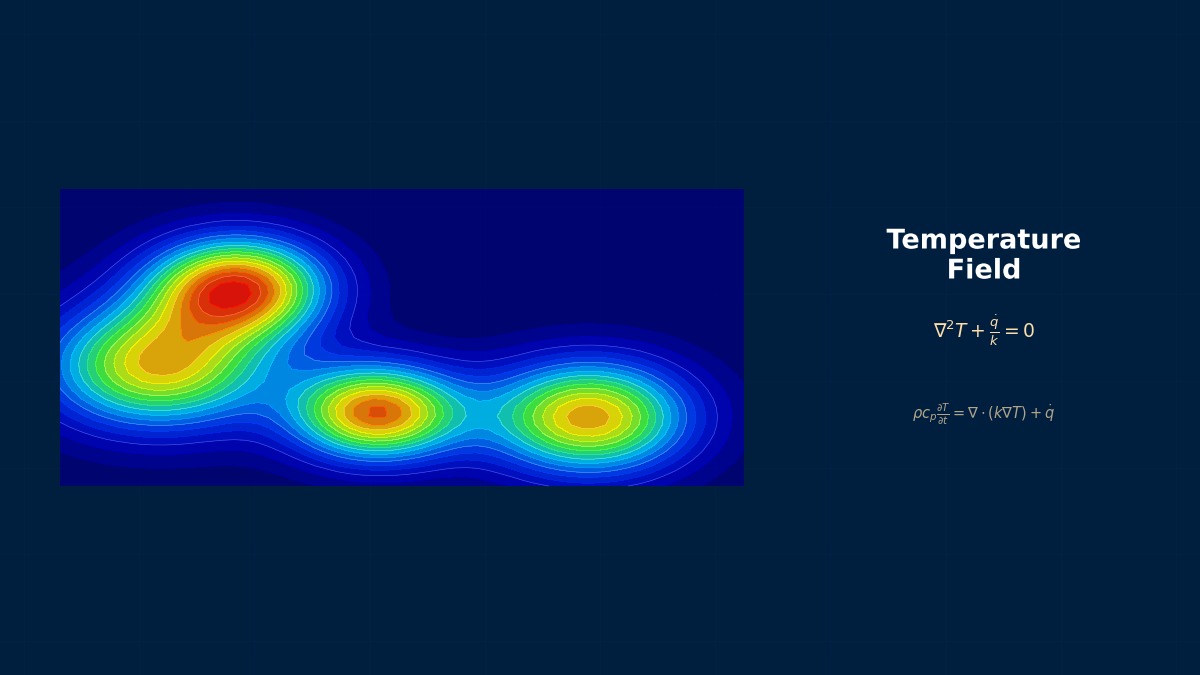
Directly Coupled (Monolithic) Conjugate Heat Transfer
Theory and Physics
Difference Between Direct and Partitioned Coupling
Professor, what's the difference between "direct coupling" and partitioned coupling? Which one is better?
Simply put, solving the governing equations for fluid and solid as a single simultaneous equation system is direct coupling (monolithic method). Partitioned coupling (partitioned method) is an approach where the solid solver and fluid solver run separately, exchanging temperature and heat flux at the interface like a game of catch.
Catch...? You mean they exchange data many times?
Yes, in partitioned coupling, an outer iteration is required: "calculate temperature on the solid side → pass interface heat flux to fluid → fluid calculates temperature → return interface temperature to solid." This back-and-forth repeats until convergence, which increases computation time and can diverge under poor conditions.
Direct coupling eliminates the need for this interface exchange; the solid and fluid temperature fields are determined simultaneously in a single solve of the simultaneous equations. Since temperature continuity and heat flux conservation at the interface are algebraically guaranteed, there are no convergence worries.
Wait, so is direct coupling superior in every way?
There are pros and cons. Direct coupling requires a dedicated solver and the solid and fluid meshes must be integrated. Partitioned coupling is more flexible when you want to combine existing structural and CFD solvers. However, for problems involving thin solid layers like chip cooling on electronic boards, the Biot number tends to become large, and direct coupling often offers better accuracy and efficiency.
| Characteristic | Direct Coupling (Monolithic) | Partitioned Coupling (Partitioned) |
|---|---|---|
| Equation System | One simultaneous equation system | Solve solid and fluid separately |
| Interface Handling | Automatically guaranteed algebraically | Converged via outer iteration |
| Stability | Unconditionally stable (implicit) | Conditionally stable |
| Solver Flexibility | Requires dedicated solver | Can combine existing solvers |
| Mesh | Integrated mesh (conformal) | Independent meshes possible |
| Memory Usage | Large (matrix is huge) | Small (solved by partitioning) |
Governing Equations and Monolithic Matrix
So what does it look like mathematically? What form does this "single simultaneous equation" take?
First, let's write the heat equations for the solid domain $\Omega_s$ and fluid domain $\Omega_f$.
Solid side (heat conduction only):
Fluid side (convection + diffusion):
In direct coupling, after discretizing these two using the Finite Element Method (FEM) or Finite Volume Method (FVM), they are assembled into a single block matrix system with shared interface nodes. It looks something like this:
Wow, a 3x3 block matrix! What does the middle $\Gamma$ represent?
$\Gamma$ is a subscript representing the interface between solid and fluid. Nodes on the interface belong to both solid and fluid, and the temperature $\mathbf{T}_\Gamma$ is shared. This is the mechanism that algebraically guarantees "temperature continuity."
In practice, it's often written more compactly as a 2x2 matrix:
Here, $\mathbf{K}_{sf}$ and $\mathbf{K}_{fs}$ are the interface coupling matrices (off-diagonal coupling blocks), representing the exchange of heat through the interface. The difference with partitioned coupling is that these coupling terms don't exist there; instead, data is exchanged via outer iterations.
Interface Consistency Conditions
How do you mathematically express the condition that "temperature and heat flux are continuous" at the interface?
There are two conditions that must be satisfied at the interface $\Gamma$. First, temperature continuity (Dirichlet condition):
And heat flux conservation (Neumann condition):
$n$ is the normal direction vector at the interface. In direct coupling, since interface nodes are shared, temperature continuity is automatically satisfied by node coincidence. Heat flux conservation is algebraically guaranteed within the weak form (variational formulation) because the interface integrals cancel between adjacent elements.
To use an analogy, partitioned coupling is like "two rooms exchanging temperature over the phone," while direct coupling is like "removing the wall to make one room." In a game of telephone, information discrepancies (interface errors) occur, but if there's no wall, there's no possibility for discrepancy in the first place.
Theoretical Basis for Stability
I hear direct coupling has "high stability." Why is that said?
Good question. In partitioned coupling, the "solid → fluid → solid → ..." iteration becomes a Gauss-Seidel-like sequential update. If the ratio of thermal properties between solid and fluid (especially $k_s/k_f$ or $\rho c_p$ ratio) is extreme, the spectral radius of this iteration can exceed 1, leading to divergence in some cases.
In direct coupling, since all degrees of freedom are solved simultaneously, using implicit time integration makes it unconditionally stable. Particularly:
- Cases with large thermal conductivity differences like $k_s \gg k_f$ (metal solid + air fluid)
- Cases with thin solid layers where the Biot number $\text{Bi} = hL/k_s$ is $O(1)$ or greater
- Transient analyses with large time steps
Under these conditions, partitioned coupling iterations struggle to converge, but direct coupling can solve them without issue.
I see... So partitioned coupling struggles when property differences are large.
There's a theoretical result shown by Giles (1997): the interface condition number for partitioned coupling is:
Larger $\kappa_\Gamma$ leads to slower convergence. For a combination like steel ($k_s = 50$ W/(m$\cdot$K)) and air ($k_f = 0.026$), the ratio is about 2000 times. The biggest advantage of direct coupling is that it is not affected by this $\kappa_\Gamma$.
History of Monolithic CHT
The formulation of direct coupling CHT was first proposed by Saxena and Launder in 1990. However, computational performance at the time couldn't handle the enormous matrix size, making it impractical for real problems. In the 2000s, multifrontal methods and iterative methods with AMG preconditioning became practical, finally enabling direct coupling CHT on the scale of millions of degrees of freedom. Today, software like COMSOL and STAR-CCM+ allow setting up monolithic CHT through GUI operations, making it widely used not only by researchers but also by practicing engineers.
Physical Meaning of Each Term
- Heat storage term $\rho c_p \partial T/\partial t$: Rate of thermal energy storage per unit volume. An iron frying pan heats up and cools down slowly (large $\rho c_p$), while an aluminum pot is the opposite. In transient CHT analysis, this term determines the speed of temperature response.
- Heat conduction term $\nabla \cdot (k \nabla T)$: Heat diffusion based on Fourier's law. This is the dominant heat transport mechanism on the solid side. The value of $k$ differs by orders of magnitude: copper 400, steel 50, air 0.026 W/(m$\cdot$K), greatly affecting the condition number of the direct coupling matrix.
- Convection term $\rho c_p \mathbf{u} \cdot \nabla T$: Heat transport due to fluid motion. This term does not exist on the solid side. In the direct coupling matrix, it appears only in the fluid block and is the cause of the matrix's asymmetry.
- Interface coupling matrix $\mathbf{K}_{sf}$: Off-diagonal block representing thermal coupling between solid and fluid. Acts like a "glue" that enforces temperature and heat flux continuity at interface nodes. The existence of this matrix is the essence of direct coupling.
Assumptions and Applicability Limits
- Assumes no temperature jump at the interface (ignores microscale thermal resistance). To consider contact thermal resistance of TIM (Thermal Interface Material), add thin film elements at the interface.
- It is assumed that the velocity field $\mathbf{u}$ is already obtained from the Navier-Stokes equations on the fluid side (full velocity-temperature coupling is possible but makes the matrix even larger).
- Radiative heat transfer is linearized (the $T^4$ term is handled by Newton's method or Picard iteration).
- For phase change (melting/solidification), a latent heat term must be added, increasing the nonlinearity of the matrix.
Numerical Methods and Implementation
Discretization and Matrix Assembly
How do you actually assemble the monolithic matrix on a computer?
The basics are the same as regular FEM/FVM. Discretize the solid and fluid domains separately to create element matrices, then assemble them into the global matrix. The key point is the numbering of interface nodes.
For FEM, the weak form for a solid element is:
For fluid elements, the convection term $\int \rho_f c_{p,f} N_i (\mathbf{u} \cdot \nabla N_j) \, d\Omega$ is added to this.
The trick in assembly is to assign elements on the interface to both the solid and fluid domains. By numbering the interface nodes so they appear only once in the global matrix, temperature continuity is automatically guaranteed. In actual solvers, care must be taken to avoid double-counting the DOFs (degrees of freedom) of shared nodes.
What about for FVM? Most CFD solvers are FVM-based, right?
Sharp observation. CFD solvers like STAR-CCM+ or Fluent are FVM-based, but their CHT functionality also handles the solid domain within the same FVM framework. The mechanism ensures heat flux conservation at interface cell faces. In FVM, the "face flux" between adjacent cells corresponds to the interface coupling.
Specifically, the heat flux at an interface face is calculated as:
using a harmonic average. Here, $\delta_s$, $\delta_f$ are the distances from the interface to the solid and fluid cell centers, respectively. Distributing this to the corresponding rows in the solid and fluid matrices completes the monolithic matrix.
Solver Strategy
How do you solve the resulting huge matrix? Direct methods would probably blow up memory...
Exactly. The monolithic matrix includes all DOFs of solid+fluid, so it's very large. The solution method is chosen based on problem scale:
| Method | Applicable Scale | Characteristics |
|---|---|---|
| Direct Method (LU decomposition) | ~500k DOF | Robust but memory $O(n^2)$. For benchmarking small problems |
| GMRES + ILU Preconditioner | ~5M DOF | Handles asymmetric matrices. Effective when fluid advection term causes asymmetry |
| GMRES + AMG Preconditioner | 10M DOF~ | Standard choice for large-scale CHT. Default in STAR-CCM+ |
| GMRES with Block Preconditioner | Tens of millions DOF | Preconditions solid and fluid blocks independently. Research level |
I hear about AMG a lot lately. Is it effective for direct coupling CHT too?
It's extremely effective. AMG (Algebraic Multigrid) automatically creates a hierarchy of "coarse approximations" and "fine approximations" of the matrix, simultaneously damping low-frequency and high-frequency error components. The monolithic matrix for CHT tends to have a poor condition number because material properties differ by orders of magnitude between solid and fluid, but AMG can significantly mitigate this effect.
In practice, setting the AMG convergence criterion to a residual below $10^{-6}$ is standard.
Mesh Requirements
Are there special constraints on the mesh for direct coupling?
The most important requirement is mesh conformity (conformal mesh) at the interface. The nodes (FEM) or faces (FVM) on the solid side and fluid side of the interface must match. Some solvers support non-conformal interfaces, but accuracy tends to suffer.
Practical points to note:
- Boundary layer mesh on solid walls: Sufficient prism layers (inflation layers) are needed near the interface on the fluid side. Mesh design based on $y^+$ is essential.
- Solid interior: Place at least 3 or more element layers in thin wall sections where temperature gradients are steep.
- Mesh size ratio: The element size ratio between solid and fluid sides at the interface should ideally be within a factor of 5.
Partitioned coupling allows independent meshes, so this is an inconvenient aspect of direct coupling...
That's true. However, with tools like STAR-CCM+ that can "generate solid+fluid meshes in one go within a single software," creating a conformal mesh is relatively easy. In fact, partitioned coupling can sometimes be more troublesome due to the effort required to "align meshes between two solvers."
Me
Related Topics
なった
詳しく
報告
固体と流体の支配方程式を単一行列で連立する強連成手法。収束性に優れるが大規模問題では計算コストが課題。
待って待って、固体と流体の支配方程ってことは、つまりこういうケースでも使えますか?
Governing Equations
Discretization Methods
この方程式を、コンピュータで実際にどうやって解くんですか?
有限要素法(FEM)による空間離散化を使うんだ。要素剛性マトリクスを組み立て、全体剛性方程式を構築する。
行列解法アルゴリズム
行列解法アルゴリズムって、具体的にはどういうことですか?
直接法(LU分解、Cholesky分解)または反復法(CG法、GMRES法)により連立方程式を解く。大規模問題では前処理付き反復法が効果的なんだ。
| 解法 | 分類 | メモリ使用量 | 適用規模 |
|---|---|---|---|
| LU分解 | 直接法 | O(n²) | 小〜中規模 |
| Cholesky分解 | 直接法(対称正定値) | O(n²) | 小〜中規模 |
| PCG法 | 反復法 | O(n) | 大規模 |
| GMRES法 | 反復法 | O(n·m) | 大規模・非対称 |
| AMG前処理 | 前処理 | O(n) | 超大規模 |
つまり有限要素法のところで手を抜くと、後で痛い目を見るってことですね。肝に銘じます!
商用ツールにおける実装
で、直接カップリング法をやるにはどんなソフトが使えるんですか?
| ツール名 | 開発元/現在 | 主要ファイル形式 |
|---|---|---|
| Ansys Fluent | Ansys Inc. | .cas, .dat, .msh, .jou |
| Simcenter STAR-CCM+ | Siemens Digital Industries Software | .sim, .java, .csv |
| COMSOL Multiphysics | COMSOL AB | .mph |
| Ansys Mechanical (旧ANSYS Structural) | Ansys Inc. | .cdb, .rst, .db, .ans, .mac |
| Abaqus FEA (SIMULIA) | Dassault Systèmes SIMULIA | .inp, .odb, .cae, .sta, .msg |
ベンダーの系譜と製品統合の経緯
各ソフトの成り立ちって、結構ドラマチックだったりしますか?
Ansys Fluent
次はAnsys Fluentの話ですね。どんな内容ですか?
Simcenter STAR-CCM+
次はSimcenter STARの話ですね。どんな内容ですか?
CD-adapcoが開発。2016年にSiemensが買収しSimcenterブランドに統合。ポリヘドラルメッシュが特徴。
現在の所属: Siemens Digital Industries Software
ここまで聞いて、が開発がなぜ重要か、やっと腹落ちしました!
COMSOL Multiphysics
「COMSOL Multiphysics」について教えてください!
1986年スウェーデンで設立。MATLAB連携のFEMLABとして開始、後にCOMSOLに改名。マルチフィジックスに強み。
現在の所属: COMSOL AB
おお〜、が開発の話、めちゃくちゃ面白いです! もっと聞かせてください。
ファイル形式と相互運用性
異なるソルバー間でモデルを変換する際は、要素タイプの対応関係、材料モデルの互換性、荷重・境界条件の表現差異に注意が必要になるんだ。特に高次要素や特殊要素(コヒーシブ要素、ユーザー定義要素等)はソルバー間で直接変換できない場合が多い。
なるほど…フォーマットって一見シンプルだけど、実はすごく奥が深いんですね。
実務上の注意点
教科書には載ってない「現場の知恵」みたいなものってありますか?
メッシュ収束性の確認、境界条件の妥当性検証、材料パラメータの感度分析がすごく大事なんだ。
- メッシュ依存性の検証: 少なくとも3水準のメッシュ密度で収束性を確認
- 境界条件の妥当性: 物理的に意味のある拘束条件の設定
- 結果の検証: 理論解、実験データ、既知ベンチマーク問題との比較
いやぁ、直接カップリング法って奥が深いですね… でも先生の説明のおかげでだいぶ整理できました!
うん、いい調子だよ! 実際に手を動かしてみることが一番の勉強だからね。分からないことがあったらいつでも聞いてくれ。
直接連成の数学的厳密性
直接連成法(Monolithic CHT)は固体と流体の支配方程式を単一の線形代数系として同時に解く。界面に余剰の境界条件を課さず、温度と熱フラックスの連続性が代数的に保証される。理論的には最も厳密だが、係数行列の次元数が急増する。1990年にSaxena & Launderが提唱したこの定式化は、計算機性能の限界から2000年代まで実用上は限られた規模にしか適用できなかった。
各項の物理的意味
- 蓄熱項 $\rho c_p \partial T/\partial t$:単位体積あたりの熱エネルギー蓄積率。【日常の例】鉄のフライパンは熱しにくく冷めにくいが、アルミ鍋は熱しやすく冷めやすい——これは密度 $\rho$ と比熱 $c_p$ の積(熱容量)の違い。熱容量が大きい物体は温度変化が緩やかになる。水は比熱が非常に大きい(4,186 J/(kg·K))ため、海沿いの気温は内陸より安定する。非定常解析ではこの項が温度の時間変化速度を決める。
- 熱伝導項 $\nabla \cdot (k \nabla T)$:フーリエの法則に基づく熱伝導。温度勾配に比例した熱流束。【日常の例】金属スプーンを熱い鍋に入れると持ち手まで熱くなる——金属は熱伝導率 $k$ が高いため、高温側から低温側へ素早く熱が伝わる。木製スプーンが熱くならないのは $k$ が小さいから。断熱材(グラスウール等)は $k$ が極めて小さく、温度勾配があっても熱が伝わりにくい。「温度差のあるところに熱が流れる」という自然の傾向を数式化したもの。
- 対流項 $\rho c_p \mathbf{u} \cdot \nabla T$:流体の運動に伴う熱輸送。【日常の例】扇風機に当たると涼しく感じるのは、風(流体の流れ)が体表面近くの暖かい空気を運び去り、新鮮な冷たい空気を供給するから——これが強制対流。暖房で部屋の天井付近が暖かくなるのは、暖められた空気が浮力で上昇する自然対流。PCのCPUクーラーのファンも強制対流で放熱している。対流は熱伝導よりも桁違いに効率的な熱輸送手段。
- 熱源項 $Q$:内部発熱(ジュール熱、化学反応熱、放射線吸収等)。単位: W/m³。【日常の例】電子レンジは食品内部のマイクロ波吸収(体積発熱)で加熱する。電気毛布のヒーター線はジュール発熱($Q = I^2 R / V$)で暖かくなる。リチウムイオン電池の充放電時の発熱、ブレーキパッドの摩擦熱も熱源として解析で考慮される。外部から「表面」に熱を与える境界条件とは異なり、熱源項は「内部」でのエネルギー生成を表す。
仮定条件と適用限界
数値解法と実装
数値手法の詳細
具体的にはどんなアルゴリズムで直接カップリング法を解くんですか?
離散化の定式化
形状関数 $N_i$ を用いて未知量を近似:
これを数式で表すとこうなるよ。
基礎方程式の離散形
これを数式で表すとこうなるよ。
うーん、式だけだとピンとこないです… 何を表してるんですか?
連続体の支配方程式を離散化すると、以下の代数方程式系が得られる:
ここで $[K]$ は全体剛性マトリクス(または同等のシステムマトリクス)、$\{u\}$ は未知節点変数ベクトル、$\{F\}$ は外力ベクトルなんだ。
あっ、そういうことか! 連続体の支配方程式をってそういう仕組みだったんですね。
要素技術
「要素技術」って聞いたことはあるんですけど、ちゃんと理解できてないかもしれません…
| 要素タイプ | 次数 | 節点数(3D) | 精度 | 計算コスト |
|---|---|---|---|---|
| 四面体1次 | 線形 | 4 | 低(シアロッキング) | 低 |
| 四面体2次 | 二次 | 10 | 高 | 中 |
| 六面体1次 | 線形 | 8 | 中 | 中 |
| 六面体2次 | 二次 | 20 | 非常に高 | 高 |
| プリズム | 線形/二次 | 6/15 | 中〜高 | 中 |
積分スキーム
積分スキームって、具体的にはどういうことですか?
ここまで聞いて、要素タイプがなぜ重要か、やっと腹落ちしました!
収束性と安定性
収束しなくなったら、まず何をチェックすればいいですか?
- h-refinement: メッシュを細分化(要素サイズ h を小さく)して精度向上
- p-refinement: 要素の多項式次数を上げて精度向上
- hp-refinement: h と p を同時に最適化
収束速度: 二次要素で $O(h^2)$ のオーダーで誤差が減少(滑らかな解の場合)
なるほど…メッシュを細分化って一見シンプルだけど、実はすごく奥が深いんですね。
ソルバー設定の推奨事項
線形要素 vs 2次要素
熱伝導解析では線形要素でも十分な精度が得られることが多い。温度勾配が急な領域(熱衝撃等)では2次要素を推奨。
熱流束の評価
要素内の温度勾配から算出。節点応力と同様にスムージングが必要な場合がある。
対流-拡散問題
ペクレ数が高い(対流支配)場合、風上的安定化(SUPG等)が必要。純粋な熱伝導問題では不要。
非定常解析の時間刻み
熱拡散の特性時間 $\tau = L^2 / \alpha$($\alpha$: 熱拡散率)に対して十分小さい刻みを設定。急激な温度変化には自動時間刻み制御が有効。
非線形収束
温度依存物性値による非線形性はマイルドな場合が多く、Picard反復(直接置換法)で十分なことが多い。放射の強非線形性ではニュートン法を推奨。
定常解析の判定
全節点の温度変化が閾値以下($|\Delta T| / T_{max} < 10^{-5}$等)で収束と判定。
陽解法と陰解法のたとえ
陽解法は「今の情報だけで次を予測する天気予報」——計算は速いが大きな時間刻みでは不安定(嵐を見逃す)。陰解法は「未来の状態も考慮した予測」——大きな時間刻みでも安定するが、各ステップで方程式を解く手間がかかる。急激な温度変化がない問題では陰解法で大きな時間刻みを使う方が効率的。
実践ガイド
実践ガイド
先生、「実践ガイド」について教えてください!
直接カップリング法の実務的な解析フローと注意点を解説する。
先生の説明分かりやすい! 直接カップリング法ののモヤモヤが晴れました。
解析フロー
最初の一歩から教えてください! 何から始めればいいですか?
2. 求解 (Solving)
- ソルバー設定(解法、収束基準、出力制御)
- ジョブ投入と計算実行
- 収束モニタリング
メッシュ生成のベストプラクティス
メッシュの良し悪しってどうやって判断するんですか?
要素品質指標
メッシュ密度の決定
メッシュ密度の決定って、具体的にはどういうことですか?
- 応力集中部: 最低3層以上の要素を配置
- 応力勾配の大きい領域: 要素サイズを周囲の1/3〜1/5に
- 荷重印加点近傍: 局所細分化
- 遠方領域: 粗いメッシュで計算効率を確保
境界条件の設定指針
境界条件って、ここを間違えると全部ダメになるって聞いたんですけど…
- 過拘束に注意: 剛体移動の拘束は6自由度のみ
- 対称条件の活用: 計算規模の削減
- 荷重の等価分配: 集中荷重 vs. 分布荷重の選択
あっ、そういうことか! 過拘束に注意ってそういう仕組みだったんですね。
商用ツール別の実装手順
いろんなソフトがあるんですよね? それぞれの特徴を教えてください!
| ツール名 | 開発元/現在 | 主要ファイル形式 |
|---|---|---|
| Ansys Fluent | Ansys Inc. | .cas, .dat, .msh, .jou |
| Simcenter STAR-CCM+ | Siemens Digital Industries Software | .sim, .java, .csv |
| COMSOL Multiphysics | COMSOL AB | .mph |
| Ansys Mechanical (旧ANSYS Structural) | Ansys Inc. | .cdb, .rst, .db, .ans, .mac |
| Abaqus FEA (SIMULIA) | Dassault Systèmes SIMULIA | .inp, .odb, .cae, .sta, .msg |
Ansys Fluent
次はAnsys Fluentの話ですね。どんな内容ですか?
Simcenter STAR-CCM+
次はSimcenter STARの話ですね。どんな内容ですか?
CD-adapcoが開発。2016年にSiemensが買収しSimcenterブランドに統合。ポリヘドラルメッシュが特徴。
現在の所属: Siemens Digital Industries Software
先生の説明分かりやすい! ツール名のモヤモヤが晴れました。
よくある失敗と対策
初心者がやりがちな失敗パターンってありますか? 事前に知っておきたいです!
| 症状 | 原因 | 対策 |
|---|---|---|
| 計算が収束しない | メッシュ品質不良、不適切な境界条件 | メッシュ改善、拘束条件見直し |
| 応力が異常に大きい | 応力特異点、メッシュ依存 | 特異点回避、局所メッシュ細分化 |
| 変位が非現実的 | 材料定数誤り、単位系不整合 | 入力データ確認 |
| 計算時間が過大 | 不要な細分化、非効率な解法 | メッシュ最適化、並列計算 |
品質保証チェックリスト
教科書には載ってない「現場の知恵」みたいなものってありますか?
- メッシュ収束性を3水準以上で確認したか
- 力の釣り合い(反力合計)を検証したか
- 結果が物理的に妥当な範囲か確認したか
- 既知の理論解またはベンチマーク問題と比較したか
いやぁ、直接カップリング法って奥が深いですね… でも先生の説明のおかげでだいぶ整理できました!
うん、いい調子だよ! 実際に手を動かしてみることが一番の勉強だからね。分からないことがあったらいつでも聞いてくれ。
EVバッテリー冷却への適用
テスラModel 3のバッテリーパック冷却設計では直接連成CHTが2018年頃から採用されたと業界で報告されている。液冷プレートの蛇行流路と電池セル(18650型)の発熱体を同時にモデル化し、セル温度均一性を±2K以内に抑えることが目標値とされた。ANSYS Fluent内の「Solid-Fluid Coupling」機能が使われ、1モジュール(96セル)の計算に約8時間を要した。
解析フローのたとえ
熱解析のフローは「お風呂の追い焚き設計」で考えてみましょう。浴槽の形(解析対象)を決め、お湯の初期温度(初期条件)と外気温(Boundary Conditions)を設定し、追い焚きの出力(熱源)を調整する。「2時間後にぬるくなっていないか?」を計算で予測する——これが非定常熱解析の本質です。
初心者が陥りやすい落とし穴
「放射を無視していいですか?」——室温付近なら大抵OK。でも数百度を超えたら話は別です。放射による熱伝達は温度の4乗に比例するため、高温では対流を圧倒します。晴れた日に日向と日陰で体感温度が全然違うのを経験したことがありますよね? あれが放射の威力です。工業炉やエンジン周りの解析で放射を無視するのは、猛暑日に「日差しは関係ない」と言い張るようなものです。
境界条件の考え方
熱伝達係数 $h$ は「窓の断熱性能」だと思ってください。$h$ が大きい=窓が薄い=熱がどんどん逃げる。$h$ が小さい=二重窓=熱が逃げにくい。この数値1つで結果が大きく変わるため、文献値の引用や実験による同定が重要です。「とりあえず10 W/(m²·K)で…」と適当に入れていませんか?
ソフトウェア比較
商用ツール比較
いろんなソフトがあるんですよね? それぞれの特徴を教えてください!
直接カップリング法に対応する主要な商用CAEツールの機能比較と、各製品の歴史的背景を詳述する。
対応ツール一覧
で、直接カップリング法をやるにはどんなソフトが使えるんですか?
| ツール名 | 開発元/現在 | 主要ファイル形式 |
|---|---|---|
| Ansys Fluent | Ansys Inc. | .cas, .dat, .msh, .jou |
| Simcenter STAR-CCM+ | Siemens Digital Industries Software | .sim, .java, .csv |
| COMSOL Multiphysics | COMSOL AB | .mph |
| Ansys Mechanical (旧ANSYS Structural) | Ansys Inc. | .cdb, .rst, .db, .ans, .mac |
| Abaqus FEA (SIMULIA) | Dassault Systèmes SIMULIA | .inp, .odb, .cae, .sta, .msg |
Ansys Fluent
次はAnsys Fluentの話ですね。どんな内容ですか?
Simcenter STAR-CCM+
次はSimcenter STARの話ですね。どんな内容ですか?
CD-adapcoが開発。2016年にSiemensが買収しSimcenterブランドに統合。ポリヘドラルメッシュが特徴。
現在の所属: Siemens Digital Industries Software
ここまで聞いて、が開発がなぜ重要か、やっと腹落ちしました!
COMSOL Multiphysics
「COMSOL Multiphysics」について教えてください!
1986年スウェーデンで設立。MATLAB連携のFEMLABとして開始、後にCOMSOLに改名。マルチフィジックスに強み。
現在の所属: COMSOL AB
Ansys Mechanical (旧ANSYS Structural)
「Ansys Mechanical」について教えてください!
1970年にSwanson Analysis Systems Inc. (SASI) が開発。APDL(Ansys Parametric Design Language)ベース。
現在の所属: Ansys Inc.
あっ、そういうことか! が開発ってそういう仕組みだったんですね。
機能比較マトリクス
変換時のリスク
変換時のリスクって、具体的にはどういうことですか?
- 要素タイプの非互換: ソルバー固有要素は中立フォーマットで表現不可
- 材料モデルの差異: 同名でも内部実装が異なる場合がある
- 境界条件の再定義: 多くの場合、手動での再設定が必要
- 結果データの比較: 出力変数の定義(節点値 vs. 要素値、積分点値)に差異
あっ、そういうことか! 異なるツール間でのモってそういう仕組みだったんですね。
ライセンス形態
「ライセンス形態」って聞いたことはあるんですけど、ちゃんと理解できてないかもしれません…
| ツール | ライセンス | 特徴 |
|---|---|---|
| 商用FEA | ノードロック/フローティング | 高額だが公式サポート付き |
| OpenFOAM | GPL | 無償だがサポートは有償 |
| COMSOL | ノードロック/フローティング | モジュール単位で購入 |
| Code_Aster | GPL | EDF開発のOSSソルバー |
選定の指針
結局どれを選べばいいか、判断基準を教えてもらえますか?
直接カップリング法のツール選定においては以下を考慮:
- 解析規模: 数万〜数億DOFへのスケーラビリティ
- 物理モデル: 必要な構成則・要素タイプの対応状況
- ワークフロー: CADとの連携、自動化の容易さ
- コスト: 初期投資 + 年間保守 + 教育コスト
- サポート: 技術サポートの質とレスポンス
いやぁ、直接カップリング法って奥が深いですね… でも先生の説明のおかげでだいぶ整理できました!
うん、いい調子だよ! 実際に手を動かしてみることが一番の勉強だからね。分からないことがあったらいつでも聞いてくれ。
COMSOL vs Fluent 直接連成比較
直接連成CHTで最も使いやすいとされるのはCOMSOL Multiphysicsだ。GUI操作だけで固体・流体・熱伝達の多物理連成が設定でき、学術機関ではデファクトスタンダードに近い。一方、ANSYS Fluentは2022R2から「Coupled Energy Solver」が強化され、大規模モデル(1億セル超)での直接連成が実用速度で動くようになった。COMSOLの年間ライセンスはFloating版で約200万円、Fluentは構成による。
選定で最も重要な3つの問い
- 「何を解くか」:直接カップリング法に必要な物理モデル・要素タイプが対応しているか。例えば、流体ではLES対応の有無、構造では接触・大変形の対応能力が差になる。
- 「誰が使うか」:初心者チームならGUIが充実したツール、経験者ならスクリプト駆動の柔軟なツールが適する。自動車のAT車(GUI)とMT車(スクリプト)の違いに似ている。
- 「どこまで拡張するか」:将来の解析規模拡大(HPC対応)、他部門への展開、他ツールとの連携を見据えた選択が長期的なコスト削減につながる。
先端技術
先端トピックと研究動向
直接カップリング法の分野って、これからどう進化していくんですか?
直接カップリング法における最新の研究動向と先進的手法を見ていこう。
最新の数値手法
次は最新の数値手法の話ですね。どんな内容ですか?
うーん、式だけだとピンとこないです… 何を表してるんですか?
高性能計算 (HPC) への対応
| 並列化手法 | 概要 | 適用ソルバー |
|---|---|---|
| MPI (領域分割) | 分散メモリ型。大規模問題の標準 | 全主要ソルバー |
| OpenMP | 共有メモリ型。ノード内並列 | 多くのソルバー |
| GPU (CUDA/OpenCL) | GPGPU活用。特に陽解法で有効 | LS-DYNA, Fluent等 |
| ハイブリッド MPI+OpenMP | ノード間+ノード内並列 | 大規模HPC環境 |
トラブルシューティング
トラブルシューティング
よくあるエラーと対策
先生も直接カップリング法で徹夜デバッグしたことありますか?(笑)
1. 収束失敗
収束失敗って、具体的にはどういうことですか?
症状: ソルバーが指定反復回数内に収束せず異常終了
考えられる原因:
- メッシュ品質の不足(過度に歪んだ要素)
- 材料パラメータの不適切な設定
- 不適切な初期条件
- 非線形性が強すぎる(荷重ステップの不足)
つまり収束失敗のところで手を抜くと、後で痛い目を見るってことですね。肝に銘じます!
2. 非物理的な結果
次は非物理的な結果の話ですね。どんな内容ですか?
症状: 応力/変位/温度等が物理的に非現実的な値
考えられる原因:
- 境界条件の誤設定
- 単位系の混在(SI単位と工学単位の混同)
- 不適切な要素タイプの選択
- 応力特異点の存在
対策:
- 反力の合計を確認(力の釣り合い)
- 単位系の一貫性を確認
- 要素タイプの適切性を再検討
- 特異点除去またはサブモデリング
先輩が「収束失敗だけはちゃんとやれ」って言ってた意味が分かりました。
3. 計算時間の超過
計算時間の超過って、具体的にはどういうことですか?
症状: 計算が想定時間の何倍もかかる
対策:
- メッシュの粗密分布の最適化
- 対称性の活用(1/2, 1/4モデル)
- ソルバー設定の最適化(反復法、前処理の選択)
- 並列計算の活用
4. メモリ不足
「メモリ不足」について教えてください!
症状: Out of Memory エラー
先輩が「収束失敗だけはちゃんとやれ」って言ってた意味が分かりました。
対策:
- アウトオブコア解法の使用
- メッシュ規模の削減
- 64bit版ソルバーの使用確認
- メモリ割り当ての増加
おお〜、収束失敗の話、めちゃくちゃ面白いです! もっと聞かせてください。
Nastran代表的エラー
代表的エラーって、具体的にはどういうことですか?
- FATAL 2012: 特異剛性マトリクス → 拘束条件の見直し
- USER WARNING 5291: 要素品質不良 → メッシュ修正
- SYSTEM FATAL 3008: メモリ不足 → MEM設定の調整
Abaqus代表的エラー
「代表的エラー」について教えてください!
- Excessive distortion: 要素の過大変形 → NLGEOM確認、メッシュ改善
- Zero pivot: 拘束不足 → 境界条件追加
- Time increment too small: 収束失敗 → ステップ設定見直し
なるほど。じゃあツール名ができていれば、まずは大丈夫ってことですか?
「解析が合わない」と思ったら
- まず深呼吸——焦って設定をランダムに変えると、問題がさらに複雑になる
- 最小再現ケースを作る——直接カップリング法の問題を最も単純な形で再現する。「引き算のデバッグ」が最も効率的
- 1つだけ変えて再実行——複数の変更を同時に行うと、何が効いたか分からなくなる。科学実験と同じ「対照実験」の原則
- 物理に立ち返る——計算結果が「重力に逆らって物が浮く」ような非物理的な結果なら、入力データの根本的な間違いを疑う
Related Topics
なった
詳しく
報告